Cones worksheets for 1st Grade
These cones worksheets for 1st grade give teachers a targeted set of geometry activities built around the defining attributes — one flat circular face, one curved lateral surface, one vertex — that set a cone apart from every other 3D shape first graders encounter that year. Each worksheet addresses a distinct skill, so teachers can sequence them across a unit or pull individual ones for quick review without reteaching from scratch.
Skills Covered Across the Set
The worksheets move through the key tasks first graders need to master before a geometry unit closes:
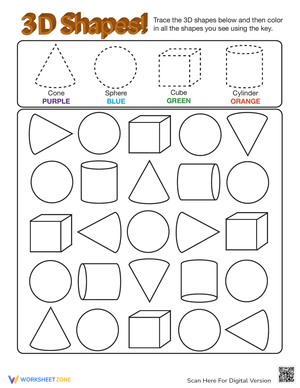
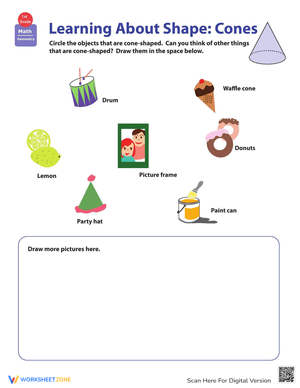
- Visual identification: Students circle or color cones hidden in a mixed array of 3D shapes. Cylinders, spheres, cubes, and rectangular prisms appear as distractors, which forces genuine discrimination rather than simple pattern-matching.
- Attribute labeling: Students mark the flat circular base, the curved surface, and the apex, then write the count next to each part. The written count mirrors the question format used on many first-grade geometry assessments, so students practice both the concept and how it's assessed.
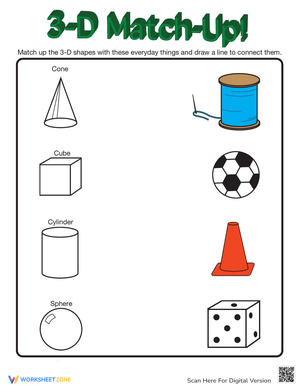
- Real-world sorting: Cut-and-paste tasks present traffic cones, party hats, ice cream cones, and paper cups alongside cylinders and spheres. Students sort by shape attribute, not by color or size — exactly the distinction CCSS geometry standards require.
- Orientation recognition: A subset of activities shows cones tipped sideways or pointing downward. Students confirm whether each shape is still a cone, which is a spatial reasoning task that trips up more students than most teachers anticipate.
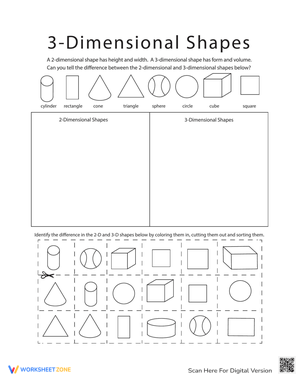
- Shape comparison: Short sentence frames ask students to write one way a cone is like a cylinder and one way it differs. Even in a single sentence, this task reveals whether a student understands that both shapes have a circular base or whether they're relying on visual impression alone.
Frequent Student Errors Worth Catching Early
The most persistent mistake we see is orientation confusion. A first grader who correctly labels an upright cone will often mark "not a cone" when shown the same shape on its side or inverted. This isn't a vocabulary problem — the student knows the word. It's a spatial reasoning gap, and the orientation worksheets expose it directly. A few minutes of whole-group discussion over those specific items resolves the confusion faster than re-explaining the definition would.
A second error cuts deeper: students conflate the 2D triangle with the 3D cone because both appear triangular in pictures. A child who draws a cone will often produce a triangle with a curved base and consider the job complete. The attribute-labeling tasks interrupt that confusion because no triangle has a curved surface to mark — the labeling step forces students to account for a dimension that their mental image of a triangle doesn't include.
A smaller but reliable error surfaces during real-world sorting: students move the sharpened tip of a pencil into the cone column because it "looks pointy." That's actually a productive mistake to surface in discussion. Explaining why a pencil tip is not a standalone cone — it's a cone-shaped feature fused to a cylinder — deepens understanding of what a face and a base actually mean, which is worth more than simply correcting the sort.
Why This Format Works for This Age and This Skill
First graders are in the middle of a developmental shift from recognizing shapes globally ("that looks like a cone") to analyzing them by their components ("it has one flat circular face and one vertex"). When students are asked to hold a definition in working memory while simultaneously processing a complex mixed-shape image, accuracy drops — a well-documented effect of cognitive load. These worksheets reduce that load by separating tasks: one worksheet labels, another identifies, another compares. Students aren't expected to do all three simultaneously until the final review, by which point the earlier steps have become automatic.
The cut-and-paste format is worth defending to colleagues or administrators who question its rigor. The act of physically moving a picture of an ice cream cone into the correct column reinforces the categorization decision in a way that a pencil checkmark doesn't. There's also a practical benefit: when a student pastes a cylinder in the cone column, that error is visible and permanent, making it easy to spot during a quick gallery walk without collecting every paper.
Recommended Ways to Build These Worksheets Into Your Lesson Plans
The cones worksheets for 1st grade works most effectively when identification and attribute tasks come before sorting or comparison work — roughly the first two days of a cone-focused sequence. On day one, have students roll a paper cone across a flat desk before they touch the worksheet. A cone rolls in a circle because its apex is a single fixed point while its base is a full circle, so the rolling arc curves back around the tip. No other 3D shape moves quite like that. The demonstration takes under a minute and gives students a physical memory that anchors the "curved surface" label they're about to write.
The sorting and comparison worksheets fit better at the end of the unit, once students have already handled cones and cylinders in separate lessons. Placing these inside dry-erase sleeves in a math center makes each worksheet reusable across three or four rotations without reprinting. For the two or three minutes before a class transition — that restless window after whole-group instruction wraps — the orientation identification tasks are a reliable low-stakes close. Students can work independently and finish without waiting, which also makes them functional as exit-ticket routines.
Standard Alignment
CCSS.MATH.CONTENT.1.G.A.1 requires first graders to distinguish shapes by their defining attributes and to build or draw shapes that possess specified attributes. The standard explicitly separates defining attributes — number of faces, whether surfaces are flat or curved, presence of a vertex — from non-defining ones like color, overall size, and orientation. The attribute-labeling and orientation worksheets target that distinction directly. The comparison tasks, cone versus cylinder and cone versus sphere, also serve 1.G.A.1 because they require students to articulate differences using attribute language rather than visual impression alone. In classroom terms, these tasks are typically introduced in the second semester, after students have established basic number fluency and reviewed 2D shapes.
Differentiating the Worksheets Across Ability Levels
For students still developing fine motor control, the cut-and-paste sorting worksheet can be modified by pre-cutting the images so the student's full attention goes toward the categorization decision. For students who move through identification tasks quickly, add a written layer: after circling cones, they write the count and then list two attributes that prove each circled shape qualifies. That second step slows impulsive responders and demands evidence, not just recognition.
The cones worksheets for 1st grade as a set is ordered to build difficulty progressively, but individual worksheets can be pulled out of sequence when a student needs more time at a specific step. Students who need a gentler entry point benefit from starting with orientation worksheets that show only upright cones before encountering tipped or inverted versions. Students working above grade level can extend the comparison sentence frames — instead of completing a provided stem, they write the comparison from scratch and then draw both shapes from two different orientations, a visual-spatial extension that reveals conceptual depth a sentence frame alone won't show.
Frequently Asked Questions
How many faces does a cone have?
A cone has one face: the flat circular base. The curved outer surface connects the base to the apex but does not count as a face because it is not flat. Some first-grade curricula use the word "surface" for the curved part and reserve "face" for flat regions, which keeps the vocabulary consistent with how the terms are used in later grades.
Can a cone roll, and does that come up on worksheets?
A cone can roll, but not in a straight line. Because the lateral surface is curved, the shape rolls freely. Because one end is a wide circle and the other is a single point, it traces a circular arc around its apex rather than rolling straight. Several worksheets in the set ask students to predict and explain this behavior, which connects the abstract attribute "curved surface" to something observable and memorable.
Are these worksheets appropriate for kindergartners working above grade level?
The cones worksheets for 1st grade is written to first-grade attribute language and standard expectations, but the identification and coloring tasks are accessible to kindergartners who have been introduced to basic 3D shapes. The labeling and comparison worksheets assume students can write short phrases, so those may need oral response adaptations for younger students who aren't yet writing independently.
What's the best way to use these worksheets for formative assessment?
The real-world sorting worksheet functions particularly well as a formative check at the end of a cone lesson. Reviewing the two sorted columns takes seconds per paper and immediately shows which students have internalized the defining attributes and which students are still sorting by visual similarity rather than by geometric property. Students who place the pencil tip or a funnel in the cone column are signaling a specific conceptual gap — they understand "pointy" but not "base and vertex" — which points directly to what the reteach needs to cover.
Clear All