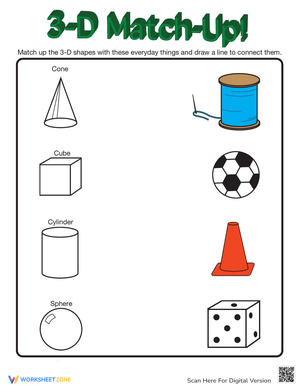
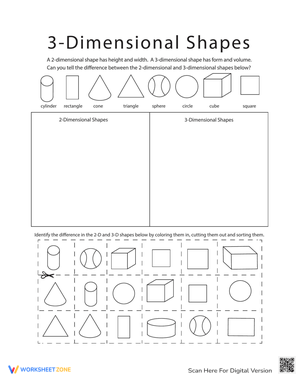
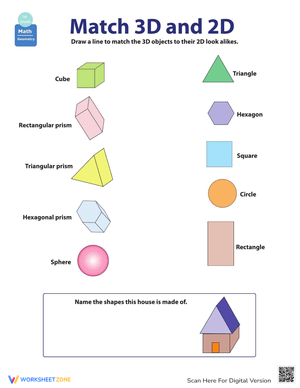
These 1st grade cubes printable worksheets give teachers a ready set of standalone resources for the geometry vocabulary jump that trips up first graders more than any other: using faces, edges, and vertices precisely enough to distinguish a cube from any other box-shaped solid. Each worksheet targets one skill within the cube unit, so teachers assign them as that skill comes up in instruction rather than running through the set in sequence.
What Each Worksheet Targets
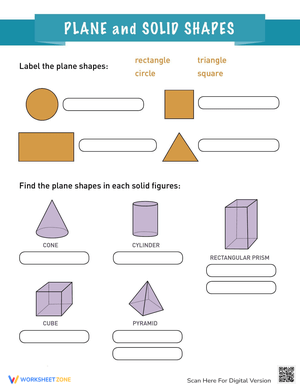
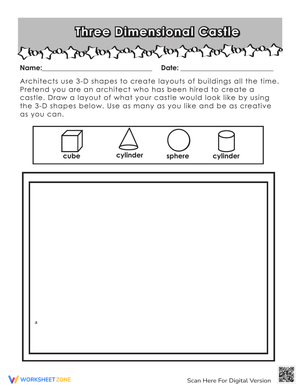
The set covers the full arc of a first-grade cube unit, from initial recognition through structured comparison with other solids. Students work with the defining attributes of a cube — 6 square faces, 12 edges, 8 vertices — across multiple activity formats. The specific skills across the worksheets include:
- Labeling faces, edges, and vertices on isometric diagrams using color-coded marks
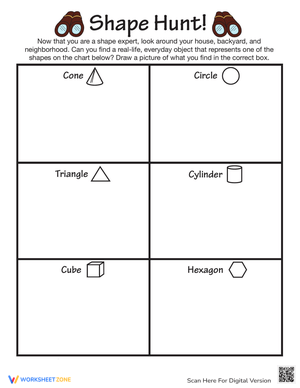
- Sorting picture cards of real-world objects into "cube" and "not a cube" categories
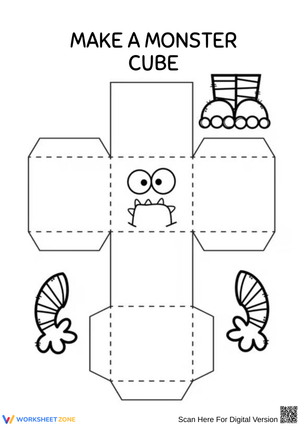
- Cutting and folding cube nets to assemble a physical three-dimensional solid
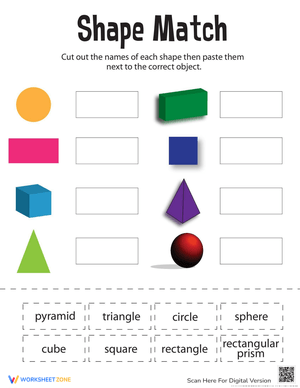
- Matching the 2D square to the face of a 3D cube as a bridge between shape families
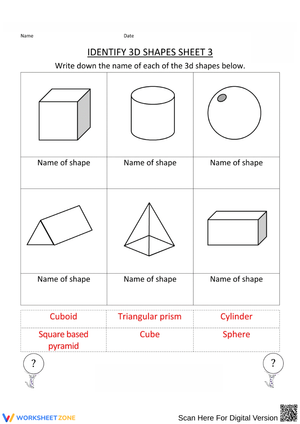
- Comparing a cube and a rectangular prism to identify which property differs between them
The sorting worksheet deserves particular attention. Asking students to exclude a rectangular prism from the cube pile requires them to apply attribute knowledge rather than retrieve a memorized answer — a meaningfully different cognitive demand than the counting tasks.
Why This Format Works at This Grade Level
There is a developmental reason this unit lands in first grade: children have been interacting with cube-shaped objects — blocks, dice, ice cubes — since before they could talk. The formal instruction doesn't introduce a foreign object; it gives children the geometric language to describe something they already handle. That prior familiarity is a real asset, but it also creates a specific challenge. Students who "know" what a cube looks like from experience sometimes resist counting its properties systematically, treating the counting as unnecessary. Worksheets that require students to mark each face with a tally, trace each edge with a colored pencil, and circle each vertex build the habit of checking attributes rather than trusting intuition — a habit that carries forward when less familiar solids appear in later units.
The jump from a flat square to a solid cube is also genuinely hard for six-year-olds. A square on paper and a cube in the hand feel like completely different things. Cube net activities close that gap because students physically experience how six separate squares — flat, two-dimensional squares — close up to form one solid. Teachers who run that folding activity before assigning the labeling worksheets see faster mastery of the attribute counts, consistently.
Frequent Student Errors Worth Watching For
The most common error in this unit is writing 3 for the number of faces. When a cube appears in standard isometric view, only three faces are visible. First graders trust what they see, so they count three faces and move on; the answer feels complete. Drawing their attention to the hidden back, bottom, and far-side faces — and asking them to rotate a physical block to verify — resolves this quickly, but the error reappears on any worksheet that presents the cube only in isometric view without a rotation prompt.
A second consistent error is swapping edges and vertices. Students learn both words in close succession, and the labels don't attach reliably after one exposure. Watch for students who circle corners when asked to mark edges, or who draw arrows to flat surfaces when the task asks for vertices. Worksheets that use color-coding — "trace all edges in blue, circle all vertices in red" — reduce this confusion more reliably than repeated verbal definitions do. The kinesthetic act of choosing a color and applying it to the correct feature seems to do what rereading a definition does not.
How to Build These Worksheets Into Your Lesson Plans
Because the 1st grade cubes printable worksheets are standalone resources, teachers can drop individual worksheets into different moments of the unit without restructuring their existing lesson plans. The labeling and counting worksheets work best as follow-ups to manipulative time, not as introductions to it. Hand students a wooden or foam cube before any worksheet that asks them to count faces, edges, or vertices. Let them place a sticky dot on each face as they count to six. Once they have verified the count physically, the two-dimensional diagram on the worksheet stops being a puzzle about perspective and starts being a record of something they already know.
The real-world sorting worksheets are strong morning work the day after you introduce the unit. They ask students to retrieve just-learned attributes and apply them — a low-stakes retrieval exercise that sets up the rest of the morning block without requiring teacher direction. The net worksheet, by contrast, works best as a small-group or partner activity rather than independent work. Cutting and folding require fine motor coordination that slows some first graders significantly; pairing students for that task keeps the geometric thinking front and center instead of the mechanics of using scissors.
For formative assessment, the sorting worksheet is more diagnostic than it appears. Students who correctly exclude a rectangular prism from the cube pile have internalized the attribute definition. Students who include it are working from a visual gestalt — "it looks like a cube to me" — rather than checking properties. That distinction tells you exactly where to focus reteaching before the end of the unit.
Standard Alignment
These worksheets address CCSS.MATH.CONTENT.1.G.A.1, which requires first graders to distinguish between defining attributes — the number of faces a solid has, the shape of those faces — and non-defining attributes such as size, color, or orientation. The standard also calls on students to build and draw shapes that match their defining attributes, which is precisely what cube net assembly accomplishes. In classroom terms, 1.G.A.1 is where teachers formalize the vocabulary so that attribute-based sorting becomes transferable across all shape units, not just the cube. Students who can articulate why a rectangular prism is not a cube — because its faces are rectangles, not squares — are applying the standard at its full depth.
Adjusting These Worksheets for Different Learners
Students who are still consolidating number recognition benefit from attribute-counting worksheets that include a labeled reference diagram alongside the task — a cube with its 6 faces, 12 edges, and 8 vertices already identified. That reference removes one layer of demand without removing the geometric content, so students practice the vocabulary without the additional pressure of counting from a cold start.
Students who move through the counting tasks quickly are ready for the comparison work: identifying how a cube and a rectangular prism are alike and how they differ. These 1st grade cubes printable worksheets can serve that extension group without requiring a separate resource, since the sorting and comparison activities are already included in the set. For the highest-performing students, asking them to draw their own cube net without a template — starting from scratch — turns a structured exercise into a genuine spatial reasoning challenge. The instructional cost of that extension is zero; it requires only a blank sheet of paper and the expectation that they try.
Frequently Asked Questions
How many faces, edges, and vertices does a cube have?
A cube has exactly 6 faces, all of which are congruent squares. It has 12 edges — the line segments where two faces meet — and 8 vertices, where three edges intersect at a corner. Fluency with those three numbers is the primary vocabulary target of the attribute-counting worksheets in this set. Students who can state the counts and explain what is being counted have reached the depth the standard requires.
What is the difference between a cube and a rectangular prism?
Both solids have 6 faces, 12 edges, and 8 vertices, so the count alone won't distinguish them. The difference is in the faces: every face of a cube is a square, meaning all 12 edges are equal in length. A rectangular prism has rectangular faces; opposite edges are equal, but not all edges share the same length. First graders who sort a shoe box into the cube pile are making exactly this error — they recognize a box-shaped solid without checking whether its faces are squares. That's the misconception the comparison worksheet is built to catch.
When in a geometry unit should I use these worksheets?
Run the manipulative introduction first — students who handle physical cubes before any paper task show faster attribute recall on the worksheets. Use the labeling and counting worksheets as guided practice on day two or three of the unit, after students have had hands-on time. Save the net worksheet for later in the unit once students are confident with the vocabulary; folding and assembling a net is more meaningful when students already know what the finished shape is supposed to have. The sorting worksheets are flexible and work well as a warm-up review the week after the formal unit ends.
Can these worksheets be used in kindergarten or second grade?
The attribute-counting and real-world sorting worksheets are accessible to strong kindergartners who have had prior solid shape exposure. Second graders who missed cube vocabulary in first grade can use the same 1st grade cubes printable worksheets for targeted catch-up practice, though the net activity suits second graders particularly well because their fine motor skills and spatial reasoning are more developed. Students above second grade working on solid geometry are better served by resources that address surface area or volume.













 Interactive Worksheet Maker
 Quiz Maker
 Word Search Maker
 Crossword Puzzle Maker
 Word Scramble Generator
 Sentence Scramble Generator
 Handwriting Worksheet Generator
 Name Tracing Generator
 Fill In The Blank Generator