


























0
Views
0
Downloads

Save
0 Likes
Share
3D Shapes Identification Worksheet for Kids
0 Views
0 Downloads
Paste this activity's link or code into your existing LMS (Google Classroom, Canvas, Teams, Schoology, Moodle, etc.).
Students can open and work on the activity right away, with no student login required.
You'll still be able to track student progress and results from your teacher account.
Information
Description
What It Is:
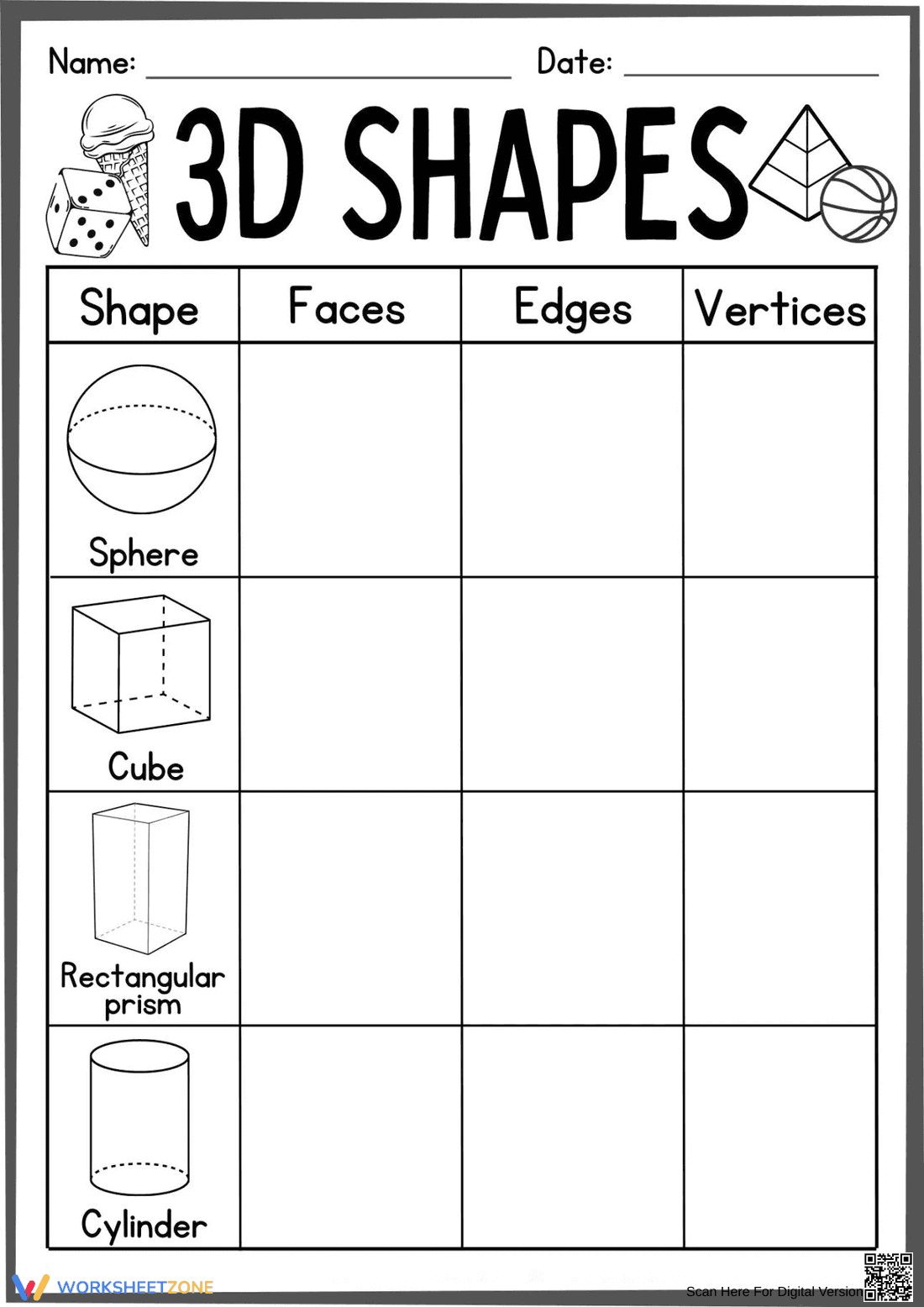
This worksheet helps students identify and analyze different 3D shapes by focusing on their faces, edges, and vertices. The worksheet features a variety of 3D shapes, including spheres, cubes, rectangular prisms, and cylinders.
Why Use It:
This activity helps students understand geometric properties such as faces, edges, and vertices, foundational concepts in geometry. It is a great hands-on learning tool for students to visually explore and classify 3D shapes.
How to Use It:
• Students will examine each shape and record the number of faces, edges, and vertices in the provided spaces.
• Teachers can guide the class by reviewing each shape together and discussing their geometric properties.
• This worksheet can be used individually or as a group activity to promote geometric understanding.
Grade Suitability:
Best suited for students in Grade 1.
• Helps early learners grasp basic 3D shape properties.
• Encourages students to connect visual representations with geometric terms.
Target Users:
• Early elementary school students.
• Teachers focusing on basic geometry concepts in math.
This worksheet helps students identify and analyze different 3D shapes by focusing on their faces, edges, and vertices. The worksheet features a variety of 3D shapes, including spheres, cubes, rectangular prisms, and cylinders.
Why Use It:
This activity helps students understand geometric properties such as faces, edges, and vertices, foundational concepts in geometry. It is a great hands-on learning tool for students to visually explore and classify 3D shapes.
How to Use It:
• Students will examine each shape and record the number of faces, edges, and vertices in the provided spaces.
• Teachers can guide the class by reviewing each shape together and discussing their geometric properties.
• This worksheet can be used individually or as a group activity to promote geometric understanding.
Grade Suitability:
Best suited for students in Grade 1.
• Helps early learners grasp basic 3D shape properties.
• Encourages students to connect visual representations with geometric terms.
Target Users:
• Early elementary school students.
• Teachers focusing on basic geometry concepts in math.


