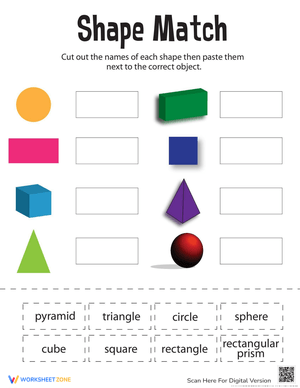
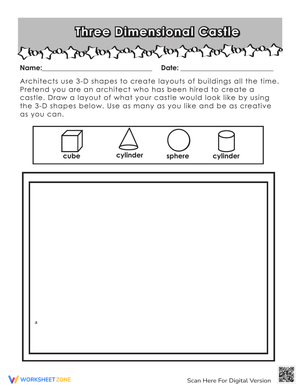
1st Grade Spheres worksheets
These 1st grade spheres worksheets resources focus on a single, decisive distinction — sphere versus circle — because that comparison is exactly where early geometry instruction either sticks or slips. The set gives teachers print-ready tasks built around identifying, sorting, and naming spheres using objects students already know: balls, globes, oranges. No digital setup, no extra materials — just clear pictures, clean directions, and a focused skill.
The Specific Skills Targeted in Each Worksheet
Each worksheet addresses one or two tightly defined tasks rather than surveying all 3D shapes at once. That narrow scope is intentional — Grade 1 students build geometric understanding through repeated contact with one concept, not through a survey of several solid figures compressed into a single session.
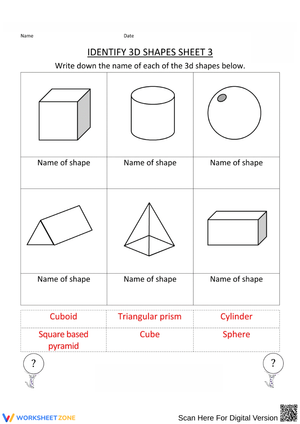
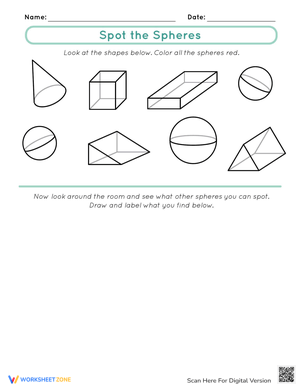
- Identify spheres within a mixed group of 2D shapes and 3D solids
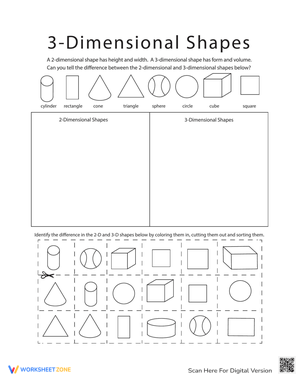
- Sort objects into two columns: spheres and non-spheres
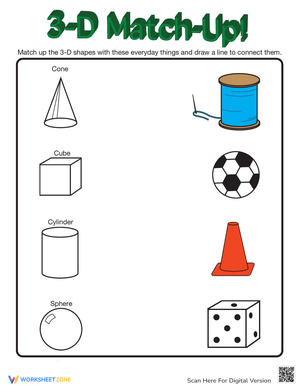
- Match real-world images — a tennis ball, a globe, an orange — to the word sphere
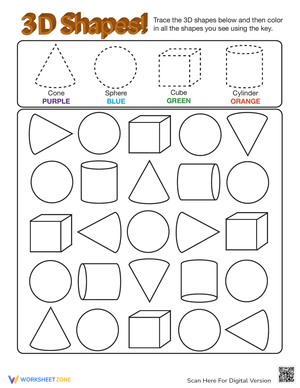
- Color only the spherical objects on a page that includes cubes and cylinders as distractors
- Compare a flat circle to a solid sphere and mark which one rolls in every direction
- Trace and write the word sphere alongside a labeled illustration
The vocabulary work matters as much as the identification tasks. A well-built 1st grade spheres worksheets set addresses both in the same session — students who can point to a sphere but cannot write or say the word are not yet meeting the language demands of Grade 1 geometry standards, and these worksheets target that gap directly.
Why One Shape at a Time Produces Stronger Geometry Thinking
First graders are still developing the ability to hold multiple categories in working memory simultaneously. When a worksheet presents spheres, cylinders, cones, and rectangular prisms all at once, students often default to color, size, or position cues rather than the defining attribute: round all the way around, solid, no flat faces. Keeping the focus on spheres alone reduces that cognitive overload and pushes students to attend to what actually makes one shape different from another.
The circle-sphere confusion is especially persistent because both shapes appear round in a drawing. A photograph of a basketball and a drawing of a circle can look nearly identical to a six-year-old who has not yet internalized the 2D-versus-3D distinction. Worksheets that consistently pair a circle and a sphere side by side — not just once as an introduction but across multiple tasks — train students to check the defining attribute rather than pattern-match from a previous answer.
Student Errors Worth Anticipating Before You Distribute These Pages
The most common error is calling every round image a circle, regardless of whether it depicts a flat shape or a solid object. A student who correctly labels a circle on a 2D shapes page will often write circle again when shown a photograph of a basketball — not because the student misunderstands the word, but because the visual cue of roundness overrides the 2D-versus-3D distinction they have not yet fully internalized. The fix is fast: during the whole-group intro, hold a real ball in one hand and a paper circle in the other and have students say aloud, "One is flat. One is solid." That thirty-second move cuts this specific error noticeably on the printed page.
A second pattern appears on sorting tasks: students sometimes place a coin or a flat button in the sphere column because those objects are round and small. They are responding to roundness in a general sense rather than to solidity. When that happens, asking "Can you roll it in any direction? Does it look the same from every angle?" redirects attention to the actual defining attribute without turning the correction into a drawn-out explanation.
How to Work These Worksheets Into a Short Geometry Block
The most effective lesson sequence runs concrete-to-pictorial: place two or three real objects on the table — a tennis ball, a cube block, and an orange work well — before any worksheet appears. Students handle the objects, then respond to a few quick teacher questions using math vocabulary. Only after that whole-group anchor does a worksheet come out. This order means students bring a clear mental model to the printed page rather than building understanding from pictures alone.
Most of these worksheets fit a 10-minute small-group block or a 15-minute center rotation. The Friday geometry warm-up, the last 8 minutes of a math block, and the Monday review after morning meeting are all natural slots. One practical move worth noting: leave a real ball on the table while students work independently. When a child hesitates between a circle and a sphere, that object provides an immediate reference point without stopping the class — a small adjustment that consistently improves accuracy. The 1st grade spheres worksheets format also makes it easy to return the same worksheet as spiral review weeks later, keeping geometry vocabulary active without building a new lesson around it.
Adjusting the Set for Different Levels in the Same Classroom
For students still building print awareness or working on English language skills, read each direction aloud before the task begins and point to a completed sample item. Coloring and cut-and-sort pages reduce writing demands while preserving the conceptual work. Covering half the images on a page with a blank sheet narrows the visual field for students who freeze when too many choices appear at once — a simple structural move that avoids the need for a separate, simplified version.
Students who are ready to go deeper benefit from a different push: ask them to explain in one sentence why a specific object is or is not a sphere. That oral or written justification moves them from identification to attribute reasoning, which is the geometric thinking these standards are building toward. A partner structure — one student names an object, the other decides the shape and states a reason — turns one worksheet into a two-way language task with no additional materials required.
Standard Alignment
These worksheets align to CCSS.MATH.CONTENT.1.G.A.1, which directs students to distinguish between defining attributes and non-defining attributes of shapes and to build and draw shapes that possess defining attributes. In classroom terms, this means Grade 1 students are not just naming shapes — they are identifying what makes a sphere a sphere (round all over, solid, no flat faces) as distinct from non-defining properties like color or size. The sphere-versus-circle sorting and identification tasks directly address the 2D-versus-3D reasoning embedded in this standard, placing these worksheets inside the geometry unit rather than in a supplemental enrichment slot.
Frequently Asked Questions
What grade level do these worksheets target?
These worksheets are written for Grade 1, though they serve as a reteach or review tool in early Grade 2 and as an extension option for kindergarteners who are ready to move beyond flat shapes. The tasks assume students can identify basic 2D shapes and are beginning to compare them to 3D solids.
Do I need manipulatives to use these worksheets?
Not required, but pairing a real object with the worksheet — a ball placed on the table while students work — improves accuracy in a noticeable way. When a student hesitates between a circle and a sphere, the object provides an immediate reference point without stopping the lesson for the whole class.
How do I explain the difference between a circle and a sphere to a first grader?
Hold both at the same time: a paper circle in one hand and a ball in the other. Say, "A circle is flat — it lives on paper. A sphere is solid — it takes up space, and it rolls." Students who can repeat that distinction aloud before a sorting task answer the 1st grade spheres worksheets sorting questions with far greater accuracy than students who only encounter a written definition on the page.
Can these worksheets function as formative assessment?
Yes. A quick scan of completed sorting pages tells you whether students are using shape attributes or falling back on size and color cues. The student who places a coin in the sphere column and a square block in the non-sphere column has not yet internalized solidity as a defining criterion — that is actionable information before the geometry unit moves forward.
Clear All