


























Views
Downloads


Printable Sorting & Counting Shapes Assessment | Grade K
Paste this activity's link or code into your existing LMS (Google Classroom, Canvas, Teams, Schoology, Moodle, etc.).
Students can open and work on the activity right away, with no student login required.
You'll still be able to track student progress and results from your teacher account.
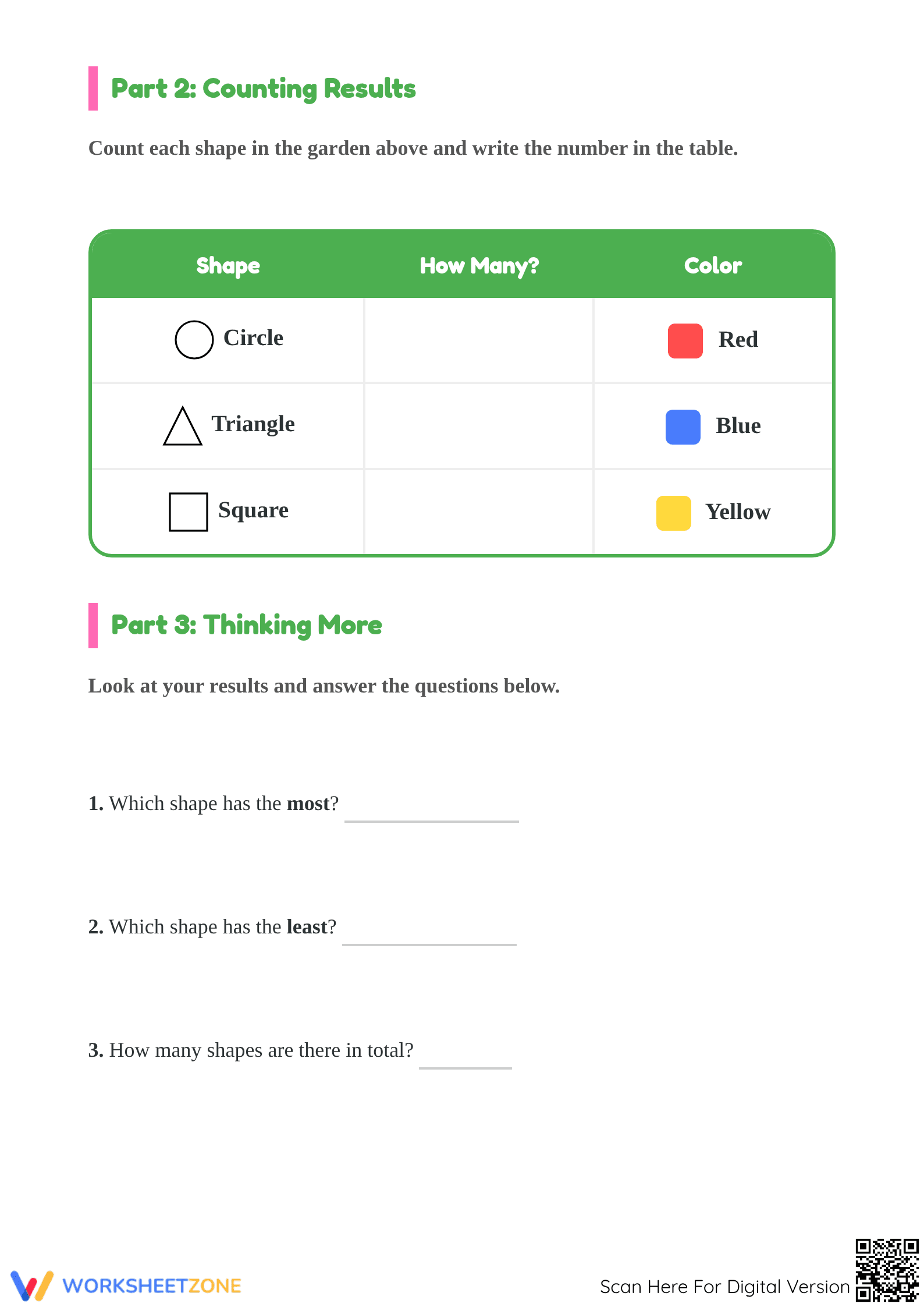
Identify, color, and classify flat shapes with this comprehensive 2-page math assessment. Students first navigate a "Shape Garden" to locate and color specific 2D objects, then transition to data collection by counting their results in a structured table. This process ensures early learners bridge the gap between visual identification and numerical representation.
At a Glance
- Grade: Kindergarten · Subject: Math
- Standard:
K.G.A.3— Identify shapes as flat two-dimensional or solid three-dimensional objects- Skill Focus: Identifying, sorting, counting, and comparing basic flat 2D shapes
- Format: 2 pages · 7 tasks · Answer key included · PDF
- Best For: Comprehensive end-of-unit geometry assessment or as a mid-week formative check
- Time: 15–20 minutes
What's Inside
This assessment consists of two clear pages designed for young learners. Page one features a visual "Shape Garden" filled with circles, triangles, and squares for coloring. Page two provides a data table for recording counts and three critical thinking questions that ask students to compare quantities (most/least) and calculate a total sum. A full answer key is included for rapid grading.
Skill Progression
- Guided Practice: Students begin with visual discrimination, using a specific color key to identify and color circles, triangles, and squares within the Shape Garden (1 task).
- Supported Practice: Learners then move to data organization, counting the colored shapes and recording their findings in a structured "How Many?" table (3 categories).
- Independent Practice: The final stage requires high-order thinking as students analyze their recorded data to determine maximums, minimums, and total sums (3 questions).
This progression ensures a smooth gradual-release transition from simple identification to independent data analysis.
Standards Alignment
The primary focus is `K.G.A.3`, requiring students to identify shapes as two-dimensional. By isolating flat circles, squares, and triangles, students demonstrate mastery of 2D geometry while supporting `K.MD.B.3` through classification and counting. Both standard codes can be copied directly into lesson plans, IEP goals, or district curriculum mapping tools.
How to Use It
Deploy this as a summative assessment after a unit on geometry or as a mid-week formative check. During the coloring phase, observe whether students can distinguish between vertices and curves to identify triangles versus circles. Expect students to complete both pages within 15 to 20 minutes depending on their fine motor coloring speed.
Who It's For
This resource is tailored for Kindergarten students and Grade 1 learners requiring a geometry refresh. The large shapes and clear fonts support students with visual processing needs, while the open-ended "Thinking More" section allows for extension. It pairs naturally with a hands-on shape sorting bin or an anchor chart featuring basic 2D attributes.
According to the RAND AIRS 2024 report on early childhood numeracy, the integration of visual identification with data recording significantly improves long-term retention of geometric concepts. This worksheet leverages that research by moving students through the Bloom's Taxonomy levels of identifying and analyzing. By first coloring (identifying) and then counting and comparing (analyzing), students build a robust mental model of 2D geometry. The `K.G.A.3` standard emphasizes the distinction between flat and solid shapes, and this activity provides the essential "flat" foundation required before introducing 3D solids. Teachers using this resource can confidently track student progress in sorting and counting, ensuring that every learner meets foundational math benchmarks. The inclusion of comparative questions like "most" and "least" prepares students for higher-order data analysis in later primary grades, making this an essential tool for any Kindergarten math curriculum looking for proven instructional materials.


