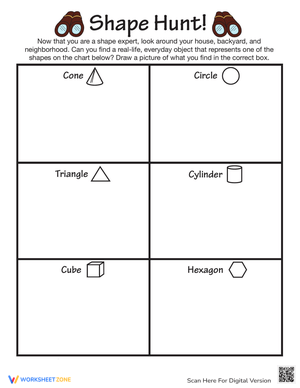
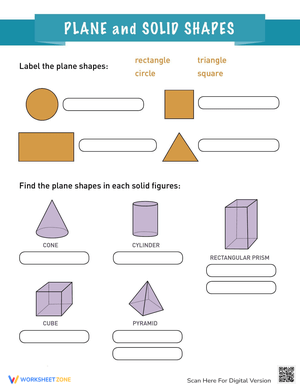
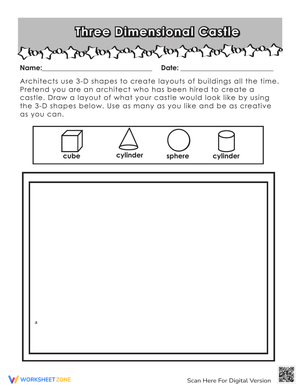
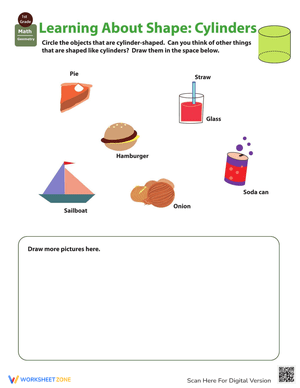
These 1st grade cylinders printable worksheets give first graders focused, repeated practice with one of the most recognizable 3D solids — a shape they encounter daily in soup cans, glue sticks, and paper towel rolls long before they ever open a math textbook. Each worksheet targets a distinct skill within the geometry unit, from basic visual identification to attribute-based reasoning, so the set works as a complete instructional resource or as individual pieces pulled for a specific lesson need.
The Specific Skills Targeted in Each Worksheet
The worksheets address cylinder recognition across several formats so students build the concept from multiple angles. Across the set, students will:
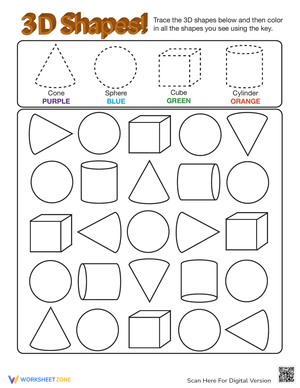
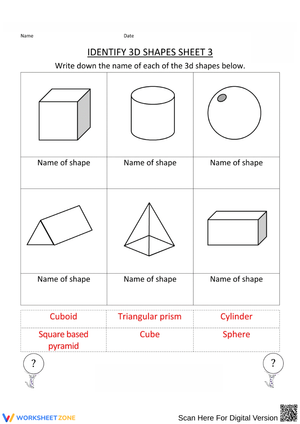
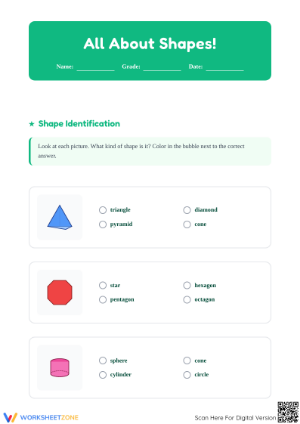
- Pick a cylinder out of a mixed group of 3D shapes — cube, sphere, cone, rectangular prism — and color it to confirm identification
- Count and label each surface as flat or curved, recording two flat circular faces and one curved surface
- Mark whether a cylinder rolls, slides, or stacks, and explain which surface makes each motion possible
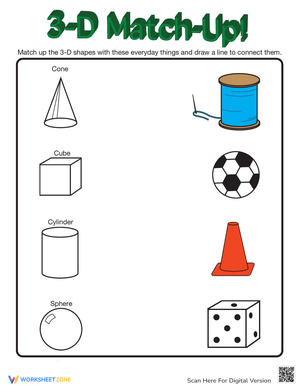
- Match real-world photographs — soup can, battery, drum, candle, rolling pin — to a geometric cylinder diagram
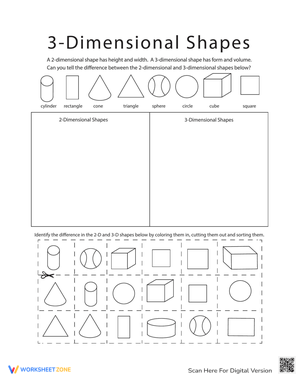
- Sort cut-and-paste image cards into "cylinder" and "not a cylinder" columns
- Trace the outline of a cylinder and practice drawing the elliptical tops that represent circular faces on a flat page
The drawing and tracing work matters more than it looks. Representing a 3D object on paper requires students to hold the actual shape's structure in mind — they can't just memorize a silhouette. When a student draws the ellipse to show a circle seen at an angle, that is spatial understanding, not just motor skill.
Mistakes Students Make That These Worksheets Help You Catch
The most consistent confusion in first grade 3D geometry is the cylinder-cone mix-up. Students who correctly label a soup can as a cylinder will often call an ice cream cone a cylinder too, because both have a circular face at the base. They stop analyzing after they find the circle. The cone's pointed top doesn't trigger a correction — they remember "round at the bottom" as the rule, not "two parallel circular faces connected by a curved surface." Sorting worksheets that place cones and cylinders in the same image set surface this error immediately, which is exactly when it needs to be addressed.
A second pattern worth watching: students try to count cylinder edges the way they count cube edges. A cube has 12 clearly visible edges, and first graders learn to trace them finger by finger. When they meet a cylinder, they find the circular rim where each flat face meets the curved surface and call it an edge — landing on "2 edges." In formal geometry, a cylinder carries zero edges, and the gap between what students observe and what the definition actually allows needs direct instruction, not just a worksheet prompt.
Orientation errors show up reliably in identification tasks. A student who correctly marks a standing cylinder — label facing out, like a can on a shelf — will sometimes mark the same shape lying on its side as something different entirely. Including cylinders in multiple orientations on every worksheet prevents that from hardening into a fixed misconception.
Lesson-Planning Ideas to Get the Most From These Worksheets
The most effective sequence pairs physical handling with paper practice, separated by at least one teaching period. On day one, set out a collection of real cylinders — a soup can, a C battery, a glue stick, a paper towel roll — and run a "Roll, Slide, or Stack" exploration before any worksheet touches a student's desk. Students test each object on a smooth surface: flat face down, the can slides and stacks; curved surface down, it rolls. That physical memory becomes the anchor when students encounter the same question in print. 1st grade cylinders printable worksheets used after that hands-on experience consistently produce more considered, attribute-based answers than worksheets used cold as the introduction to the shape.
For math centers, the sorting worksheet works well as a self-checking station when the answer key sits face-down and students flip it after completing the cut-and-paste. The matching worksheet pairs naturally with a "Shape Museum" — a classroom shelf where students have contributed real-world cylinders brought from home — so a student who second-guesses an answer can pick up a reference object. The attribute-counting worksheet fits a whole-group warm-up: project it, complete one section together, then release students to finish independently during the last ten minutes of the math block.
Standard Alignment
These worksheets target CCSS.MATH.CONTENT.1.G.A.1, which asks first graders to distinguish defining attributes — the characteristics that make a shape what it is — from non-defining attributes like size, color, or orientation. A cylinder is a cylinder whether it's a tall drinking glass or a squat tuna can, standing upright or rolling across a table. The attribute-counting and sorting tasks in this set hold students directly accountable to that distinction, since success requires evaluating structural properties rather than recognizing a familiar image. This standard also lays the conceptual groundwork that geometry continues to build through fifth grade and beyond, when students calculate the surface area and volume of the same solid forms they learned to name and describe in first grade.
Adjusting the Worksheets for a Range of Learners
For students still building confidence with shape vocabulary, pair the identification worksheet with a labeled anchor chart showing a cylinder's two flat circular faces and curved surface. Rather than asking them to recall attribute names from memory, the chart keeps cognitive load on the geometric reasoning — not on vocabulary retrieval. Students who are ready for more challenge can move beyond marking "yes" or "no" on a sorting task and write or dictate a full attribute-based justification: "This is not a cylinder because it has one pointed end instead of a second flat circle."
The real-world matching worksheet adapts well for students who struggle to connect drawn representations to physical objects. Swap the geometric line-drawing for a photograph of a real cylinder, and the task becomes a concrete-to-concrete match rather than a concrete-to-abstract translation — same geometric thinking, lower representational demand. 1st grade cylinders printable worksheets in this set can also run simultaneously across a tiered small-group rotation, with different students working on different formats based on where they are in the progression from recognition to attribute analysis.
Frequently Asked Questions
Do these worksheets cover only cylinders, or do other 3D shapes appear?
Each worksheet focuses on the cylinder as the target shape, but most identification and sorting tasks include cones, spheres, cubes, and rectangular prisms as distractors. That contrast is intentional — students need to evaluate a cylinder's attributes against those of other 3D shapes, not simply recognize a familiar image with no competing options nearby.
What grade level do these worksheets fit?
These worksheets are written for first grade, where 3D shape identification and attribute analysis appear in the geometry domain under the Common Core framework. The tasks are also appropriate for kindergarteners ready for attribute work beyond basic naming, and for second graders who need a structured geometry review before moving into more complex shape composition work.
How do these worksheets support formative assessment?
Reviewing 1st grade cylinders printable worksheets completed independently — without an anchor chart available — gives a clear picture of what a student actually knows versus what they've been prompted to recall. That review lets a teacher identify three distinct gaps at once: students who still confuse cylinders with cones, students who miscounted flat faces, and students who recognize the shape in only one orientation. Each gap points to a different instructional next step, which makes this format more diagnostically useful than a single yes/no observation during a whole-group lesson.













 Interactive Worksheet Maker
 Quiz Maker
 Word Search Maker
 Crossword Puzzle Maker
 Word Scramble Generator
 Sentence Scramble Generator
 Handwriting Worksheet Generator
 Name Tracing Generator
 Fill In The Blank Generator