




























Views
Downloads
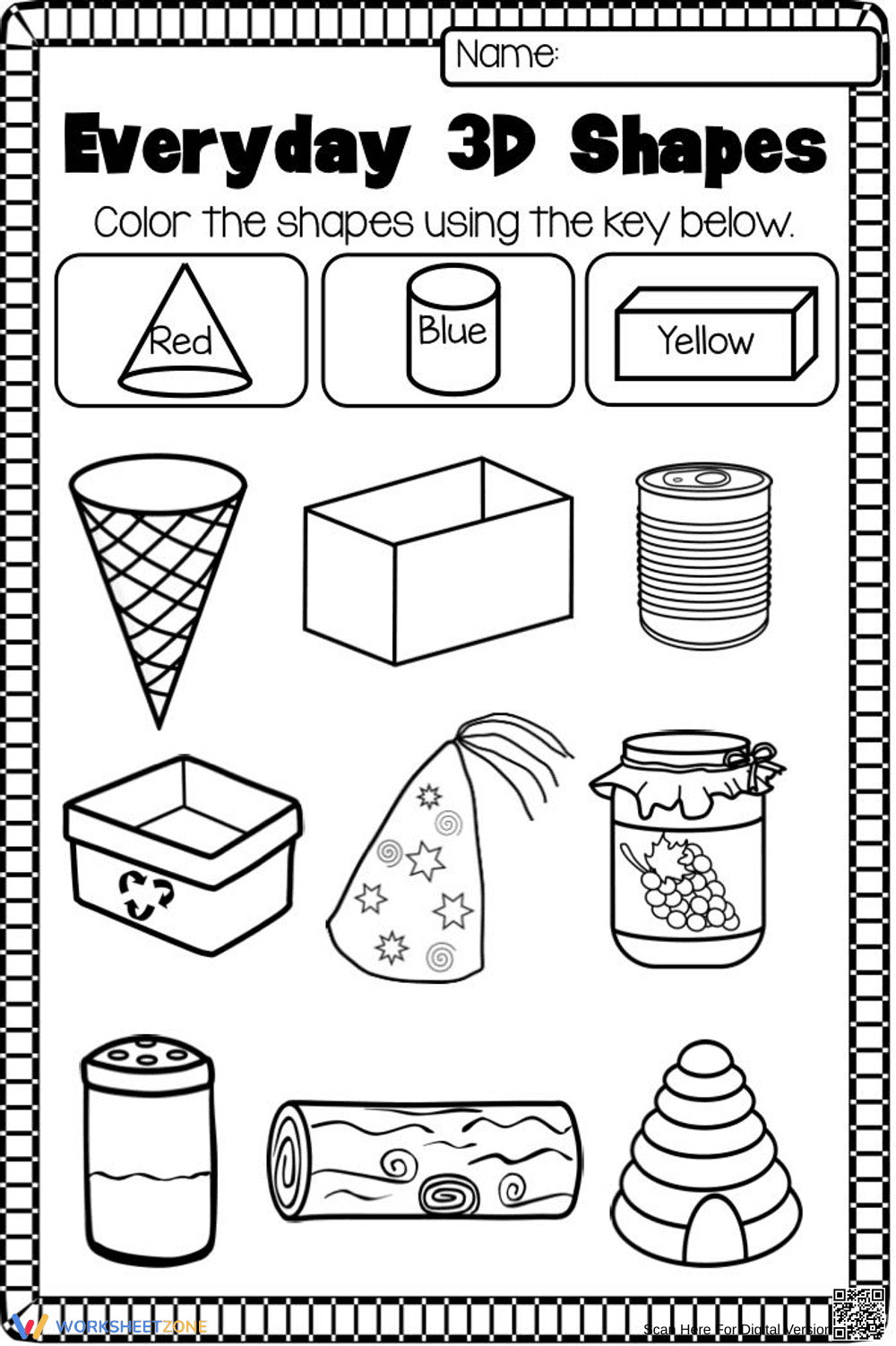

Kindergarten 3D Shapes — Printable No-Prep Worksheet

Paste this activity's link or code into your existing LMS (Google Classroom, Canvas, Teams, Schoology, Moodle, etc.).
Students can open and work on the activity right away, with no student login required.
You'll still be able to track student progress and results from your teacher account.
This printable geometry worksheet helps kindergarten and first-grade students identify three-dimensional shapes in real-world objects. By coloring everyday items like cones, cylinders, and rectangular prisms according to a color key, young learners build essential spatial reasoning skills and connect abstract math concepts to their daily environment.
At a Glance
- Grade: Kindergarten · Subject: Math
- Standard:
CCSS.MATH.CONTENT.K.G.A.2— Correctly name three-dimensional shapes regardless of their orientations or overall size- Skill Focus: Identifying 3D shapes in everyday objects
- Format: 1 printable page · 9 unique problems · Answer key included · PDF format
- Best For: Independent geometry practice, homework, or morning work
- Time: 15–20 minutes
This single-page PDF features nine illustrations of common items like an ice cream cone, a tin can, and a log. A visual key associates three 3D shapes—cones, cylinders, and rectangular prisms—with specific colors. Students analyze each object, determine its shape, and color it accordingly. A teacher answer key is included.
Zero-Prep Classroom Workflow
This activity requires under 2 minutes of teacher preparation. First, print the single-page PDF (1 minute). Second, distribute the sheets with red, blue, and yellow crayons (1 minute). Third, review completed worksheets using the included answer key. This simple structure makes the page excellent for sub plans, morning work, or early finishers.
Standards Alignment
This activity aligns with `CCSS.MATH.CONTENT.K.G.A.2` to help students name shapes regardless of orientation. It also supports `CCSS.MATH.CONTENT.K.G.B.4` by prompting students to analyze and compare three-dimensional shapes. Both standard codes can be copied directly into lesson plans, IEP goals, or district curriculum mapping tools.
How to Use It
Use this worksheet as a formative assessment after direct instruction on 3D shapes. Walk around to observe if students confuse cylinders with cones, noting who needs targeted intervention. Alternatively, assign this as a warm-up to activate prior knowledge. Students typically complete the coloring tasks within 15 to 20 minutes.
Who It's For
This resource is tailored for kindergarten and first-grade students learning to distinguish solid shapes. It benefits English language learners who profit from pairing visual shapes with real-world objects. Pair this worksheet with a classroom shape hunt or a 3D shape anchor chart to reinforce geometric vocabulary before students begin coloring.
According to research on visual learning paradigms by Fisher & Frey (2014), scaffolding abstract geometric concepts with familiar, real-world objects significantly improves retention and conceptual transfer in early childhood education. This worksheet targets standard `CCSS.MATH.CONTENT.K.G.A.2` by requiring students to identify and categorize 3D shapes—specifically cones, cylinders, and rectangular prisms—using everyday items. By translating physical attributes into geometric classifications through a structured coloring task, learners build the spatial visualization skills necessary for later multi-dimensional math. The single-page layout provides a focused, low-cognitive-load environment that allows teachers to quickly assess student understanding. This resource serves as a practical tool for establishing foundational geometry skills, ensuring that young students can confidently bridge the gap between concrete physical objects and abstract mathematical models in alignment with early childhood standards.


