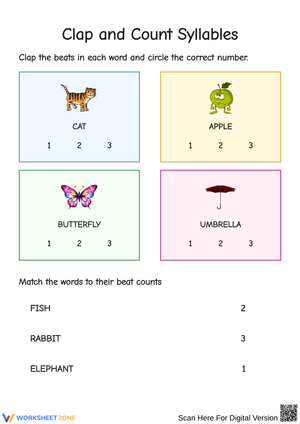
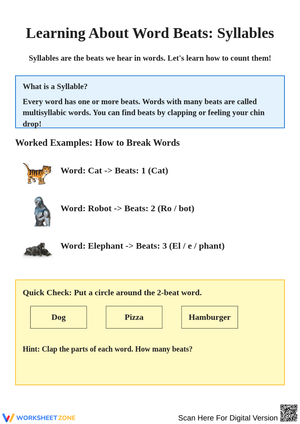
These 1st grade syllables worksheets address the moment in early phonics when clapping out beats has to become dividing written words — and that transition is genuinely harder to teach than pacing guides suggest. Students who clap "sun-flow-er" during circle time without hesitation will still draw the syllable line in the wrong place when they sit down with a pencil, because hearing structure and seeing it on paper are different cognitive tasks. Each worksheet in this set isolates a discrete skill, moving from auditory beat-counting through visual word-splitting so that work on one worksheet directly prepares students for the next.
The Specific Skills Each Worksheet Builds
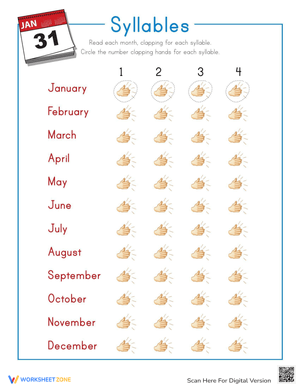
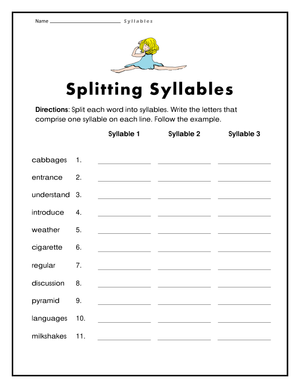
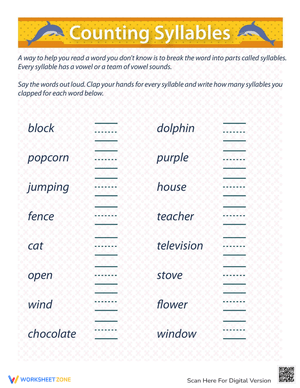
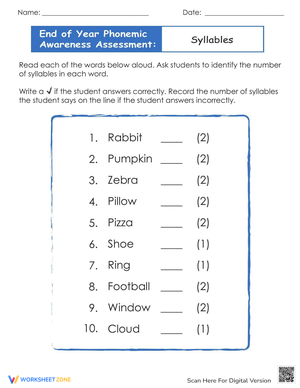
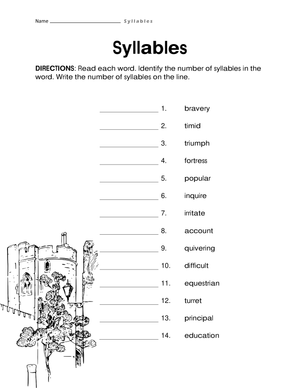
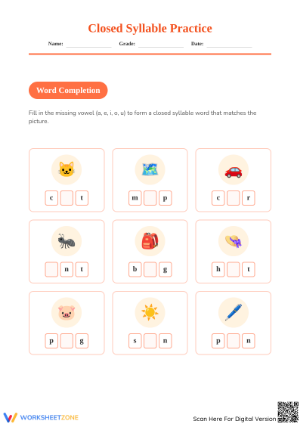
The set covers four skill areas, each on its own worksheet, so teachers can assign them in sequence or pull individual sheets for targeted intervention.
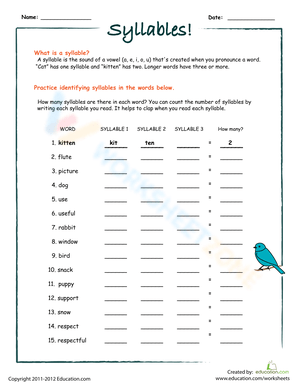
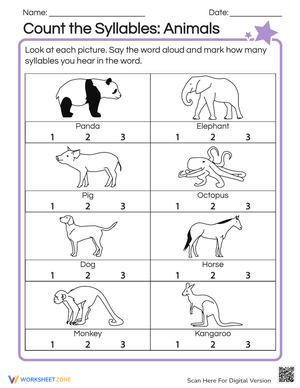
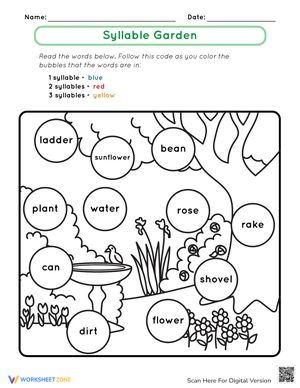
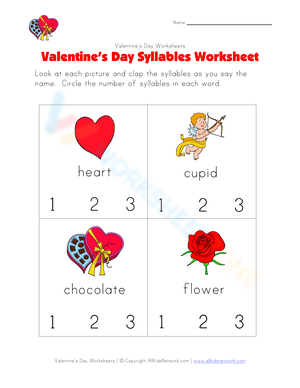
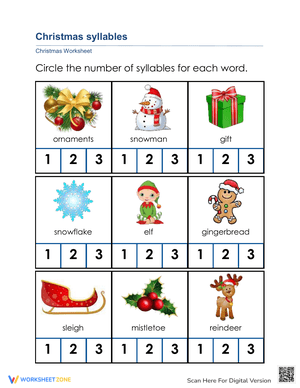
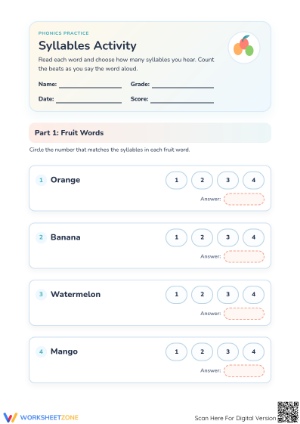
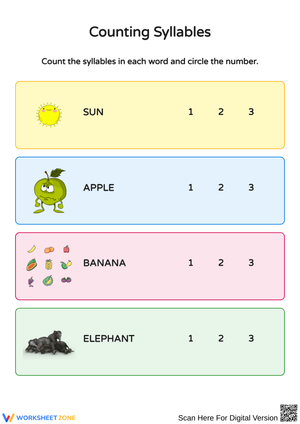
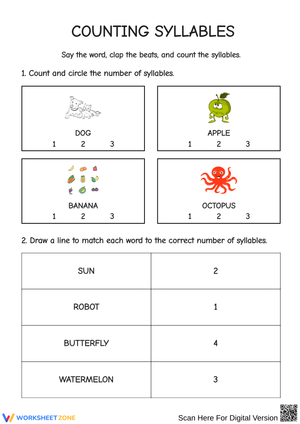
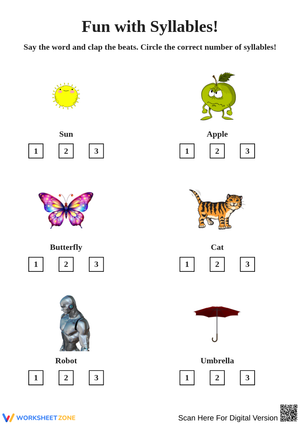
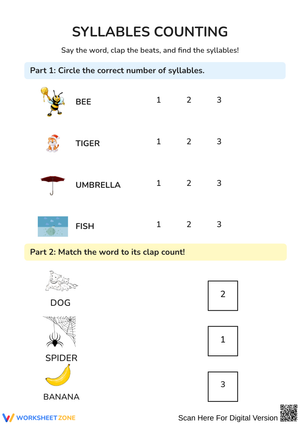
- Beat counting with pictures: Students say a pictured word aloud, use the chin-drop method — placing a hand under the chin and counting the natural jaw drops while speaking — and then mark a matching number of boxes. The chin-drop approach is notably more reliable than clapping for students who tend to clap rhythmically rather than responding to syllable boundaries specifically. Words are drawn from high-frequency noun vocabulary so students aren't spending cognitive effort on word meaning while working on word structure.
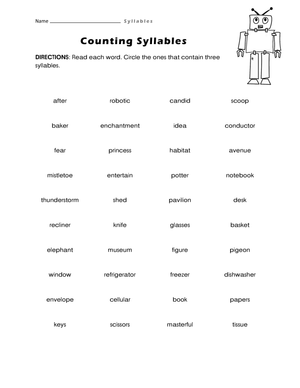
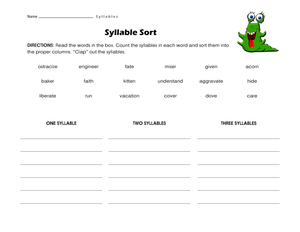
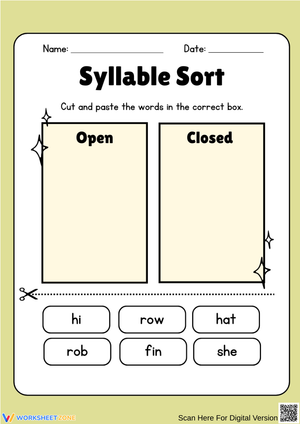
- Syllable sorting: Students sort word cards into columns labeled by syllable count — one, two, or three beats. Thematic groupings (seasonal vocabulary, animal names) give students a meaningful context rather than a random word list, which helps with sustained attention during the sorting task.
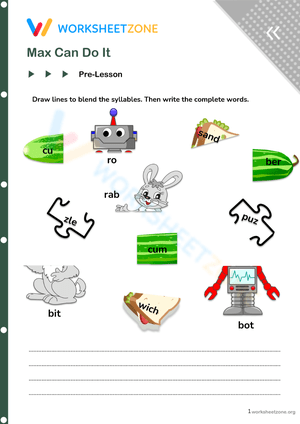
- Compound word splitting: Students draw a line between the two base words inside a compound — "sunlight," "raincoat," "cupcake" — then write each part separately. Because both halves are words the students already know, this worksheet makes word-boundary logic intuitive before students encounter the more abstract VC/CV rule.
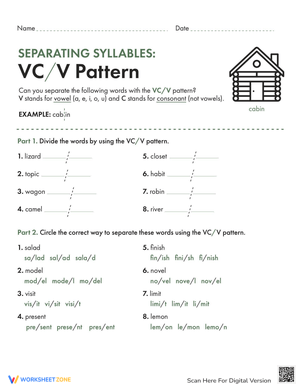
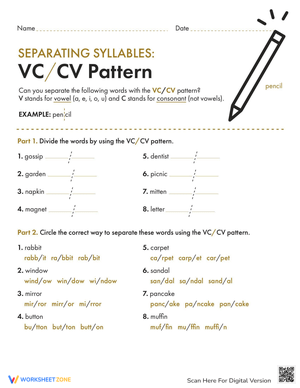
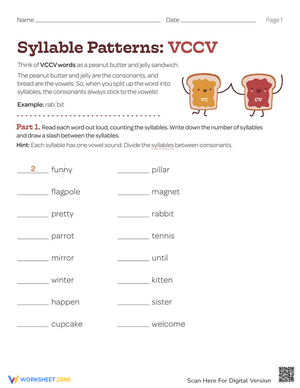
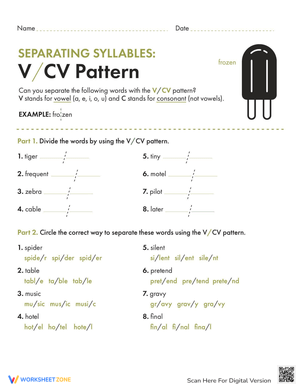
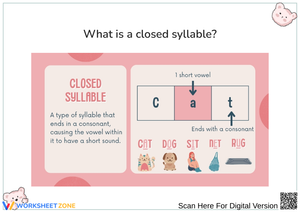
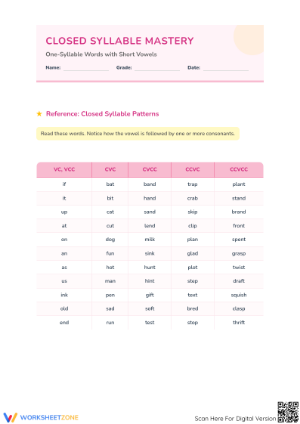
- Closed-syllable division: Students apply the VC/CV rule to two-syllable words like "napkin," "basket," and "dentist," drawing a slash between the two consonants in the medial cluster. This is the most demanding worksheet in the set and works best after students are solid on the first three skills.
Frequent Error Patterns Worth Watching For
The most persistent mistake in first-grade syllable work isn't mishearing a word — it's confusing vowel letters with vowel sounds. A student who counts three vowel letters in "rabbit" (a, i) may confidently mark three syllables, because many first graders conflate "vowel sound" with "any vowel letter visible on the page." Watch specifically for students who split "rabbit" as "ra-bbit" rather than "rab-bit": they're applying the right idea — split in the middle — but haven't yet internalized that the division falls between the two consonants, not in front of them. A quick correction is to have those students underline just the vowels, confirm they hear two sounds, and then look between them for the consonant pair.
A second error surfaces on compound word worksheets. Students who have just learned the VC/CV rule will sometimes try to apply it to "rainbow" and split it correctly — but others look at the consonant cluster "nb" and attempt to divide there, producing something like "rai-nbow." This is a transfer error worth distinguishing from a comprehension error: the student has internalized a rule but overgeneralized it. Pointing to "rain" and "bow" as complete, familiar words reorients them without undermining the rule they're learning to use.
Building These Worksheets Into Your Weekly Lesson Plans
These 1st grade syllables worksheets fit most naturally into three different instructional slots. The beat-counting and sorting sheets work well as Monday warm-ups during the 8–10 minutes before whole-group phonics instruction — students start independently while the teacher handles morning logistics, and the format requires no re-explanation once it's been introduced. The closed-syllable division worksheet, because it requires active rule application, belongs in small-group guided reading where the teacher can watch students mark their lines in real time and redirect before a wrong split becomes a habit.
The compound word worksheet is the strongest candidate for a literacy center. Laminate it, set out dry-erase markers, and it becomes a reusable station activity. Pairing two students and having one say the word aloud while the other marks the line enforces the spoken-rehearsal step that most students skip when working alone — and that spoken step is where the real learning happens. For homework, the picture-based beat-counting worksheet is the most parent-accessible format; a brief note home explaining the chin-drop method gives families a concrete way to help without requiring any phonics background.
Standard Alignment
These worksheets align to CCSS.ELA-LITERACY.RF.1.2, the foundational skills standard requiring first graders to demonstrate understanding of spoken words, syllables, and sounds. Substandard RF.1.2b addresses segmenting single-syllable words into individual phonemes, while RF.1.2c covers isolating and pronouncing initial, medial, and final sounds — both of which underpin the syllable work here. In classroom terms, this standard surfaces in the first marking period, after students have consolidated phonemic awareness at the individual-sound level in kindergarten and are ready to work with word structure as a unit. The 1st grade syllables worksheets in this set address the standard progressively, beginning with auditory tasks before moving to written division, which mirrors the instructional sequence most reading specialists follow for this grade band.
Adjusting the Worksheets for a Range of Learners
For students who are still consolidating phonemic awareness, the picture-based beat-counting worksheet remains accessible because the image carries the word meaning — students don't need to decode print to engage with the task. If even that combination feels like too many simultaneous demands, have the student tap the table for each syllable rather than mark the paper; the physical tapping reinforces the auditory boundary without adding the written response. This keeps the student in the lesson without requiring a product they aren't ready to produce.
Students who are ready to move beyond grade-level expectations gain the most from the closed-syllable division worksheets, which connect directly to the six syllable types they'll encounter in second-grade decoding. Extend the challenge by asking them to generate their own two-syllable words, draw the division line, and verify against a word list — the generative task is significantly more demanding than marking a pre-printed word. For the syllable sort, adding an unlabeled fourth column and asking advanced students to supply four-syllable examples ("alligator," "caterpillar") raises the ceiling without changing the worksheet format or disrupting the students working at grade level beside them.
Frequently Asked Questions
At what point in the year should syllable work begin?
Most first-grade phonics sequences introduce syllable awareness during the first marking period, after students have reviewed short vowel sounds from kindergarten. The beat-counting and sorting worksheets can come as early as September or October for students who arrive with solid phonemic awareness. The closed-syllable division worksheet should wait until after direct instruction on the VC/CV rule — typically late fall or early winter in a standard scope and sequence — because applying a written rule without that instruction produces guessing rather than reasoning.
Are these appropriate for kindergarten or second-grade students?
The picture-based beat-counting and sorting worksheets are appropriate for late-kindergarten students who have strong phonemic awareness and are beginning to encounter multi-syllable words. The closed-syllable division worksheet assumes students can identify vowel sounds reliably and apply a written rule, which makes it a poor fit for most kindergartners. For second graders, the 1st grade syllables worksheets function well as a diagnostic at the start of the year: a student who struggles with the compound-word or division sheet is signaling a gap that will interfere with second-grade decoding and needs targeted work before moving forward.
How long does each worksheet take to complete?
The beat-counting and compound word worksheets run about 10–12 minutes for most first graders working independently. The closed-syllable division worksheet typically takes 15–18 minutes because students must apply a rule at each item rather than relying on auditory instinct. Budget extra time the first session with any new format — the initial run is always slower while students learn the directions, and that slowness reflects unfamiliarity with the procedure, not difficulty with the skill itself.
Do the worksheets include answer keys?
Yes. Each worksheet comes with a corresponding answer key showing the correct syllable count or division line for every item. For sorting activities, the key identifies which words belong in each column. These are especially useful when worksheets go home as homework — a parent can check work accurately without any background in phonics instruction, which removes a common friction point in home-school communication around early literacy practice.












 Interactive Worksheet Maker
 Quiz Maker
 Word Search Maker
 Crossword Puzzle Maker
 Word Scramble Generator
 Sentence Scramble Generator
 Handwriting Worksheet Generator
 Name Tracing Generator
 Fill In The Blank Generator