1st Grade Multisyllabic Words Worksheets for Phonics Practice
1st grade multisyllabic words worksheets give students a structured entry point into two-syllable territory—the part of Grade 1 phonics where many readers start to stumble once the word goes past three or four letters. The set focuses on familiar VCCV words like rabbit, napkin, and pencil, as well as compound words like sunset and cupcake, where the syllable break is concrete enough for a six-year-old to both feel and hear. Each worksheet connects oral production to print: students say the word aloud, tap or clap the parts, and then mark, sort, or write what they heard.
Skills These Worksheets Build
The set covers the core actions of early syllable work: hearing syllable breaks in spoken words, counting syllables by clapping or tapping, matching a segmented word to its printed form, and sorting words by syllable count. Task formats vary across the set so practice stays fresh without requiring students to decode new directions every time they sit down.
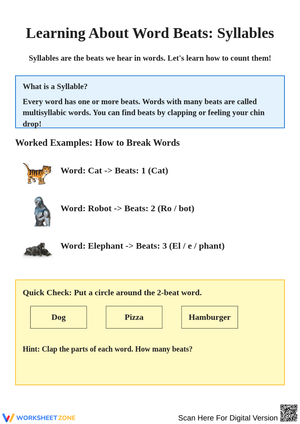
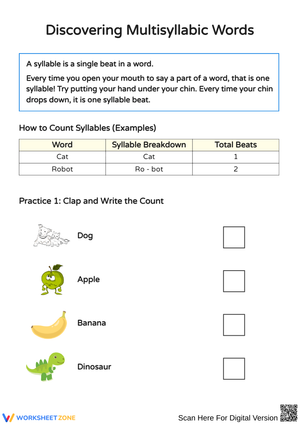
- Clap-and-count worksheets: Students say a pictured word aloud, clap the syllables, and circle or write the number they heard.
- Syllable-box tasks: Each spoken part gets its own labeled box, so students have to decide where one syllable ends and the next begins before they write.
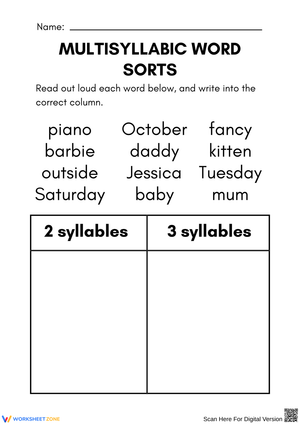
- Picture sorts: Students sort illustrated word cards into one-syllable and two-syllable columns—a low-prep format that works as a warm-up, center, or partner task.
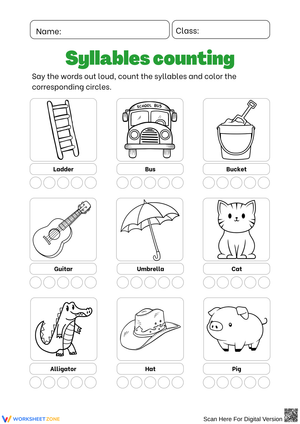
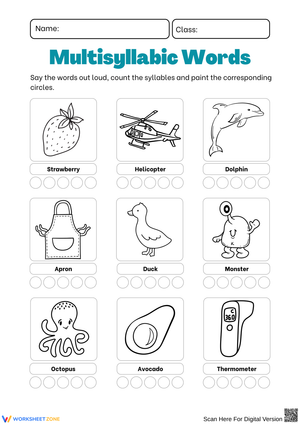
- Color-by-syllable worksheets: Students identify the syllable count of a pictured word and color it according to a simple key, keeping hands and attention on the task simultaneously.
- Read-and-match tasks: Students connect a printed two-syllable word to its corresponding picture, reinforcing that the segmented spoken form maps onto a whole written word.
The words used throughout the set are deliberately ordinary—familiar nouns and compound words that most first graders know by sound before they can read them in print. That gap between spoken recognition and print decoding is precisely where syllable practice creates real instructional value.
Where Word Choice Makes or Breaks the Lesson
The most common reason a syllable worksheet underperforms in Grade 1 isn't the task format—it's the vocabulary. When the target word is unfamiliar in speech, something like fracture or prism, students can't verify their syllable count by saying the word naturally. They guess from the picture, or from letter count, or they shut down entirely. The task stops being phonics practice and becomes a vocabulary puzzle.
The words in this set are drawn from everyday spoken vocabulary: compound words students encounter in daily conversation and common VCCV nouns that appear in early decodable readers. A student who already says "pencil" and "rabbit" correctly can put all of their attention on hearing the syllable break rather than decoding an unfamiliar meaning. That cognitive load split—separating the phonics task from the vocabulary task—is what makes Grade 1 syllable instruction transfer into independent reading rather than stay locked to the worksheet.
Errors Students Make That These Worksheets Help You Catch
The most consistent error is treating a two-syllable VCCV word as a single beat. Students who have spent most of Grade 1 reading CVC words and short consonant blends develop a rhythm of one-clap-per-word that carries over without prompting. When they see rabbit, they say it correctly in conversation but clap it once because their print-reading habit is still operating in single-syllable mode. Pointing to the double consonant in the middle and asking students to "split right there between the two letters" often resolves this faster than asking them to reclap the word.
A second pattern appears with compound words: students sometimes identify the two real words inside the compound correctly—sun and set—but then insist that sunset has "two words, not two syllables." This is a conceptual distinction worth handling explicitly before any worksheet goes into a center. A brief whole-group conversation about how a compound word is still one word with two spoken parts usually clears it up in a few minutes, and the worksheets then function as a genuine skill check rather than a site of confusion.
Building These Worksheets Into Your Phonics Lesson Plans
1st grade multisyllabic words worksheets fit most naturally into the five-to-eight minutes of practice that follows direct teacher modeling. A straightforward sequence: demonstrate by saying a word aloud, clapping the parts, and writing one mark per syllable on the board; then complete two or three items together as a class before students finish the rest of each worksheet independently or with a partner.
A few placement options that work reliably across different classroom structures:
- Morning phonics warm-up: A color-by-syllable worksheet takes under five minutes and reactivates oral segmentation from the prior lesson before new instruction begins.
- Small-group intervention: Picture-sort worksheets are well-suited here because the teacher can listen to students name each picture aloud, catching errors in spoken segmentation before they transfer to print tasks.
- Independent centers: Syllable-box worksheets work in centers because the format is self-explanatory after one modeled round—students know to place one spoken part per box without needing the teacher nearby.
- Quick exit check: A six-item clap-and-count worksheet at the close of a phonics block tells the teacher, at a glance, whether students can segment the day's target words without guided support.
One routine worth holding consistent across the week: "Say it — tap it — count it — read it." When students use the same verbal sequence every day, they stop spending working memory on the directions and start spending it on actually hearing the word. That small consistency shift tends to improve accuracy noticeably without any change to the worksheet itself.
Standard Alignment
The primary standard this set addresses is CCSS.ELA-LITERACY.RF.1.3e: "Decode two-syllable words following basic patterns by breaking the words into syllables." In instructional placement terms, RF.1.3e comes after students have consolidated single-syllable decoding—RF.1.3b covers short-vowel CVC patterns—and before the more demanding multisyllabic strategies that open up in Grade 2. These worksheets sit in that transitional stretch, which makes them most useful in the second half of Grade 1 or as targeted intervention material for Grade 2 students working below benchmark on this specific standard.
Adjusting the Set for Different Learners in the Same Room
Students still building phonemic awareness need the oral step completed with them rather than simply demonstrated. For those students, reduce each worksheet to four or five items, preteach the pictures by pointing and naming before the task begins, and let students tap on their arm or desk before writing anything. The physical tap reinforces segmentation without requiring them to hold the word in memory while also managing print output at the same time.
English learners benefit from a brief picture-walk before any worksheet is attempted. Confirming that a student knows the spoken English word for each picture removes a variable that has nothing to do with syllable knowledge. Without that check, a missed item may reflect a vocabulary gap rather than a phonemic awareness gap—two very different instructional responses.
Students who move through the core tasks easily can extend the work by sorting two-syllable words by VCCV pattern after counting syllables, writing each syllable part into boxes without the picture clue, or using each word in a spoken sentence before moving on. The worksheet becomes the floor; the conversation around it becomes the ceiling.
Frequently Asked Questions
What qualifies as a multisyllabic word for Grade 1?
In Grade 1, multisyllabic instruction almost always means two-syllable words—specifically, familiar compound words and VCCV-pattern nouns with audible, natural syllable breaks. Three-syllable words occasionally appear in late-year instruction, but the foundational work stays at two. The words in this set are ones most first graders already know by sound: rabbit, napkin, pencil, sunset.
Do students need to know the formal syllabication rule before using these worksheets?
No. In Grade 1, the goal is auditory segmentation—hearing that a word has two parts—rather than applying a written rule about where syllables divide. A student who can clap nap-kin correctly is meeting the target skill even without being able to explain why the break falls between the two consonants. Explicit rule-teaching comes later; listening and tapping comes first.
Can these worksheets serve early Grade 2 students working below grade level?
Yes. 1st grade multisyllabic words worksheets are a practical choice for Grade 2 intervention groups who haven't yet consolidated RF.1.3e. The vocabulary stays familiar enough that word meaning doesn't compete with the phonics task, and the physical formats—clapping, tapping, sorting—give students an action to anchor the segmentation work, which is especially useful for students who freeze when given a print-only task.
How many items should a Grade 1 syllable worksheet include?
Between six and twelve items works for most first graders in a focused practice context. Fewer than six gives students too little repetition for a pattern to register; more than twelve risks moving into automatic, unconsidered responses rather than active segmentation. The worksheets in this set stay inside that range.
Is oral rehearsal really necessary before the worksheet?
For most Grade 1 students, yes. 1st grade multisyllabic words worksheets show the strongest results when students have already said and tapped the target words aloud before any print task begins. Skipping oral rehearsal tends to produce work where students fill in answers based on letter count rather than actual sound segmentation—and that kind of completion doesn't reflect, or build, real phonemic awareness.
Clear All