These 1st grade recognizing syllables worksheets resources give teachers a ready-to-use progression that moves students from clapping out beats to marking syllable breaks in printed text. The set covers auditory counting, visual sorting, and written practice — the three modes first graders need to internalize the skill. Each worksheet uses picture prompts or decodable words matched to a typical Grade 1 phonics scope, so students practice syllable work without running into unfamiliar vocabulary.
What's Inside the Set
Each worksheet targets a specific point in the syllable-recognition progression. The formats vary so teachers can pull the right one for whole-group instruction, a literacy center, or a quick formative check.
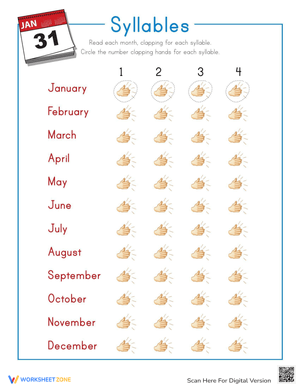
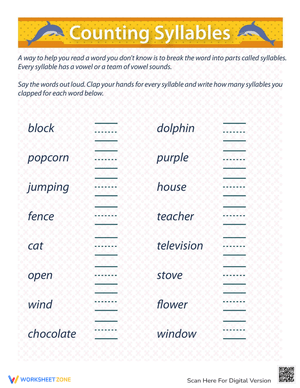
- Clap-and-write pages — Students look at a picture, say the word, count the beats, and write the number in a box. Pictures include familiar one-, two-, and three-syllable words: dog, pencil, umbrella.
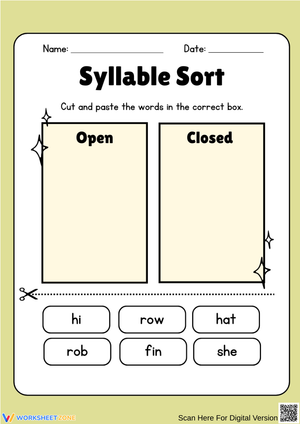
- Sort-and-paste mats — Students cut out picture cards and paste them into columns labeled 1, 2, or 3 syllables. The physical act of sorting slows students down and forces them to say each word deliberately rather than guessing.
- Syllable-split pages — Students draw a line between the two parts of printed two-syllable words. This is where picture-dependent students often meet their first real challenge: reading the word instead of just hearing it.
- Compound word practice — Simple compound words like "cupcake," "sunlight," and "raindrop" let students see that each part they already know as its own word is also a syllable. This connection reliably speeds up comprehension of the two-syllable concept.
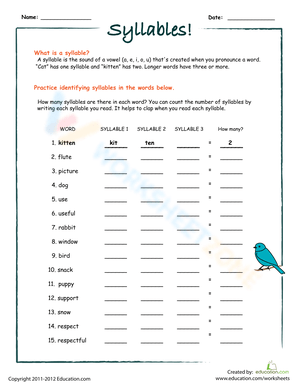
- Decodable-word syllable counts — Short word lists with CVC and CVCE words ask students to write the syllable count beside each word. This format doubles as a quick exit ticket or morning warm-up.
Frequent Student Errors Worth Watching For
The error that shows up most consistently is over-counting on consonant blends. A first grader who claps "street" will often clap twice — once for "str" and once for "eet" — because the blend feels like an extra beat when spoken quickly. That same student claps "stop" correctly. This tells the teacher the problem is not syllable awareness; it is that the student is reacting to articulatory effort rather than vowel count. The chin-drop method exposes this immediately: one jaw drop equals one syllable, regardless of the consonant cluster. Building that check into independent worksheet time — having students rest a hand under the chin before writing their number — catches this before it becomes a habit.
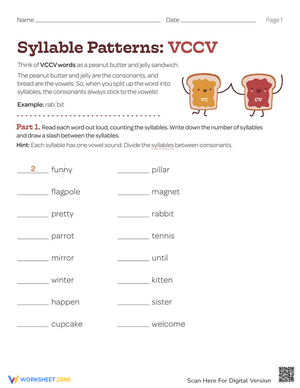
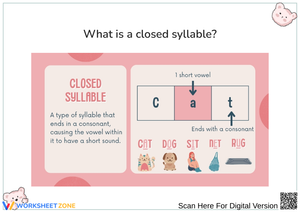
A second error appears on syllable-split pages. Students who correctly hear two beats in "rabbit" will mark the break after the first vowel, writing "ra-bbit," because they are applying a rule they half-absorbed about vowels. The standard split is "rab-bit," following the closed-syllable pattern. First graders are not ready for formal syllable-type rules, but teachers can flag this during conferring: the break goes between the two consonants, not after the vowel. Noting which students make this error during worksheet review identifies exactly who needs that concept in a small-group lesson before they encounter more complex words in second grade.
Standard Alignment
These worksheets address CCSS.ELA-LITERACY.RF.1.2 — Phonological Awareness — specifically the expectation that first graders "count, pronounce, blend, and segment syllables in spoken words." In classroom terms, RF.1.2 sits inside the phonological awareness strand of the foundational skills block, typically taught between October and February in a standard Grade 1 scope. Syllable work precedes onset-rime and phoneme segmentation in some sequences and follows it in others; either way, these worksheets slot into that instructional window without disrupting the surrounding sequence. Teachers in schools using CKLA or other structured literacy frameworks will find that the word selection — closed-syllable and compound-word examples — maps cleanly onto those programs' phonics progressions at the Grade 1 level.
How to Build These Worksheets Into Your Lesson Plans
The clap-and-write pages work best as a five-minute warm-up at the start of the phonics block, not as the block itself. Students need the full lesson for new phonics instruction; syllable practice belongs in the transition before that instruction begins, or in the last eight minutes before a specials period. The sort-and-paste mats are suited to literacy centers running Tuesday through Thursday after the Monday whole-group introduction — students have seen the target words once and are now ready to apply the concept independently. Reserve the syllable-split pages for the back half of a unit, when students are ready to move from hearing beats to locating them on a page. These are stronger as a small-group activity than whole-class work because the errors students make on them are instructive and worth a brief conversation, not just a check mark.
For teachers using a gradual release model, the 1st grade recognizing syllables worksheets set supports every stage: the clap-and-write pages work as guided "we do" practice, the sort mats function as collaborative center tasks, and the decodable-word lists serve as independent written checks.
Adjusting the Worksheets for a Range of Learners
Students who are still developing phonological awareness at the word level need the picture-based pages before any printed text. Keep those students on clap-and-count or sort-and-paste formats longer; moving them to syllable-split pages too early produces guessing rather than analysis. For these students, pair worksheet time with a physical manipulative — a row of counters they move for each beat — so the abstract concept has a tangible anchor they can control on their own.
For students who handle two-syllable words with ease, the compound-word pages often feel comfortable enough to be unchallenging. Extend those students by asking them to generate their own two-syllable words in a blank column, or by introducing three-syllable words — "umbrella," "banana," "September" — which the 1st grade recognizing syllables worksheets collection includes in its more advanced pages. A student who can sort "umbrella" correctly has developed the core skill this set targets and is ready for onset-rime work or introductory syllable-type instruction.
Frequently Asked Questions
Why does syllable recognition appear in first grade specifically rather than kindergarten or second grade?
Syllable recognition is introduced in kindergarten at a purely auditory level — students clap names and familiar spoken words. First grade is where the skill moves into print. The developmental shift in Grade 1 from picture reading toward word reading makes this the right moment to connect the beats students already hear with the letter sequences they now decode. This is why 1st grade recognizing syllables worksheets resources typically pair pictures with text rather than relying on text alone — students in Grade 1 are in transition between those two modes, and the pictures provide the bridge.
Is clapping syllables always reliable, or should teachers use a different method?
Clapping is a reasonable starting point but produces errors on fast-spoken words and consonant blends. The more reliable method for independent practice is the chin-drop check: one jaw drop per vowel sound equals one syllable. Students use this silently during worksheet time without disrupting a center. For students who still struggle with both methods, having them say the word in slow motion — stretching each vowel — surfaces the beat count more clearly than any physical gesture.
How do these worksheets fit into a structured literacy classroom?
In a structured literacy classroom, phonological awareness work precedes or accompanies phonics instruction at each level. These worksheets belong in the phonological awareness strand, not the phonics strand, even when they use printed words — because the task is still fundamentally about sound structure, not letter-sound correspondence. Teachers using CKLA, SIPPS, or Fundations can use these as supplemental practice during the phonological awareness portion of the lesson without disrupting the program's sequence.
Can these worksheets be used for intervention with older students?
Second and third graders who scored below benchmark on a phonological awareness screener often benefit from returning to syllable-counting work. The picture-based pages in this set are not babyish enough to feel embarrassing — the illustrations are simple line drawings rather than toddler clip art. For older students in intervention, the sort-and-paste mats and decodable-word lists are typically more appropriate than the clap-and-write pages, since older students generally respond better to the organizational structure of sorting tasks when rebuilding a foundational concept.












 Interactive Worksheet Maker
 Quiz Maker
 Word Search Maker
 Crossword Puzzle Maker
 Word Scramble Generator
 Sentence Scramble Generator
 Handwriting Worksheet Generator
 Name Tracing Generator
 Fill In The Blank Generator