Hearing Syllables PDF Worksheets for 1st Grade
These hearing syllables pdf worksheets for 1st grade give teachers a set of picture-based, printable tasks that convert a purely auditory skill into something students can count, sort, and document on paper. Each worksheet isolates one narrow aspect of syllable awareness — counting spoken word parts, sorting pictures by syllable count, or matching images to numbers — so the cognitive demand stays focused. The set spans one- through four-syllable words and includes answer keys designed for quick teacher review during independent work time.
What the Set Covers
Each worksheet targets a specific auditory task rather than bundling several skills into a single exercise. Students encounter four core exercise types across the collection.
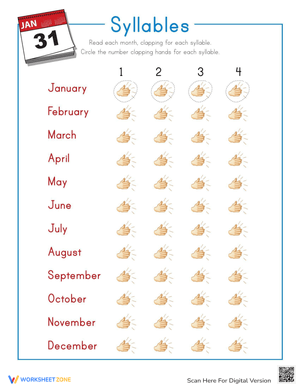
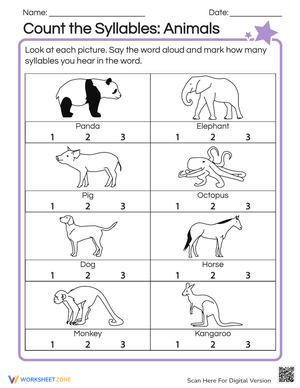
- Clap-and-count tasks: Students say each pictured word aloud, clap its syllables, and write the number they hear. The picture prompt removes any decoding barrier so the task stays phonological from start to finish.
- Syllable sorts: Students mark pictures and place them under the correct column header — one, two, or three syllables. Sorting forces a comparison decision, which deepens retention compared to counting in isolation.
- Match-and-write exercises: A picture appears alongside three number choices; students circle the correct syllable count and write it in a box, giving two confirmation points before moving on.
- Blend-and-say activities: The teacher says individual syllables aloud and students circle the matching picture — reversing the typical direction and building blending alongside segmentation in the same sitting.
Why Auditory Practice Has to Come Before Print
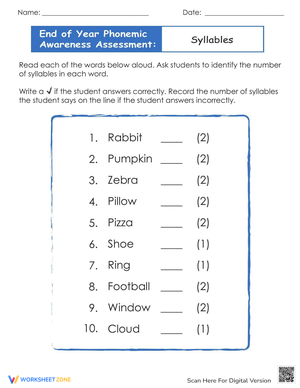
First grade is the developmental moment when phonological awareness instruction and early phonics instruction run in parallel — and the two are easy to conflate. When a student looks at the written word rabbit and counts the letters, that is not syllable awareness; it is letter counting. The skill these worksheets build is purely acoustic: can a student hear that rab-bit has two distinct beats? Hearing syllables pdf worksheets for 1st grade are built around images precisely because the picture frees the student from the written form entirely. The child says the word, hears its parts, and records what they heard — print never enters the process until the answer goes on the page.
That design choice reflects a well-documented principle from early literacy research: auditory phonological awareness develops on a continuum from large units to small ones, with syllables coming before individual phonemes. Teachers who skip syllable work and move directly to phoneme segmentation often encounter students who can isolate the /k/ in cat but freeze when asked to read napkin. Syllable counting is the macro-level practice that primes the brain for micro-level sound work later in the year.
Frequent Student Errors Worth Watching For
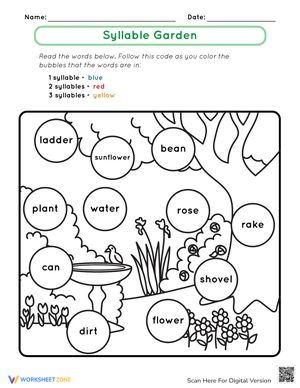
The most consistent error pattern at this level is conflating stressed and unstressed syllables. Students who count syllables in ba-na-na correctly will often write "2" for choc-o-late because the middle syllable disappears in natural speech. Three-syllable words where the middle syllable is reduced — family, different, camera — catch the most students. A second pattern surfaces with compound words: students hear rain-bow as two syllables correctly, but then count sun-flow-er as two, reasoning that it is "just one sun and one flower." Visual logic overrides the auditory count.
The jaw-drop technique addresses both errors more reliably than clapping. Have students place the back of their hand under their chin and say the word aloud — because every syllable contains exactly one vowel sound, the jaw drops once per syllable, and that movement is felt even when the syllable is unstressed. Hearing syllables pdf worksheets for 1st grade work best when teachers model the jaw-drop method for the first three or four pictures before releasing students to work independently; without that brief demonstration, students default to clapping and miss the reduced syllables every time.
Recommended Lesson-Planning Strategies for These Worksheets
These worksheets fit three distinct slots in a literacy block. As a whole-group opener, display one worksheet on the projector and work through four pictures together — roughly six minutes — before sending students to independent practice. That brief guided run-through is enough for most students to internalize the task structure without burning the whole block in teacher-led mode.
In a small-group pull-out, the one- and two-syllable sorting worksheets work well for students still developing phonological awareness at the word level; the three- and four-syllable worksheets push students who have already consolidated the easier counts. At a literacy center, pair each worksheet with a cup of counting cubes: students place one cube per syllable they hear, then check whether the cube count matches what they wrote. That self-checking move — building a physical representation and comparing it to a written answer — catches careless errors without requiring teacher presence at the table.
Standard Alignment
These worksheets align to CCSS.ELA-LITERACY.RF.1.3, which requires first graders to decode one- and two-syllable words using phonics and word analysis. Before students can visually break a written word at the syllable boundary, they must be able to hear where that boundary falls — which is exactly what this set practices. The worksheets also support CCSS.ELA-LITERACY.RF.1.2, the phonological awareness standard, particularly the expectation that students segment spoken words and recognize sound-structure patterns. Syllable awareness is the necessary precursor to both standards, and most instructional sequences place it before phoneme-level work in the fall literacy block.
Differentiating the Set Across Ability Levels
Students who are still shaky on one- and two-syllable words benefit from starting with high-frequency concrete nouns — dog, table, pencil — before encountering three-syllable vocabulary. Pull the simpler-count worksheets for those students and have them use tally marks alongside each picture so the physical count and the written count appear together on the same worksheet. For students who move through two-syllable work quickly, the three- and four-syllable worksheets introduce natural vocabulary like umbrella, caterpillar, and watermelon that stretches the task without changing the underlying skill.
One honest limitation worth naming: the cut-and-sort format on several worksheets requires fine motor control that some first graders find genuinely frustrating. For those students, replace the physical sort with a colored-dot system — they mark each picture with a crayon color that corresponds to a syllable count — and the auditory practice continues uninterrupted. The skill does not require scissors to develop.
Frequently Asked Questions
Do students need to know how to read to use these worksheets?
No. Every exercise uses picture cues so students name the pictured object aloud and count what they hear, not what they see in print. Hearing syllables pdf worksheets for 1st grade are designed specifically for students who are still in early phonics acquisition — the image handles the identification step so the auditory skill is practiced in true isolation.
How many syllables should first graders accurately count by the end of the year?
Most first graders should reliably identify one-, two-, and three-syllable words by spring. Four-syllable words appear in the set as extension work for students who have consolidated the earlier counts. Research benchmarks from programs like DIBELS and the CORE Phonics Survey point to syllable segmentation accuracy as a strong predictor of end-of-year decoding scores, so any student still inconsistent with two-syllable words in January warrants a closer look during small-group time.
Can these worksheets support intervention with students above first grade?
The picture-based format keeps the task non-threatening for students in grades 2 and 3 who still struggle with phonological awareness. The vocabulary on the three- and four-syllable worksheets — words like caterpillar, umbrella, and watermelon — is age-appropriate through third grade, so older students encounter the practice they need without material that signals they are working far below their peers.
Clear All