




























Views
Downloads
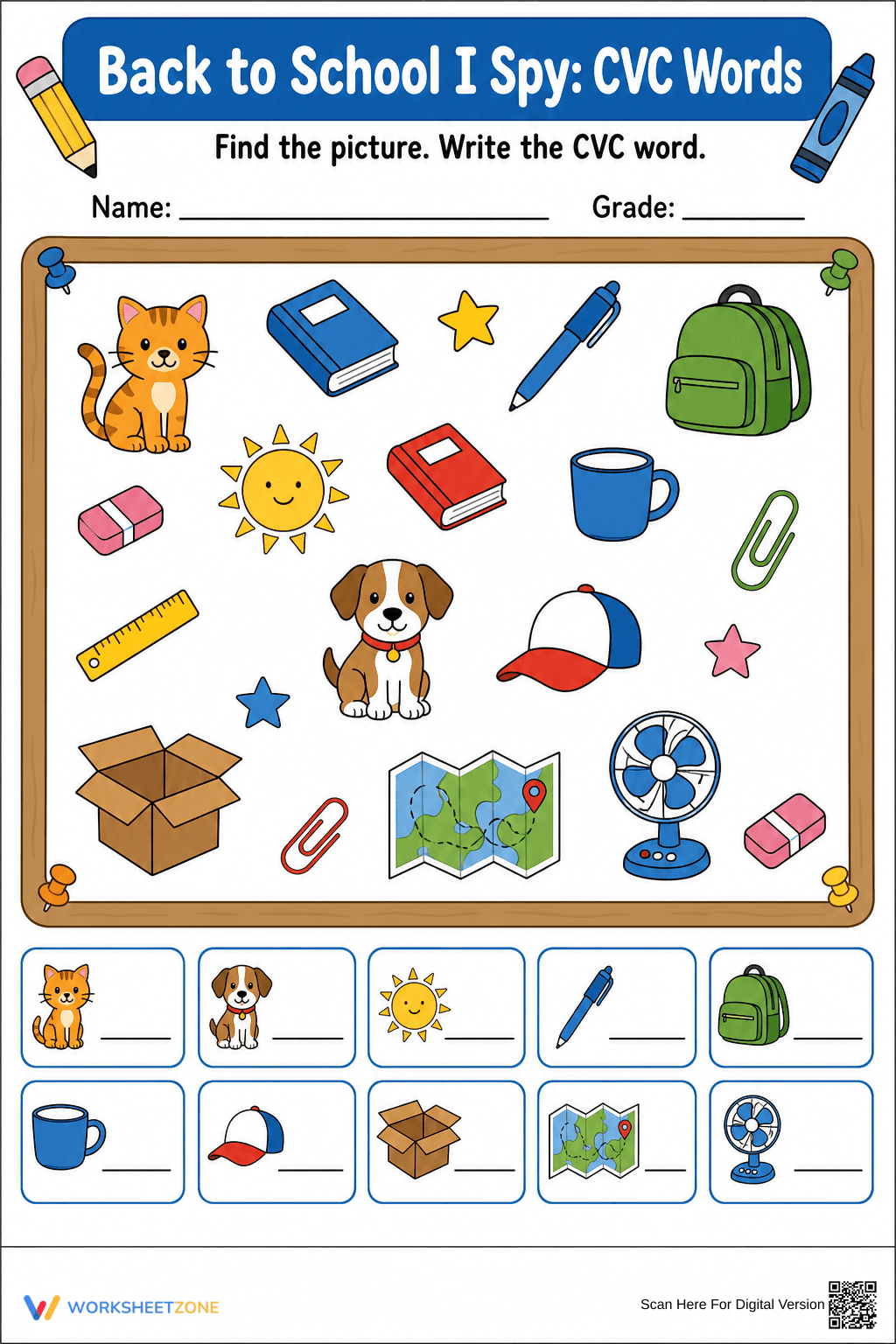

Back to School CVC Words I Spy | Essential Phonics

Paste this activity's link or code into your existing LMS (Google Classroom, Canvas, Teams, Schoology, Moodle, etc.).
Students can open and work on the activity right away, with no student login required.
You'll still be able to track student progress and results from your teacher account.
This Kindergarten and Grade 1 phonics worksheet helps students master CVC word encoding through an engaging visual search. By identifying objects like a cat, dog, and sun, learners practice isolating phonemes and translating sounds into written letters. This activity strengthens the connection between visual recognition and spelling accuracy in early readers.
At a Glance
- Grade: K-1 · Subject: ELA
- Standard:
CCSS.ELA-LITERACY.RF.K.2.D— Isolate and pronounce initial, medial vowel, and final sounds in CVC words- Skill Focus: CVC word spelling
- Format: 1 page · 10 problems · Answer key included · PDF
- Best For: Literacy centers and morning work
- Time: 10–15 minutes
This single-page PDF features a vibrant search-and-find bulletin board scene filled with school-themed illustrations and specific CVC targets. Below the search area, students find 10 individual boxes, each containing a thumbnail of a target object paired with primary-ruled handwriting lines. The layout includes clear fields for student names and grades, plus a blue header for easy classroom organization.
Zero-Prep Workflow
- Print: Select the single-page PDF and print enough copies for your class in approximately 30 seconds.
- Distribute: Hand out the sheets during your phonics block or as a transition activity in under 1 minute.
- Review: Use the included answer key for quick grading or project the page for a whole-group check.
Total teacher prep time is under 2 minutes, making this an ideal sub-plan or emergency filler for early elementary classrooms.
The primary focus is CCSS.ELA-LITERACY.RF.K.2.D: "Isolate and pronounce the initial, medial vowel, and final sounds (phonemes) in three-phoneme (consonant-vowel-consonant, or CVC) words." It also supports RF.1.2.B by encouraging students to orally produce single-syllable words by blending sounds. Both standard codes can be copied directly into lesson plans, IEP goals, or district curriculum mapping tools.
Use this as a formative assessment after introducing short vowel sounds. Observe if students can identify the medial vowel correctly for words like "map" or "fan." It also works well as a quiet-time activity for early finishers, providing meaningful practice without requiring direct teacher supervision. The expected completion time is 10 to 15 minutes.
This resource is designed for Kindergarten and first-grade students who are beginning to blend and segment sounds. It is particularly helpful for English Language Learners (ELLs) as the visual cues provide immediate context for the vocabulary. Pair this with a CVC anchor chart or a short vowel word wall for additional instructional support.
The Back to School CVC Words I Spy worksheet provides targeted practice for CCSS.ELA-LITERACY.RF.K.2.D, focusing on the essential skill of phoneme isolation and grapheme mapping. Research by Fisher & Frey (2014) emphasizes the importance of gradual release of responsibility, where visual scaffolds like the search-and-find format allow students to apply phonics rules independently after direct instruction. By requiring students to write the full CVC word rather than just circling it, the worksheet reinforces the encoding process, which is a critical precursor to fluent reading. This 10-task activity aligns with evidence-based literacy practices that prioritize multisensory engagement and clear visual-to-text associations. Educators can use this tool to gather data on student mastery of short vowel sounds and consonant blending. The structured layout ensures that learners remain focused on the phonics objective while enjoying the gamified search element.


