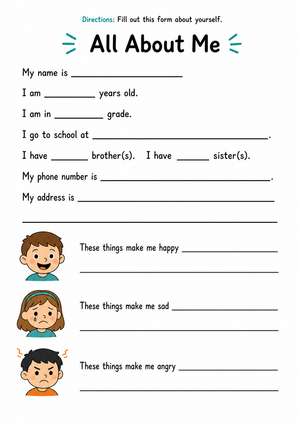
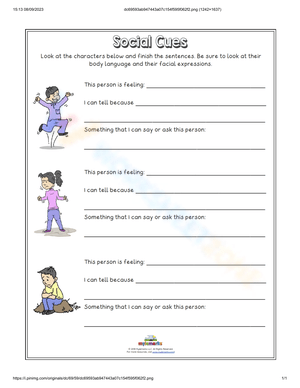
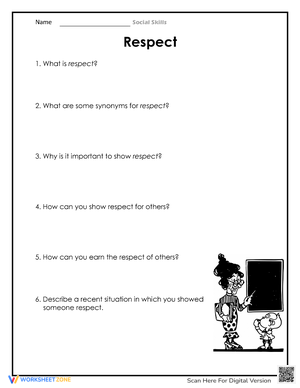
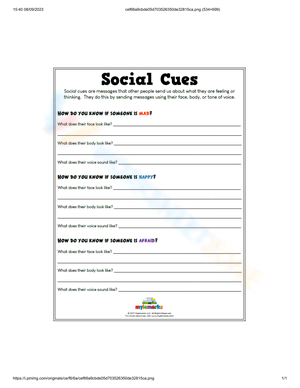
These social skills for kids worksheets printable for 1st grade give teachers a structured way to address the behavioral expectations that six- and seven-year-olds genuinely haven't mastered yet — not because they're defiant, but because no one has broken those expectations into concrete, teachable steps. Each worksheet in the set targets a specific skill, from recognizing facial expressions to working through a stop-and-think conflict sequence, and keeps the cognitive load manageable for early readers by pairing simple text with clear illustrations.
The Developmental Case for Explicit Social Instruction in Grade 1
At six and seven, children are moving out of the predominantly self-focused thinking that dominated kindergarten and beginning to register that their actions affect other people — but that awareness is just emerging. It doesn't automatically translate into behavior. A student who genuinely understands that grabbing the marker was wrong may still not know what to say afterward, or how to read the classmate's expression to gauge how upset they are. This is exactly the window when explicit instruction does the most work: the cognitive capacity for perspective-taking is developing, but the behavioral scripts aren't yet in place. Waiting until third grade to address these skills directly means three years of reactive management instead of proactive teaching.
What Each Worksheet Targets
The set covers five distinct skill areas, each addressed through activities that ask students to actively do something rather than passively receive information.
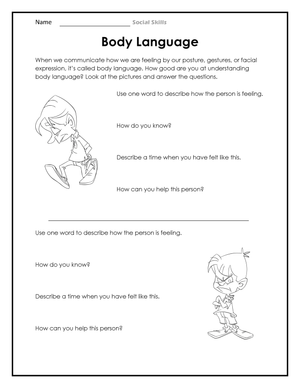
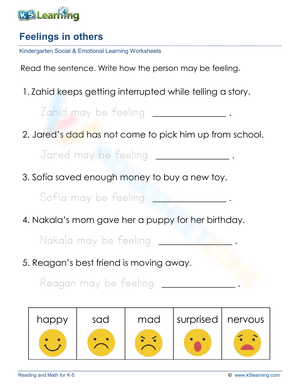
- Emotion identification: Students match illustrated faces to emotion words and draw their own expression for a given scenario, building a personal vocabulary for internal states before they're asked to regulate them.
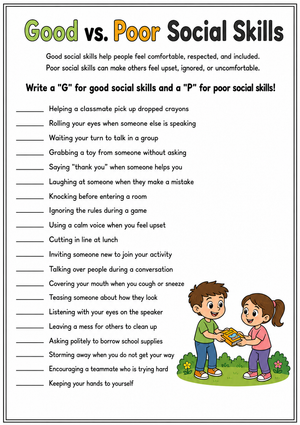
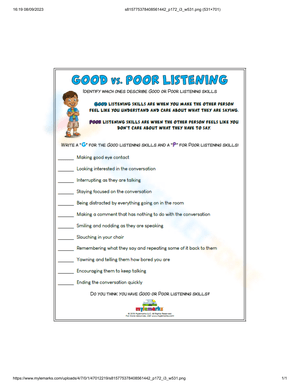
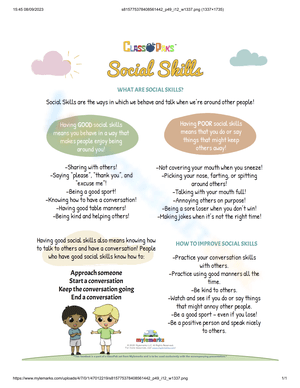
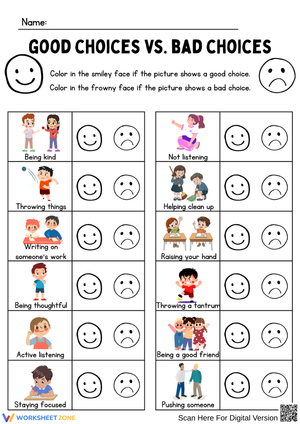
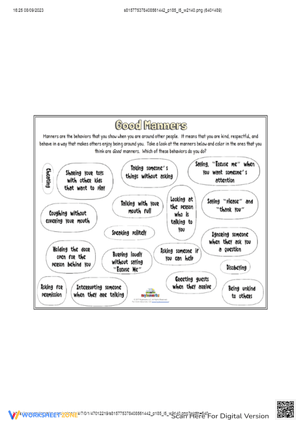
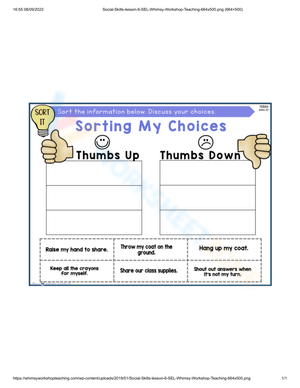
- Active listening: Students sort behaviors — eyes on the speaker, still hands, waiting for a turn — into "good listener" and "distracted listener" columns, turning an abstract expectation into a concrete checklist.
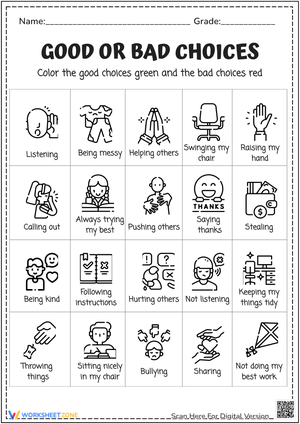
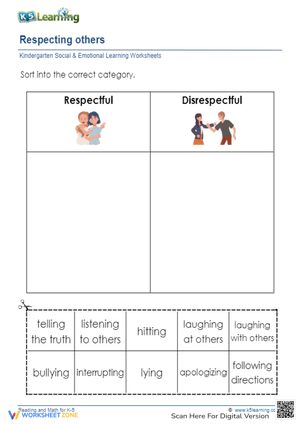
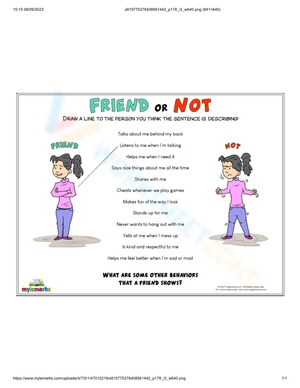
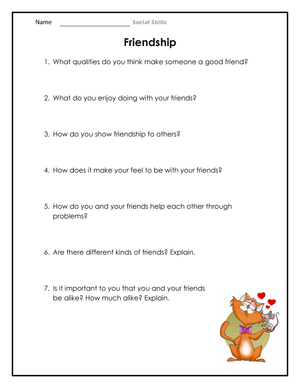
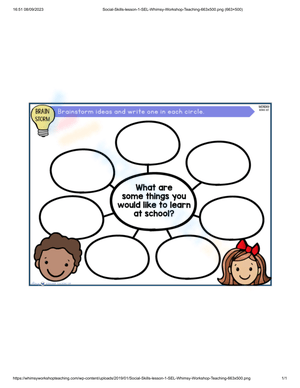
- Friendship behaviors: Sorting activities ask students to decide which actions bring people closer and which push them away, making the connection between behavior and relationship health visible.
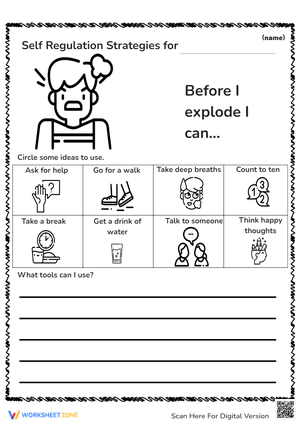
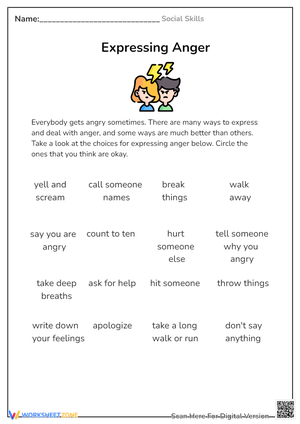
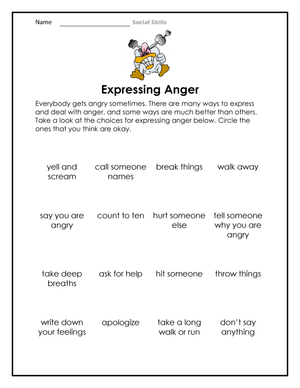
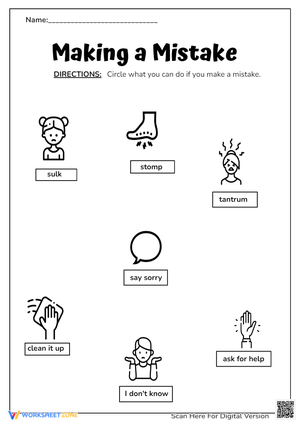
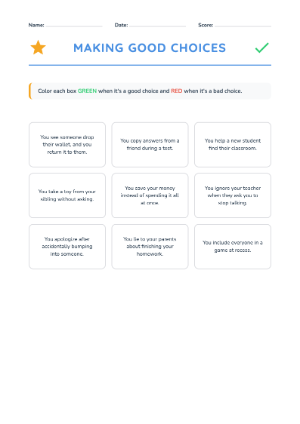
- Conflict resolution: Scenario-based exercises use a Stop, Think, Act sequence. Students circle the better choice from two options and explain why, connecting the cognitive step to the behavioral one.
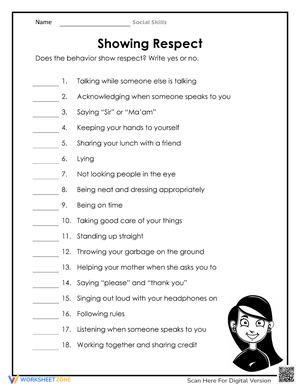
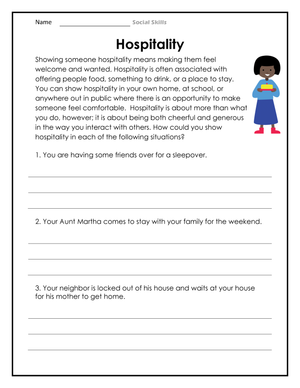
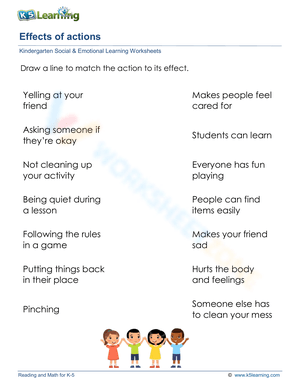
- Polite language in context: Rather than listing courtesy phrases in isolation, these activities match a social situation to the appropriate response, so students practice applying language, not just recognizing it.
Student Mistakes Worth Anticipating Before You Use These Worksheets
On emotion identification activities, students reliably distinguish "happy," "sad," and "angry" — but "frustrated" and "worried" produce consistent confusion. Most first graders write whichever word they recall first, not because they don't know both exist, but because they haven't yet separated those internal states in their own experience. A two-minute whole-class discussion before independent work — "frustrated is when you're trying hard and it isn't working; worried is when something bad might happen" — reduces that error significantly and makes the later self-management activities land with more accuracy.
On conflict resolution worksheets, a different and more instructionally important pattern appears: students circle the peaceful choice on the paper and then default to the impulsive or physical behavior at recess. The worksheet accurately records what they know. It does not record what they can execute under social pressure. That gap is normal at this age, and it is the honest argument for why written work alone isn't sufficient — the paper has to lead somewhere physical, a rehearsal, a script students can hear themselves saying out loud before they need it.
Building These Worksheets Into the Week Without Losing Instructional Time
The teachers who get the most out of this set use a single worksheet as a 7–10 minute morning meeting anchor rather than carving out a separate SEL block. Introducing an active listening worksheet on Monday and returning to it briefly on Thursday — asking students what they noticed about their own listening during the week — turns a one-off activity into a sustained behavioral focus. When a student interrupts during read-aloud, the redirect becomes "remember our listener checklist" instead of a generic correction, because the class has shared language to reference.
For the social skills for kids worksheets printable for 1st grade conflict scenarios specifically, pairing the written activity with immediate role-play is the move that makes the content transfer. After students circle the better choice in a "two kids want the same marker" scenario, two volunteers act it out using a soft object — a small ball or a marker cap — as a talking prop that signals whose turn it is to speak. Moving the lesson from the worksheet into three-dimensional practice gives the behavioral script somewhere to live in the body, which is where first graders actually retrieve it under pressure.
Standard Alignment
These worksheets align with the CASEL Core SEL Competencies, the primary framework adopted by most state SEL standards, many of which assign grade-band indicators at the K–2 level. The five competencies map directly to worksheet themes across the set. Self-awareness is addressed through emotion identification activities. Self-management is built through the Stop, Think, Act conflict sequence, where the "stop" step — the regulated pause — is the one first graders find hardest to execute in real time. Social awareness runs through every scenario worksheet that asks students to read a peer's expression or consider another point of view. Relationship skills anchor the friendship and polite language activities. Responsible decision-making is the explicit goal of the conflict resolution worksheets, where students weigh two choices and identify which one preserves the relationship. Teachers in states with formal SEL standards — including Illinois (ISBE SEL Standards), California (CA SEL Benchmarks), and New York (NYSED SEL Benchmarks) — find the coverage maps cleanly to K–2 benchmark language around identifying emotions and using problem-solving strategies in peer interactions.
Adjusting the Worksheets Across a Range of Learners
For students who are still building reading fluency, the visual-heavy worksheets — particularly the emotion identification and active listening sorting activities — work without modification to the core task. Reading scenario prompts aloud during small-group work removes the reading barrier while keeping the social thinking task fully intact. Students who are not yet writing can draw their responses in the answer box; the reasoning process is the same either way.
For students who move quickly through the core activities, the most productive extension is adding a language step after the written choice: ask them to write or dictate what they would actually say to the other person, using an "I feel _____ when _____ because _____" frame. That moves them from identifying the right action to rehearsing the specific words that accompany it — a meaningfully harder task. The social skills for kids worksheets printable for 1st grade format — short, visually anchored, scenario-based — also travels to special education pull-out settings and one-on-one counselor check-ins without structural changes, since each activity holds up outside the whole-class context it was designed for.
Frequently Asked Questions
What social skills should first graders work on first?
Emotion identification is the right starting point. Students who can't yet name what they're feeling struggle with every skill that follows — they can't regulate a feeling they haven't identified, and they can't work through a conflict when they don't know why they're upset. Once students build reliable vocabulary for the core emotions, including "frustrated," "worried," and "embarrassed" alongside the obvious four, the move into self-management and conflict resolution activities becomes considerably smoother.
How do these worksheets fit into a small-group intervention?
When a specific group of students is having recurring trouble — arguing consistently during partner reading, for example — pulling three or four of them to work through a relevant worksheet together is more targeted than whole-class re-teaching. The small-group setting lets the teacher ask "what would you do if this happened to you?" and move directly into role-playing without the self-consciousness of performing in front of the whole class. The social skills for kids worksheets printable for 1st grade conflict resolution activities are particularly well-suited to this format because the scenarios are short, concrete, and immediately recognizable to the students sitting in the circle.
Do students need to complete the worksheets in a particular order?
No — each worksheet stands alone and targets a discrete skill. That said, if a student is new to explicit social instruction, beginning with emotion identification builds the vocabulary that makes later scenario-based work more productive. Teachers with a formal SEL curriculum already in place typically match worksheet topics to whatever unit is currently underway rather than working through the set from start to finish.