1st Grade Social Skills for Autism Worksheets Printable
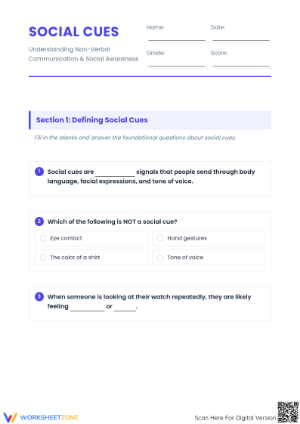
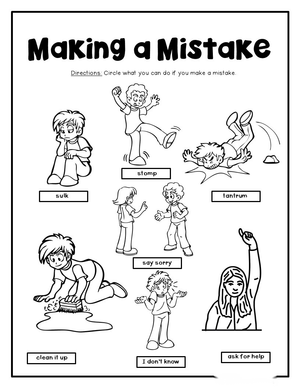
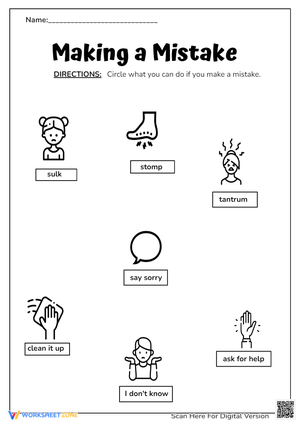
These 1st grade social skills for autism worksheets printable resources give special education teachers and speech-language pathologists structured, low-distraction activities built around the exact situations where 6- and 7-year-olds with autism most often struggle — lunch table conversations, recess entry, and partner work during centers. The set covers turn-taking, emotion recognition, personal space, and conversation initiation, pairing each concept with literal language and uncluttered visuals so cognitive demand stays on the social skill itself, not on decoding the task.
The Specific Skills Covered in Each Worksheet
The four core areas in this set reflect the social demands that increase sharply in first grade, when peer-directed interaction replaces teacher-managed play and implicit social expectations begin to carry real weight.
- Turn-taking and waiting: These worksheets break waiting into a visual sequence strip — "I watch, I wait, I go" — rather than presenting it as a single abstract rule. Students mark each step while tracing through a partner-play scenario, building a rehearsable procedure rather than an expectation they're supposed to absorb by instinct.
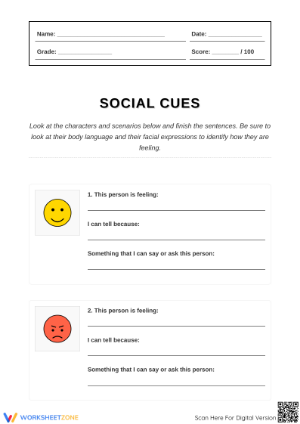
- Emotion identification: Activities progress from cartoon faces to photograph-based expressions, so students practice reading real features rather than stylized icons. One worksheet asks students to sort six facial photographs into labeled columns — a concrete matching task that builds vocabulary before asking for any interpretive judgment.
- Personal space: The personal space bubble format asks students to draw themselves at the center and shade the appropriate distance for three named settings: circle time, line-up, and the cafeteria. Naming each setting directly prevents the common gap between knowing the rule in the abstract and applying it in a specific location.
- Conversation initiation: Rather than prompting students to "be friendly," these worksheets provide exact starter phrases — "Can I play?" / "I like that too." / "Do you want to take turns?" — alongside a visual sequence showing a student speaking and a peer responding. Scripts this specific reduce the decision load that often freezes students at the moment of initiation.
Why This Format Works for This Population at This Age
At six and seven, neurotypical peer expectations accelerate quickly: collaborative centers, partner reading, and unstructured recess all demand rapid social reading that students with autism are actively working to develop. The Social Story framework — presenting a social situation as a predictable sequence of situation, thought, feeling, and action — converts ambiguous interactions into rehearsable steps. Each 1st grade social skills for autism worksheets printable in this set borrows that structure even when it isn't a traditional narrative, so students always move through a recognizable sequence rather than facing an open-ended task.
Visual design choices matter as much as content. Cognitive load research consistently shows that when background complexity increases, students with attention and processing differences lose track of the target concept. A worksheet asking students to identify which character "feels left out" works best when it shows one clear two-figure scene — not a busy illustration with ten children and playground equipment competing for attention. Every visual element either supports the lesson or works against it.
Frequent Student Errors Worth Watching For
The most consistent gap in student work is strong worksheet performance paired with no visible change in behavior. A student circles the correct emotion on every item, earns a checkmark, and then fifteen minutes later walks past a visibly distressed classmate without noticing. Worksheets build vocabulary and create visual anchors; generalization requires the teacher to make the connection explicit in the moment. When a student actually holds their personal space during morning line-up, name it: "That's your bubble — exactly what you practiced."
A second pattern appears on conversation initiation worksheets: students copy the starter phrase correctly in the written portion but deliver it in a flat, script-like way during role play, as if reading from a cue card. The worksheet gave them the words without the pragmatic context. A two-minute role play immediately after the paper task — before the student leaves the small group table — addresses this before rote delivery becomes a fixed habit.
On emotion identification tasks specifically, watch for students who memorize label-to-face pairings without reading the scenario. A student may reliably circle "angry" next to a frowning cartoon but mark "fine" when shown a photograph of a child whose face is neutral but whose body posture signals frustration. Adding simple body-language cues to the worksheet prompts prepares students for the more ambiguous signals they encounter with actual peers.
Working These Worksheets Into Your Daily Lesson Plan
The least effective use of these materials is dropping one on a student's desk as independent morning work with no prior instruction. The most productive sequence runs like this: a brief direct instruction model — five minutes, demonstrated with a paraprofessional or trained peer — followed immediately by the worksheet as a guided reference activity, then a structured practice moment such as a role play, a brief partner exchange at a play center, or a real transition where the target skill applies. The worksheet belongs in the middle of that sequence, not at the end.
For ongoing review, the minutes before high-demand transitions work well. Pulling out the personal space worksheet for two minutes before the class walks to lunch primes the student with a visual prompt right before the skill is needed — more effective than reviewing the same material during a calm, low-stakes period when the social demands feel abstract. Each 1st grade social skills for autism worksheets printable in this set rewards revisiting; the visual reference value grows as students encounter the real situations they've rehearsed on paper.
Consistency across the team is non-negotiable. If the worksheet uses the phrase "the three-step hello," that phrase should appear in the SLP's session notes, in the paraprofessional's prompting language, and on the communication log sent home. For students with autism, exact language matching is what allows a concept to transfer from one context to another — a well-meaning paraphrase from a different adult can genuinely disrupt that transfer.
Adjusting Each Worksheet for a Mixed-Ability Group
For non-verbal students or those using AAC systems, replace any write-in response with a visual choice set — three options maximum. The student points to or places the matching image rather than writing, but practices the same social reasoning. Make sure the symbols on the worksheet match the icon set already in use on the student's communication device; mismatched visuals create an unnecessary translation step at exactly the wrong moment.
For students who move through tasks quickly, extend the worksheet by asking them to generate a second scenario where the same skill applies, either drawn or dictated to a paraprofessional. This moves from surface recognition toward flexible application, which is the actual instructional goal. For students who find paper tasks inherently activating — some do, particularly those with negative histories around worksheets as evaluation tools — project the worksheet visual as a group discussion image and offer the printout as a take-home reference rather than a seat-work requirement. The social concept still gets taught; the format shifts to reduce avoidance.
Standard Alignment
These worksheets align with IEP goal areas under IDEA, specifically objectives targeting social interaction, communication initiation, and self-management. Common IEP objective language — "Student will initiate a greeting with a peer in 4 out of 5 observed opportunities" or "Student will identify the emotional state of a peer using contextual visual cues" — maps directly to the greeting and emotion identification worksheets in this set. In inclusive classrooms, the conversation and partner-work content also connects to CCSS Speaking and Listening standard SL.1.1, which calls for students to participate in collaborative conversations with partners and in groups. Teachers documenting social participation under both an IEP and grade-level standards can reference both frameworks without overreaching either one.
Frequently Asked Questions
Can these worksheets be used effectively in a general education inclusion setting?
Yes, with preparation. They work best in inclusion as part of a small-group pull-aside during centers, where a paraprofessional or co-teacher can run the direct instruction model described above. A 1st grade social skills for autism worksheets printable delivered without that model — placed on a desk while the rest of the class does something unrelated — loses most of its instructional value. Alignment between the classroom teacher and the support staff on vocabulary and visual cues is what makes it work across settings.
How do I involve families so practice carries over at home?
Send completed worksheets home with a brief note identifying the specific phrase the student is learning — not just the topic. If the worksheet uses "the bubble rule," write that phrase on the note. Parents who know the exact language can reinforce it during a playdate or a grocery store trip without realizing they're delivering instruction. The closer the home language mirrors the school language, the faster skills generalize beyond the classroom.
How should completed worksheets factor into progress monitoring?
Treat completed worksheets as documentation of exposure, not evidence of mastery. A strong result tells you the student can perform the recognition or sequencing task in a controlled, quiet setting. Actual progress monitoring for IEP social goals happens through observation data collected in natural settings — the hallway, the cafeteria, the playground — using tally sheets or time-sampling tools. Worksheets and observation data together give a far more accurate picture than either one alone.
Clear All