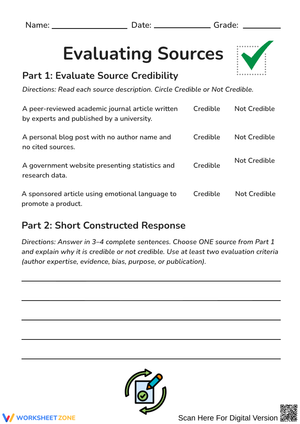
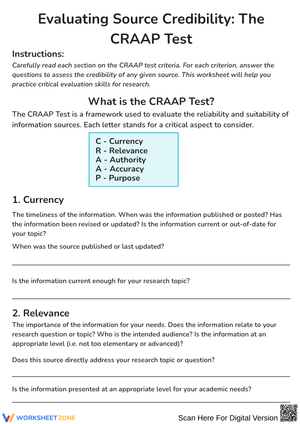
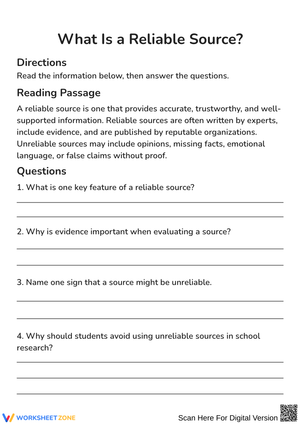
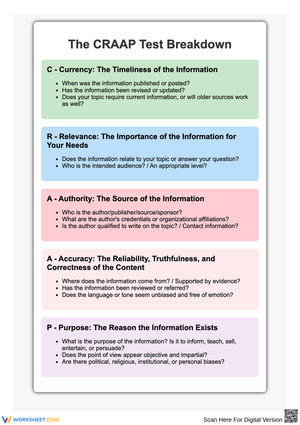
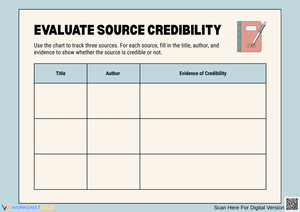
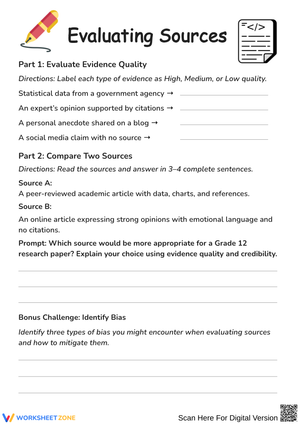
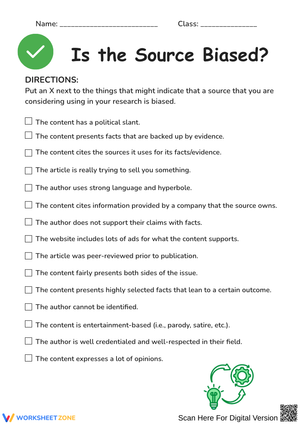
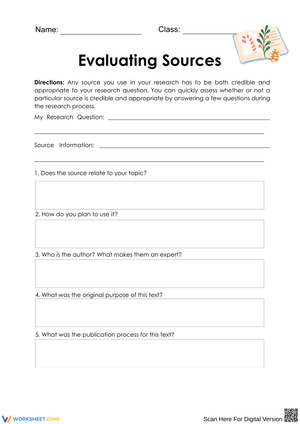
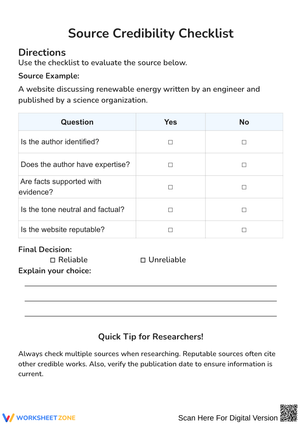
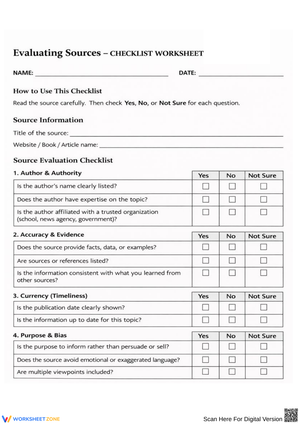
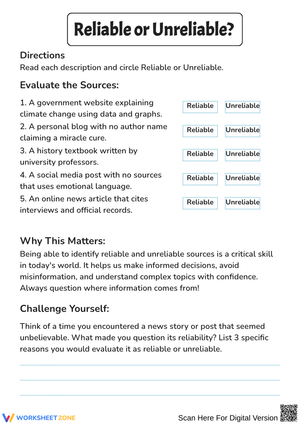
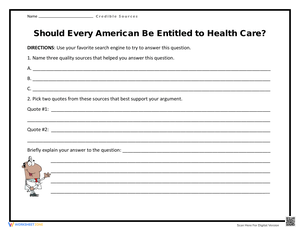
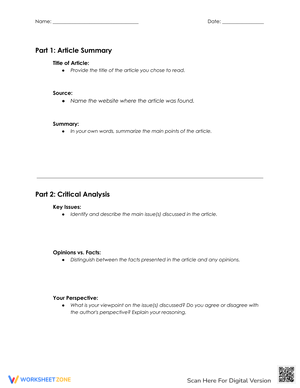
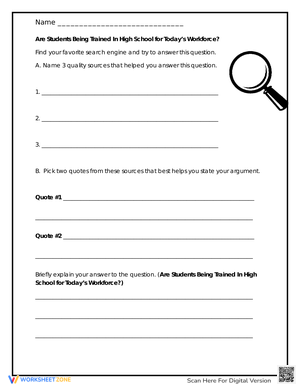
These assessing credibility of sources worksheets give students a repeatable, concrete process for vetting any text before it goes into a bibliography — news article, .gov report, peer-reviewed journal, blog post, or Wikipedia entry. The set covers the five CRAAP criteria, fact-vs.-opinion identification, author credential analysis, URL and domain reading, and omission bias detection. Each worksheet addresses one distinct skill so teachers can assign them in sequence during a research unit or pull individual worksheets when a specific gap shows up in student work.
The Specific Skills Targeted Across the Set
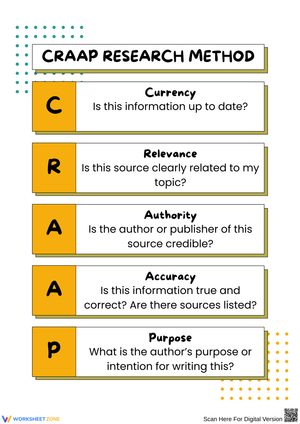
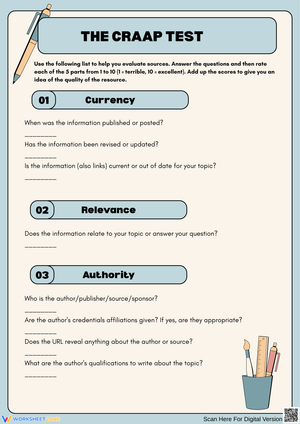
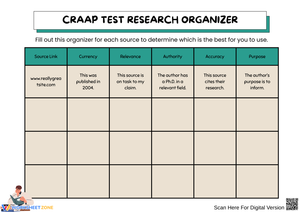
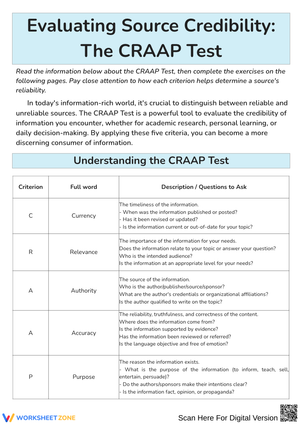
The CRAAP framework — Currency, Relevance, Authority, Accuracy, Purpose — forms the structural backbone of a significant portion of the set, with each criterion addressed in its own worksheet rather than compressed into a single checklist. That separation matters. Students who evaluate currency and relevance in isolation, before layering in authority and purpose, build cleaner analytical habits than students who rush through all five criteria at once. A currency evaluation, for instance, asks students not just to locate a publication date but to decide whether that date is material to their specific question — a 2009 article on the text of the Fourth Amendment holds up fine; a 2009 article on social media privacy law does not.
Fact-vs.-opinion sorting is a second major skill cluster. Students read short excerpts, underline phrases that carry interpretive weight rather than verifiable data, and rewrite those phrases in neutral language. Loaded adjectives — radical, common-sense, alarming — integrate smoothly into informational sentences, and students at every grade level read past them until they've had repeated practice stopping at evaluative language.
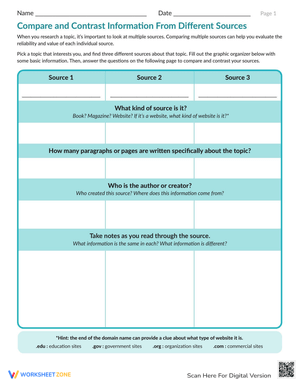
The digital source worksheets extend this work to URL structure, domain conventions, site design cues, and funding transparency. One worksheet asks students to locate the "About" or "Our Mission" page for three different organizations and note what each group says about its funding — and, equally important, what each one carefully avoids disclosing. That exercise teaches students to treat a strategic silence as a credibility signal, not just an oversight.
Frequent Errors to Watch For as Students Work Through the Set
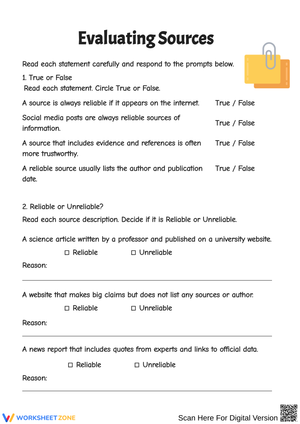
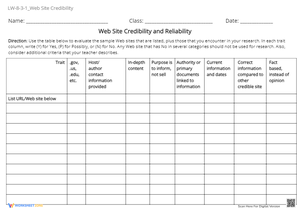
The most persistent mistake is treating the domain extension as a final verdict. Students mark ".gov — credible" and move on, which means they'll cite a government tourism bureau's promotional content with the same confidence they'd bring to a CDC study. These assessing credibility of sources worksheets counter this directly by including .org and .com sources that span the full reliability range — from peer-reviewed research hosted on a university's commercial subdomain to advocacy material dressed in reputable-looking nonprofit branding. Students discover quickly that the extension is a starting point, not a conclusion.
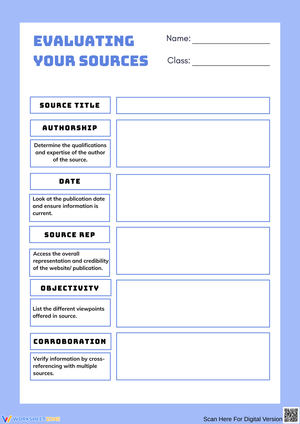
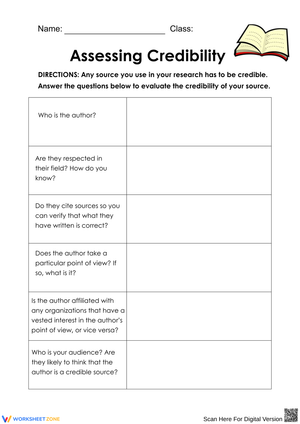
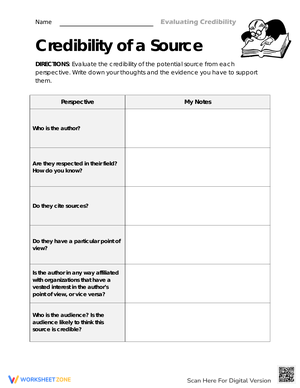
A second consistent pattern is conflating an author's name with that author's expertise. Students find a byline, write it in their notes, and consider the authority check complete. They haven't searched the person's professional record, haven't confirmed the article falls within that person's actual field, and haven't noticed that the same name appears on dozens of unrelated opinion posts published the same week. The credential worksheets push students past the name and toward verifiable professional history.
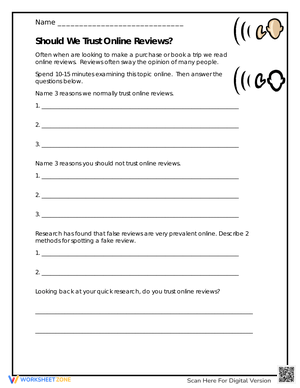
Students also struggle with omission bias — what the source doesn't say. They come to the task trained to identify false claims, not strategic silences. A worksheet that asks "What perspective is missing from this article?" often produces "none" from students who genuinely cannot see what's absent. Asking that question repeatedly, across different texts, is what eventually changes the habit.
Building These Worksheets Into a Research Unit
The most effective entry point is a shared class analysis of an obvious credibility failure — a satirical article, a heavily sponsored "informational" post, or a website that mimics the design of a legitimate news outlet but lacks any authored bylines. Running through one worksheet together as a class before students work independently sets the standard for the vocabulary and makes terms like bias, currency, and authority feel like working tools rather than test definitions.
Requiring students to submit a completed worksheet for every source they plan to cite builds accountability into the research process. Reviewing those worksheets during brief individual conferences reveals exactly where a student's evaluation breaks down — usually at authority or purpose — which is far more useful than discovering the problem at the essay-drafting stage. The ten minutes those conferences take pay for themselves.
A comparative exercise works particularly well with these assessing credibility of sources worksheets: provide two articles covering the same event — one from a wire service, one from a partisan outlet — and ask students to evaluate both. Students are often surprised that the less credible article scores higher on currency and even on surface-level authority indicators. That surprise is the pedagogical payoff. It teaches them that no single CRAAP criterion carries the full evaluation on its own.
Adjusting the Set for Different Learner Levels
For students new to research, narrow the entry point: assign the currency and relevance worksheets first, before introducing authority and purpose. Students still working to identify what a source is fundamentally about don't have the cognitive bandwidth to simultaneously assess authorial motive. Moving through the CRAAP criteria across separate worksheets in sequence, rather than all at once, prevents earlier learners from getting stuck on the evaluative steps before they're ready for them.
Students with stronger research backgrounds can move directly to the bias and omission worksheets, which demand more interpretive analysis. A useful extension: ask them to evaluate a source on their chosen topic, find a counter-source, and then compare both completed evaluations in a short written response. Comparing two finished evaluations against each other is where the skill becomes genuinely transferable rather than mechanical.
For English language learners, reducing the length of the reading excerpts used in bias exercises matters more than simplifying the analytical questions. The questions themselves are accessible; a 600-word excerpt dense with domain-specific vocabulary is the actual barrier. Shorter passages at the same analytical depth keep the focus on credibility evaluation rather than on decoding.
Standard Alignment
CCSS.ELA-LITERACY.WHST.6-8.8 asks students to "assess the credibility and accuracy of each source" — wording that maps directly onto the CRAAP framework these worksheets apply. In classroom terms, this standard is addressed during a research writing unit, and the worksheets give teachers a concrete, gradable artifact that demonstrates whether students are genuinely evaluating sources or simply listing them. CCSS.ELA-LITERACY.RI.8.8, which addresses evaluating argument and specific claims in informational text, aligns closely as well — particularly the worksheets that ask students to sort factual claims from editorial opinion and flag assertions that lack cited support.
Frequently Asked Questions
What grade levels do these worksheets suit best?
The skills addressed — CRAAP evaluation, bias detection, domain and URL literacy — are typically introduced in grades 6 and 7 and reinforced through high school. The currency and relevance worksheets work at the 5th-grade level during an introduction to research. The author credentials and purpose worksheets are better suited to grades 7 and above, when students are expected to conduct more independent inquiry and defend their source choices in writing.
Do students need prior knowledge of the CRAAP test before starting?
No prior exposure is needed. Each worksheet that applies a CRAAP criterion includes a working definition of that criterion as part of the prompt, so students encounter the vocabulary and apply it simultaneously. The framework operates as the structure of the exercise rather than as background knowledge students must bring in on their own.
How do these fit into a library or media literacy class?
They serve well as the applied practice component after direct instruction. A librarian or teacher introduces a concept — say, how an organization's funding source shapes its editorial stance — and the assessing credibility of sources worksheets give students immediate, low-stakes written practice with real or realistic texts during the same period or as a follow-up. Because each worksheet is standalone, they can be distributed one at a time at whatever pace the class sets, without committing to a pre-packaged sequence.












 Interactive Worksheet Maker
 Quiz Maker
 Word Search Maker
 Crossword Puzzle Maker
 Word Scramble Generator
 Sentence Scramble Generator
 Handwriting Worksheet Generator
 Name Tracing Generator
 Fill In The Blank Generator