




























0
Views
0
Downloads

0.0
0
Save
0 Likes
Share
Evaluating Credibility of Sources
0 Views
0 Downloads

Paste this activity's link or code into your existing LMS (Google Classroom, Canvas, Teams, Schoology, Moodle, etc.).
Students can open and work on the activity right away, with no student login required.
You'll still be able to track student progress and results from your teacher account.
Information
Description
What It Is:
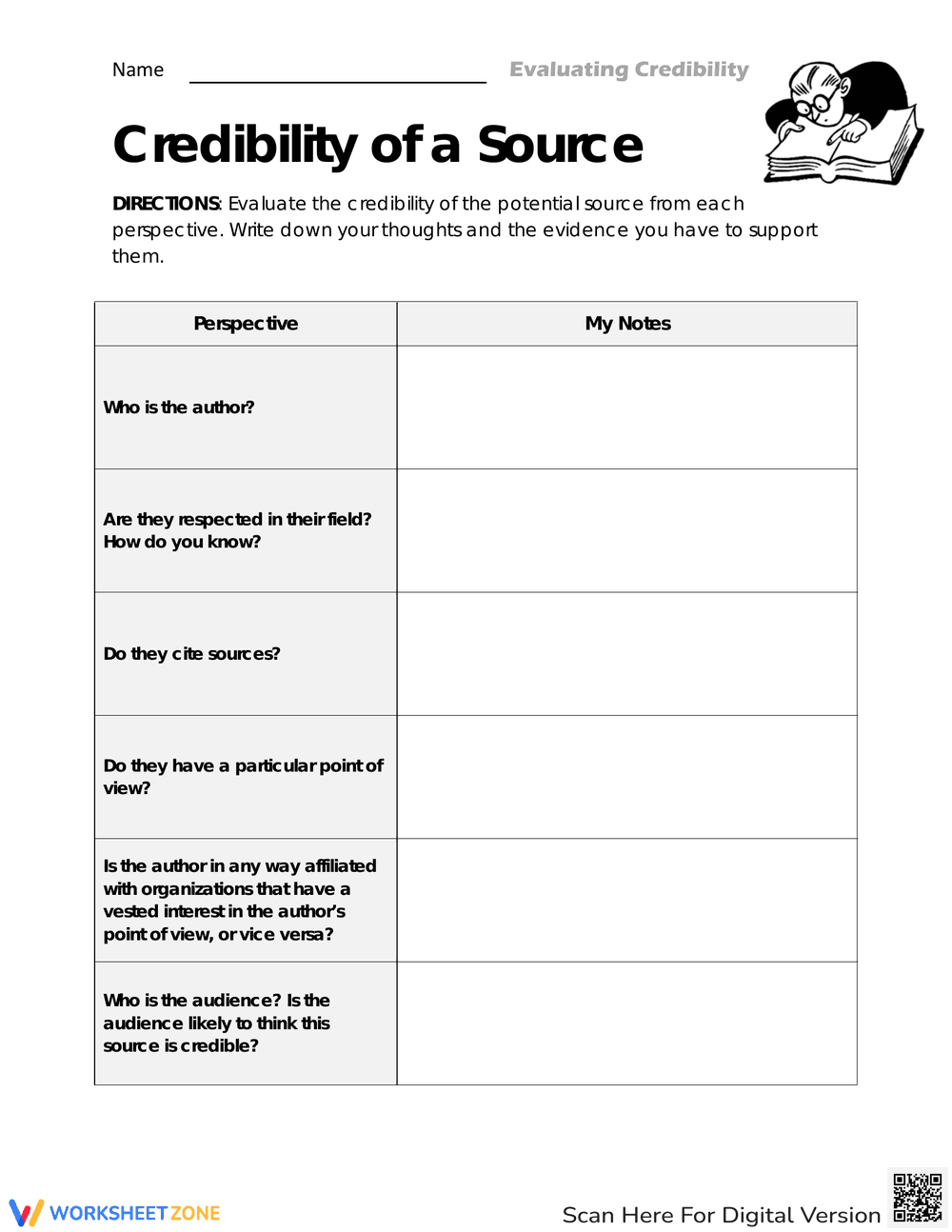
This is a worksheet titled 'Credibility of a Source'. It prompts students to evaluate the credibility of a potential source by considering different perspectives. The worksheet includes a table with 'Perspective' and 'My Notes' columns. The 'Perspective' column lists questions such as 'Who is the author?', 'Are they respected in their field? How do you know?', 'Do they cite sources?', 'Do they have a particular point of view?', 'Is the author in any way affiliated with organizations that have a vested interest in the author's point of view, or vice versa?', and 'Who is the audience? Is the audience likely to think this source is credible?'. Students are expected to write their thoughts and supporting evidence in the 'My Notes' column.
Grade Level Suitability:
This worksheet is suitable for grades 6-12. The concepts of source credibility, bias, and author's perspective are important critical thinking skills that are developed throughout middle and high school. The questions require students to analyze and evaluate information, making it appropriate for these grade levels.
Why Use It:
This worksheet helps students develop critical thinking and research skills by prompting them to evaluate the credibility of sources. It encourages them to consider the author's background, potential biases, and the intended audience, leading to a more informed understanding of the information presented. It promotes media literacy and responsible information consumption.
How to Use It:
Provide students with a source (article, website, video, etc.). Have them read or view the source and then use the worksheet to evaluate its credibility. Students should answer each question in the 'Perspective' column and provide supporting evidence in the 'My Notes' column. Encourage students to discuss their findings and compare their evaluations with others.
Target Users:
The target users are middle and high school students learning about research skills, media literacy, critical thinking, and source evaluation. Teachers can use this worksheet as part of a lesson on research, writing, or current events. Librarians can also use it to teach information literacy skills.
This is a worksheet titled 'Credibility of a Source'. It prompts students to evaluate the credibility of a potential source by considering different perspectives. The worksheet includes a table with 'Perspective' and 'My Notes' columns. The 'Perspective' column lists questions such as 'Who is the author?', 'Are they respected in their field? How do you know?', 'Do they cite sources?', 'Do they have a particular point of view?', 'Is the author in any way affiliated with organizations that have a vested interest in the author's point of view, or vice versa?', and 'Who is the audience? Is the audience likely to think this source is credible?'. Students are expected to write their thoughts and supporting evidence in the 'My Notes' column.
Grade Level Suitability:
This worksheet is suitable for grades 6-12. The concepts of source credibility, bias, and author's perspective are important critical thinking skills that are developed throughout middle and high school. The questions require students to analyze and evaluate information, making it appropriate for these grade levels.
Why Use It:
This worksheet helps students develop critical thinking and research skills by prompting them to evaluate the credibility of sources. It encourages them to consider the author's background, potential biases, and the intended audience, leading to a more informed understanding of the information presented. It promotes media literacy and responsible information consumption.
How to Use It:
Provide students with a source (article, website, video, etc.). Have them read or view the source and then use the worksheet to evaluate its credibility. Students should answer each question in the 'Perspective' column and provide supporting evidence in the 'My Notes' column. Encourage students to discuss their findings and compare their evaluations with others.
Target Users:
The target users are middle and high school students learning about research skills, media literacy, critical thinking, and source evaluation. Teachers can use this worksheet as part of a lesson on research, writing, or current events. Librarians can also use it to teach information literacy skills.


