What Alphabetical Order Worksheets Actually Teach
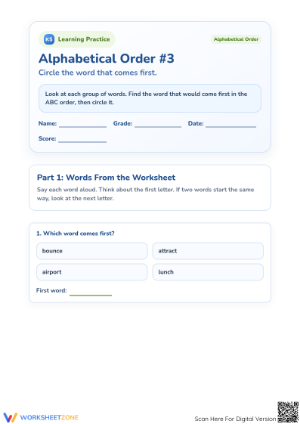
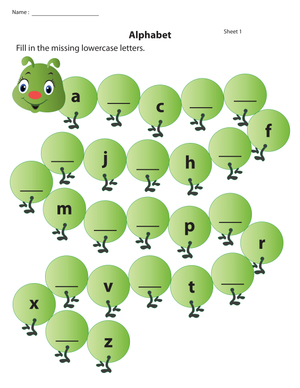
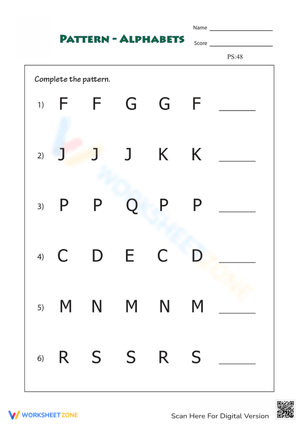
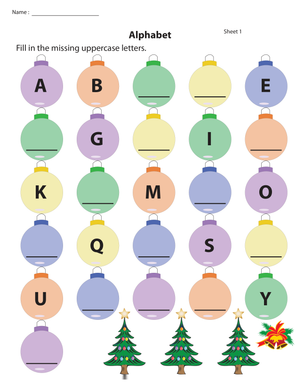
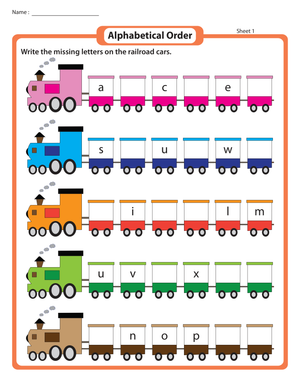
Alphabetical order worksheets do more than drill the ABCs. In a K-3 classroom, they build the sequencing logic students need to find words in a dictionary, scan a glossary, and later work through a library catalog. When you hand a first grader a list of words to sort by first letter, you're really teaching them to hold the alphabet in working memory and compare letters position by position.
These worksheets fit naturally into literacy blocks because they're quick, low-prep, and easy to check. Most run five to fifteen minutes, which makes them ideal for morning warm-ups, center rotations, and early-finisher tasks. As the year goes on, the same routine can carry harder lists, so the format stays familiar even as the challenge climbs. The best sets move students along a clear skill ladder instead of repeating the same first-letter sort all year.
Grade-by-Grade Progression: First Letter to Guide Words
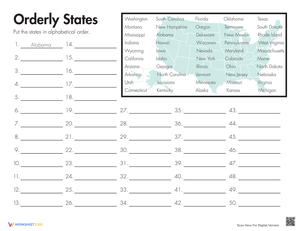
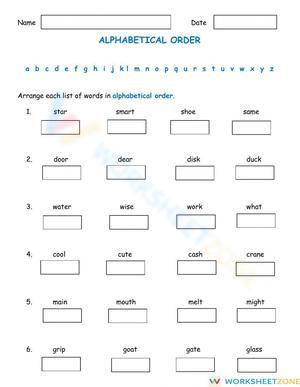
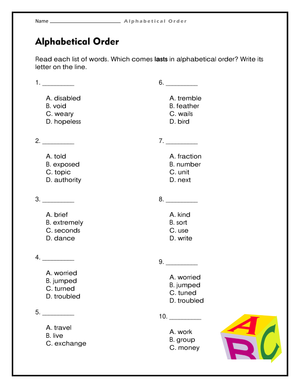
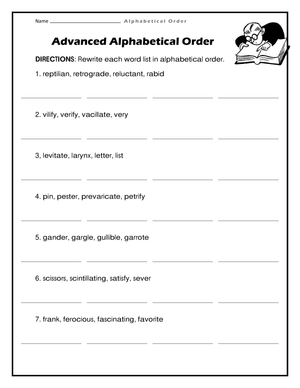
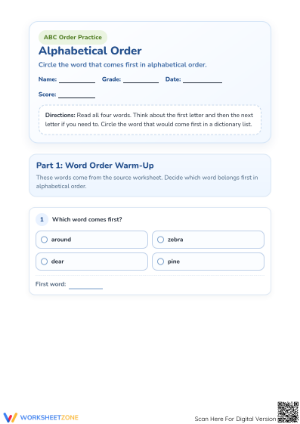
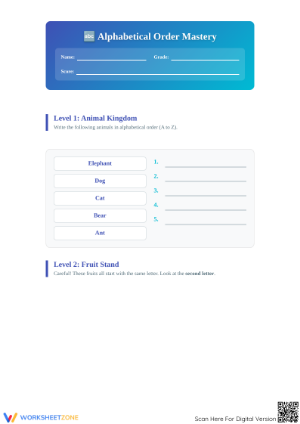
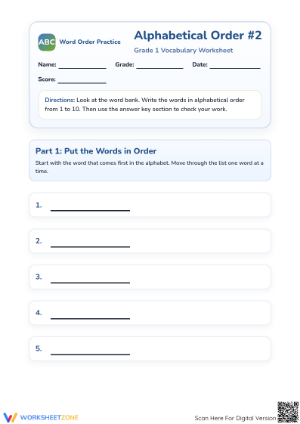
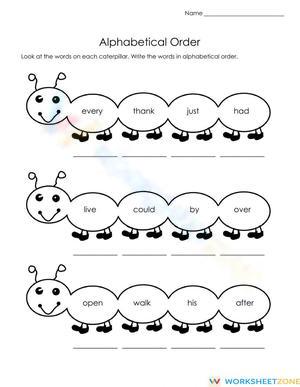
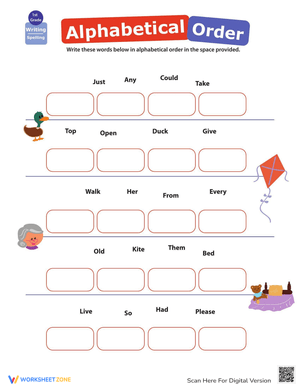
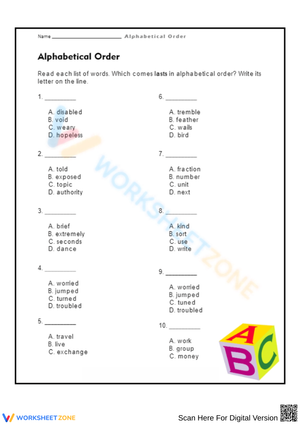
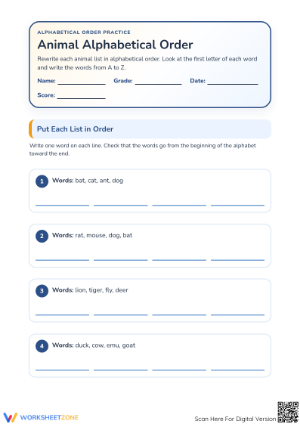
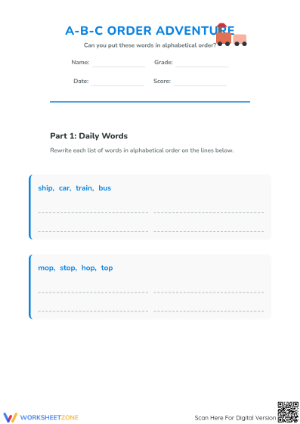
Alphabetizing gets harder in predictable stages, and matching the worksheet to the stage keeps students challenged without frustrating them. In grade 1, students sort words that all start with different letters, so they only compare the first letter of each word. By grade 2, lists include words that share a first letter, forcing students to look at the second and third letters to decide order.
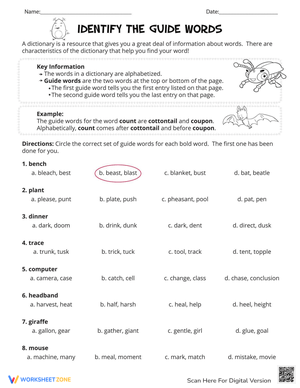
Grade 3 pushes into guide words: the two words printed at the top of a dictionary page that show the first and last entries. Students practice deciding whether a target word would fall on a given page. This is where alphabetical order stops being an isolated skill and becomes a reference tool.
Grade 2 students work toward using beginning dictionaries to check and correct spellings, while grade 3 students alphabetize by the first two or three letters and use guide words. This progression from letter sorting to guide-word fluency unfolds over two years, with each grade building on the skills the previous one introduced.
Building Toward Dictionary and Reference Skills
The real payoff of alphabetizing shows up when students open a dictionary or scan a glossary at the back of a science text. Guide word activities, where students match a word to the page it would appear on, are the bridge. A worksheet might list the guide words garden and grape and ask whether goat belongs on that page. Students have to compare second and third letters against both boundaries at once.
Once students can handle guide words on paper, transfer the skill to real books. Keep a few beginning dictionaries and a classroom thesaurus at the center where students finish an alphabetizing sheet, then have them look up two or three words they just sorted. This closes the loop between the worksheet and the tool it prepares them for.
The same skill scales up beyond the dictionary. Library catalogs, indexes, and the glossaries in content-area textbooks all rely on alphabetical order, so the minutes students spend sorting word lists pay off across every subject. Pointing out these connections helps students see alphabetizing as a research tool, not a worksheet chore, which raises the stakes just enough to keep them focused.
Classroom Implementation
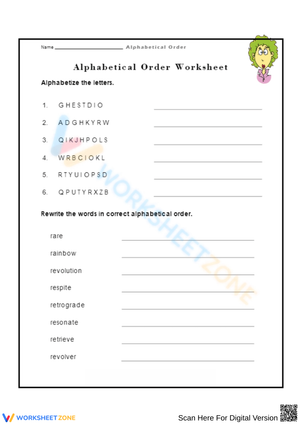
Alphabetical order worksheets work best when they're woven into routines rather than assigned as one-off busywork. Slot a short sort into your morning warm-up so students walk in, sit down, and start ordering a list of five to eight words before announcements. Use a longer guide-word sheet as one station in a literacy center rotation, paired with a dictionary for immediate application.
Here's a pattern worth watching for: students who alphabetize accurately by first letter but stall on same-first-letter lists are almost always skipping the second-letter comparison, not misremembering the alphabet. When you see a student order sun, sit, sad as if the S alone decides it, the fix isn't more alphabet practice. It's a targeted worksheet built entirely from same-first-letter words, which forces the second- and third-letter comparison students must master by grade 2. Diagnosing that single error saves weeks of the wrong intervention.
For small-group intervention, pull the three or four students who miss second-letter ordering and work a single focused sheet together, narrating your thinking aloud as you compare letters. Ten minutes of guided practice usually resets the habit.
Frequently Asked Questions
1. What grade level is best for introducing alphabetical order worksheets?
Most teachers introduce first-letter sorting in grade 1, move to second- and third-letter ordering in grade 2, and add dictionary guide words in grade 3. Kindergarten students can start with letter sequencing, but formal alphabetizing of word lists usually lands in grades 1 through 3.
2. How does alphabetical order practice connect to dictionary guide word skills?
Guide words are simply alphabetizing applied to a real page. Once students can order words by their second and third letters, they can decide whether a target word falls between the two guide words at the top of a dictionary page. That's why guide-word sheets sit at the top of the skill ladder.
3. How can teachers differentiate these worksheets for mixed-ability classrooms?
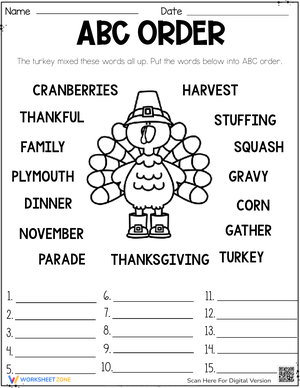
Adjust the first letters. Different-first-letter lists suit beginners, while same-first-letter lists that force second- and third-letter comparison challenge advanced students. Varying the format between cut-and-glue sorting, list reordering, and guide-word matching lets every student work the same skill at the right level.
4. Which standards align with alphabetical order and dictionary skills?
Grade 2 students work toward using beginning dictionaries to check and correct spellings, while grade 3 students alphabetize by the first two or three letters and use guide words. This two-year progression gives a clear framework for sequencing your worksheets.
5. How often should alphabetizing be practiced or assessed in the classroom?
Short, frequent practice beats long sessions. A two- to three-minute sort two or three times a week keeps the skill sharp, and a quick six-word check every couple of weeks gives you enough formative data to group students without turning alphabetizing into a unit of its own.












 Interactive Worksheet Maker
 Quiz Maker
 Word Search Maker
 Crossword Puzzle Maker
 Word Scramble Generator
 Sentence Scramble Generator
 Handwriting Worksheet Generator
 Name Tracing Generator
 Fill In The Blank Generator