


























Views
Downloads

Printable Alphabetical Order Worksheet | Grade 1 ELA
Paste this activity's link or code into your existing LMS (Google Classroom, Canvas, Teams, Schoology, Moodle, etc.).
Students can open and work on the activity right away, with no student login required.
You'll still be able to track student progress and results from your teacher account.
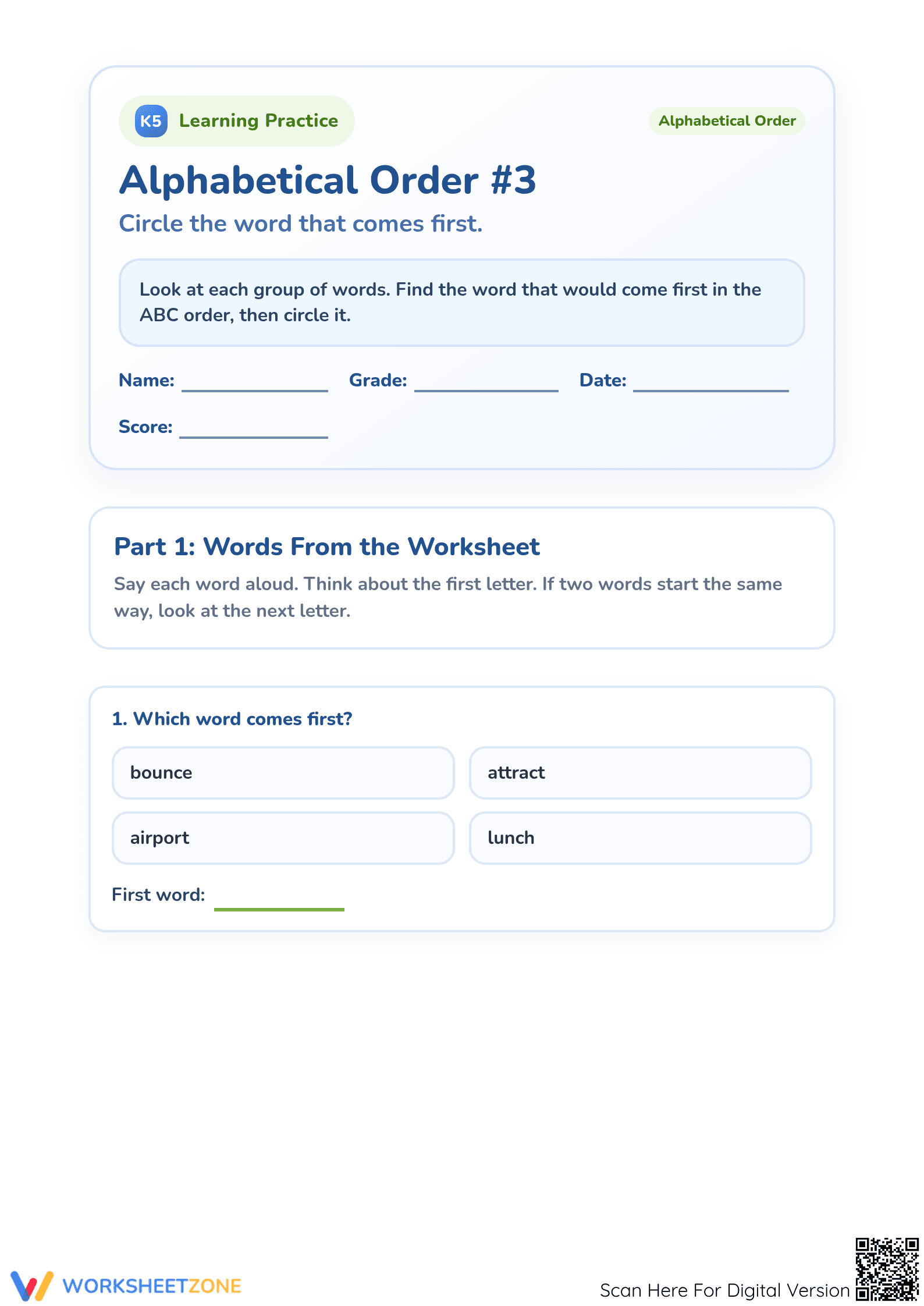
Mastering alphabetical order is a foundational literacy skill that streamlines how students interact with dictionaries, glossaries, and organized data. This Grade 1 ELA worksheet provides targeted practice in identifying which word comes first in a series, helping learners strengthen their letter-sequence recognition and early reference skills through structured word analysis.
At a Glance
- Grade: 1 · Subject: English Language Arts (ELA)
- Standard:
CCSS.ELA-LITERACY.L.1.4— Use context clues and alphabetical sequence to determine word meaning and placement- Skill Focus: Alphabetical ordering (ABC order)
- Format: 4 pages · 12 problems · Answer key included · PDF
- Best For: Literacy centers and independent skill practice
- Time: 15–20 minutes
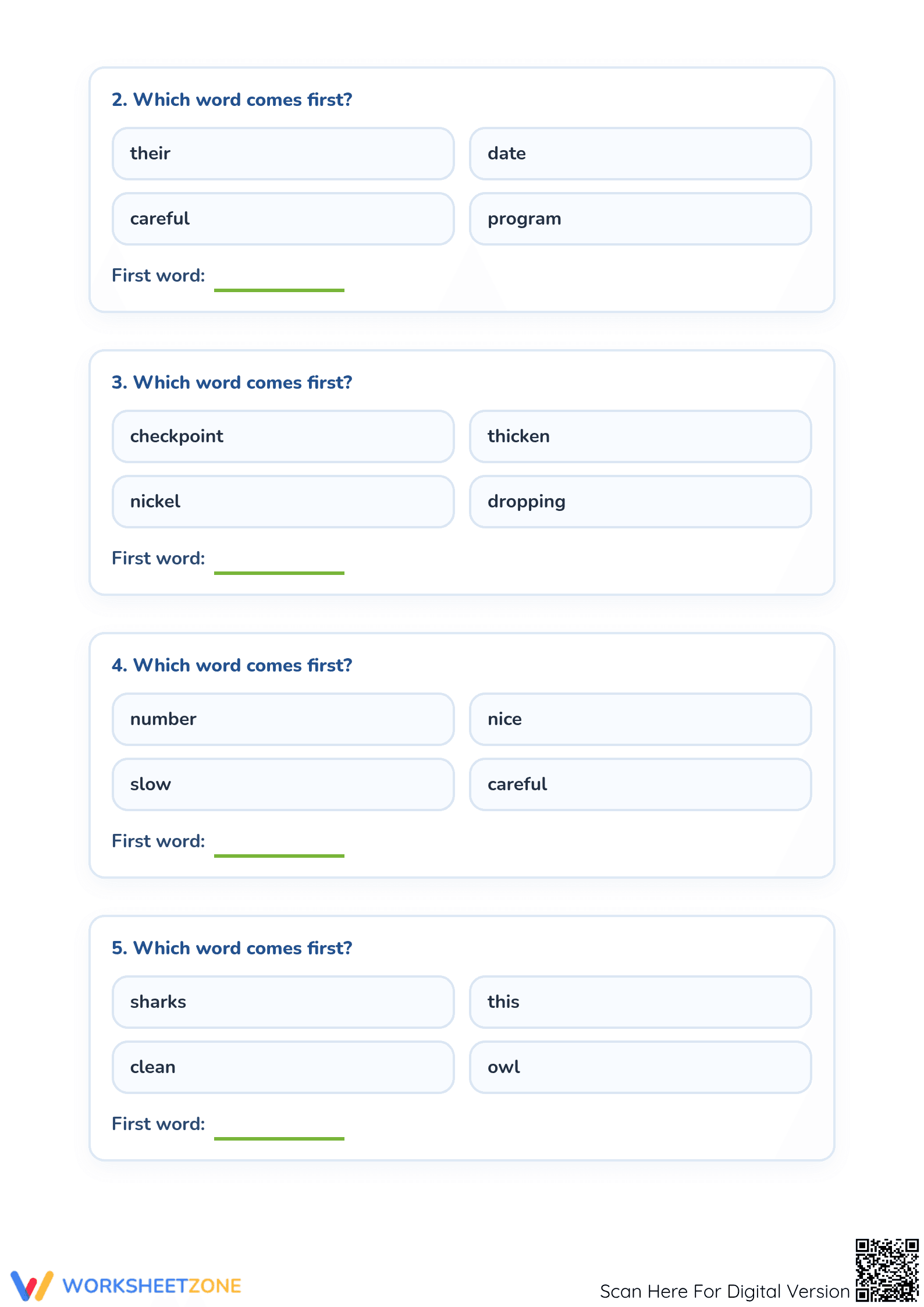
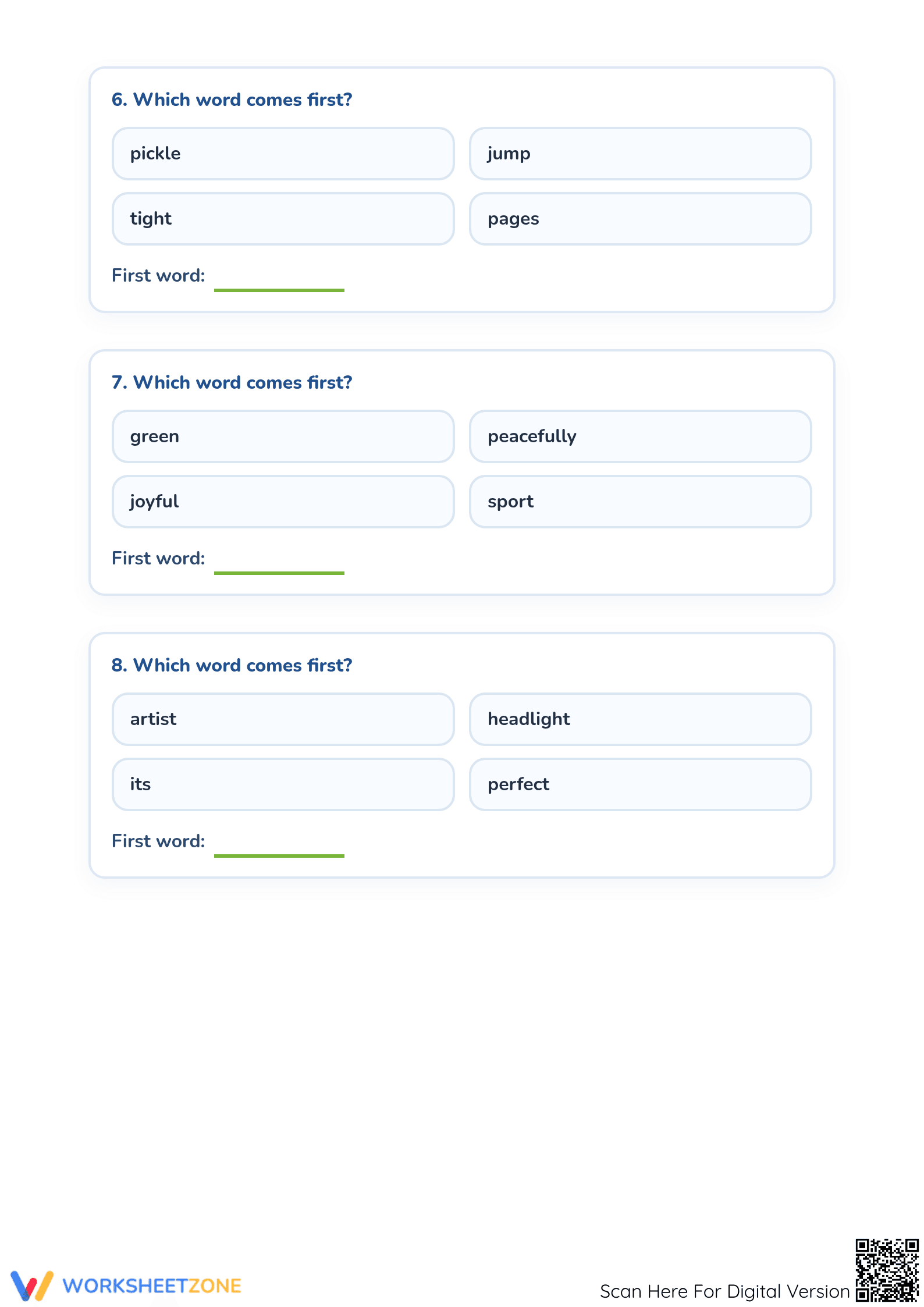
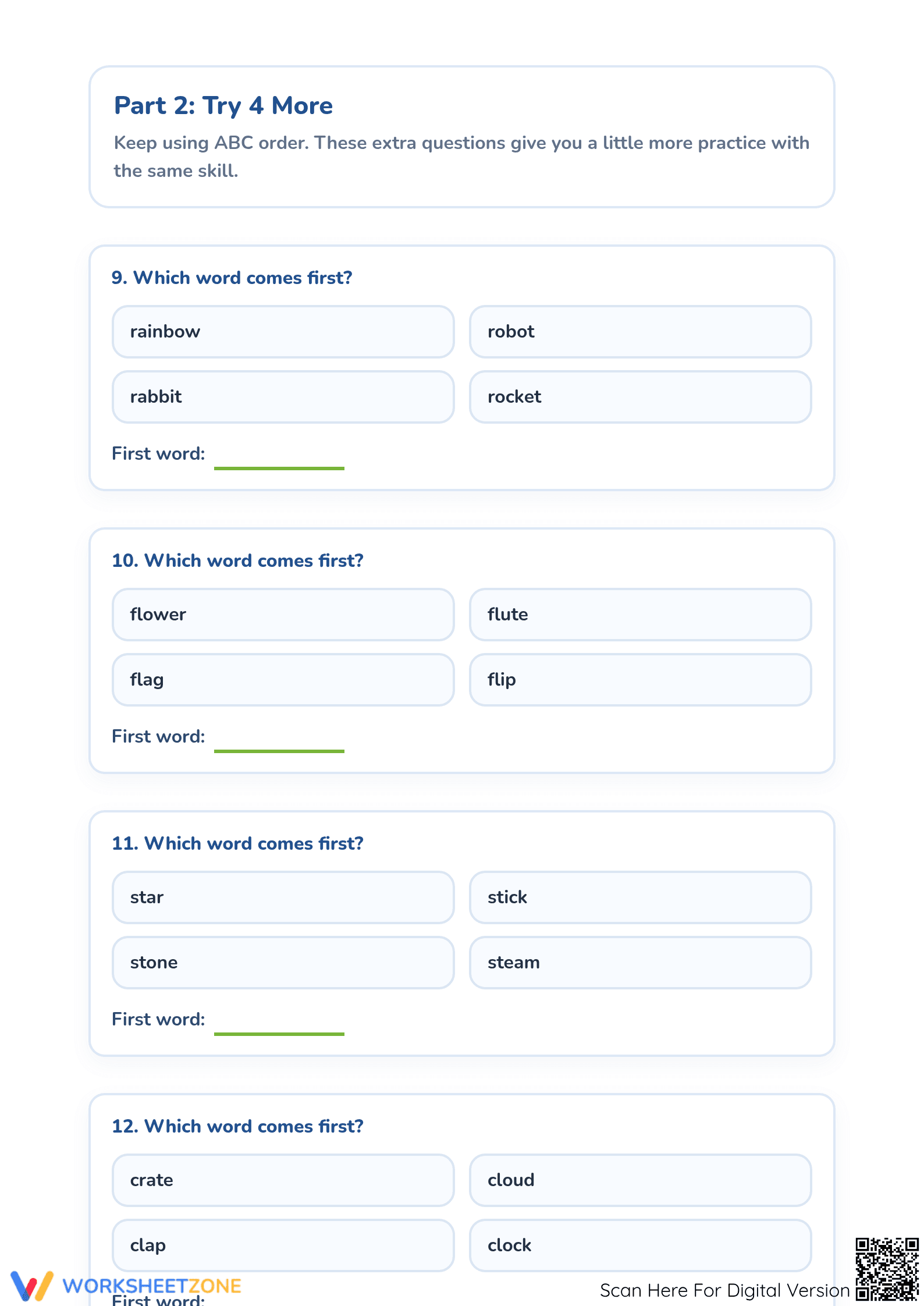
What's Inside: This comprehensive 4-page PDF contains 12 distinct practice blocks. Each task asks students to evaluate four related words and determine which one appears first in the alphabet. The first three pages focus on words with unique starting letters, while the final page introduces a challenge by grouping words that share the same initial character, requiring students to look at the second letter for correct sequencing.
Skill Progression
- Guided Practice: The first 4 problems feature high-frequency words with clearly different starting letters (e.g., attract vs. bounce), allowing students to focus on the primary alphabet sequence.
- Supported Practice: Problems 5 through 8 transition into longer words and more varied phonetic patterns, encouraging students to subvocalize the alphabet while scanning choices.
- Independent Practice: The final 4 challenge questions group words by the same starting letter (e.g., rainbow, rabbit, robot, rocket), forcing students to apply the rule of looking at the second letter for precision.
This layout follows a gradual-release model, moving from basic recognition to nuanced secondary-letter analysis.
Standards Alignment
The primary focus aligns with `CCSS.ELA-LITERACY.L.1.4`, which requires students to determine or clarify the meaning of unknown and multiple-meaning words and phrases by using a variety of strategies, including alphabetization. This resource also supports foundational reading standards by requiring active decoding of 48 unique words. Both standard codes can be copied directly into lesson plans, IEP goals, or district curriculum mapping tools.
How to Use It
This worksheet is ideal for use during the independent practice portion of a literacy block. Teachers can distribute it after a direct instruction session on the "ABC Rule." Use the challenge page (Part 2) as a formative-assessment tool: observe if students are correctly identifying that "rabbit" comes before "rainbow" by checking the second and third letters. Expected completion time ranges from 15 to 20 minutes depending on reading speed.
Who It's For
While designed for Grade 1 students, this resource is highly effective for second-grade review or for ELL students building English vocabulary. It pairs naturally with a classroom anchor chart showing the full alphabet or a grade-level reading passage where students can find and list words to practice their own ABC sorting.
According to RAND AIRS 2024, systematic practice in foundational literacy skills like alphabetical order significantly improves a student's ability to navigate complex informational texts later in their academic career. This worksheet addresses the core requirement of CCSS.ELA-LITERACY.L.1.4 by providing 12 repetitions of the sequencing task, moving from simple initial-letter identification to complex multi-letter comparison. Fisher & Frey (2014) emphasize that such structured practice is essential for moving students toward independent mastery of language conventions. By focusing on 48 high-frequency words across a 4-page spread, the resource ensures that the cognitive load remains focused on the ordering skill rather than vocabulary struggles. This balance allows for efficient formative assessment and clear evidence of student progress in literacy foundational skills.


