


























Views
Downloads


Essential Alphabet Tracing & IPA Guide | Grade K-1
Paste this activity's link or code into your existing LMS (Google Classroom, Canvas, Teams, Schoology, Moodle, etc.).
Students can open and work on the activity right away, with no student login required.
You'll still be able to track student progress and results from your teacher account.
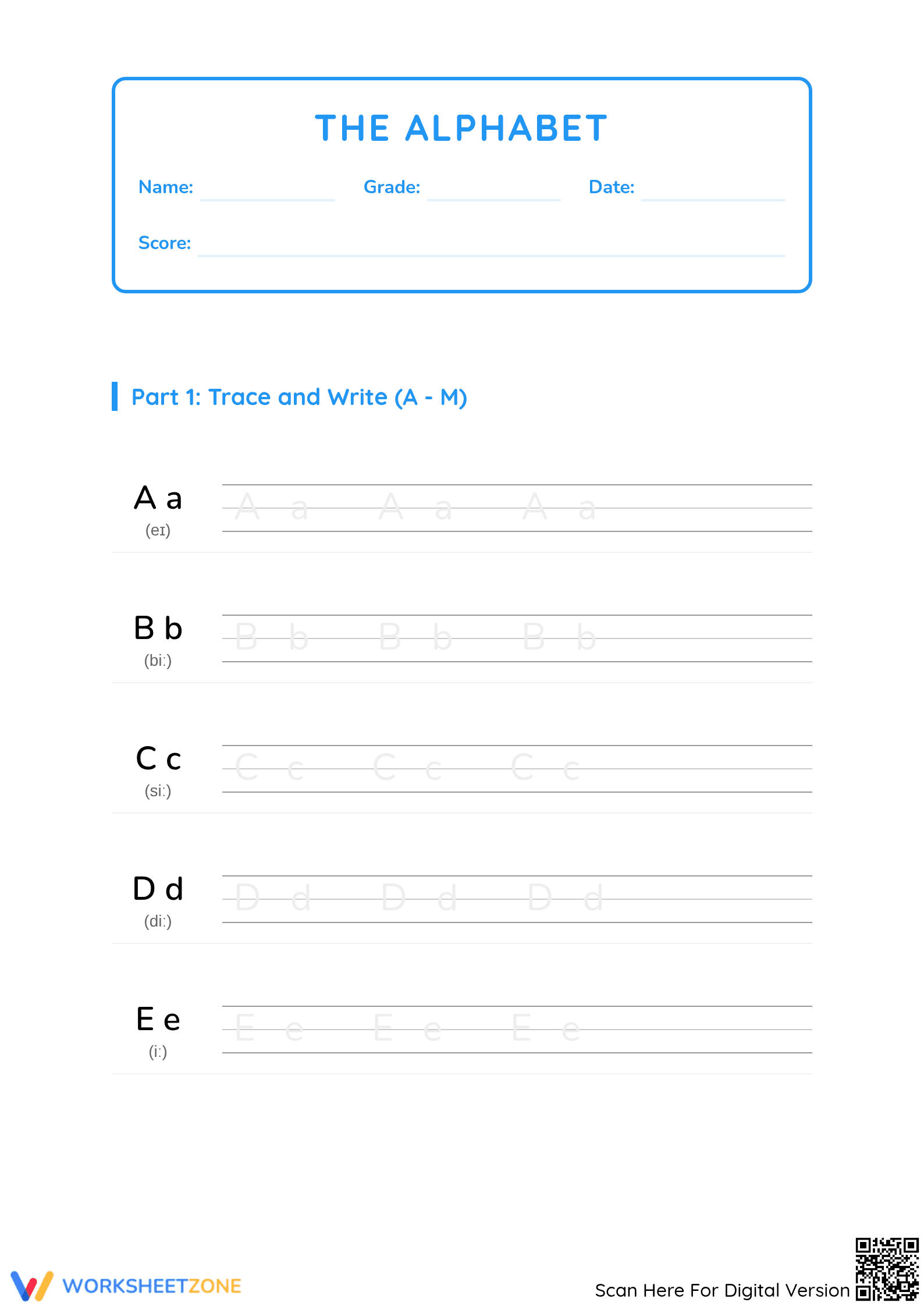
This comprehensive alphabet learning packet helps early learners master letter formation while introducing phonetic sounds through IPA notation. Students practice writing uppercase and lowercase letters with guided tracing lines, ensuring they develop the fine motor skills necessary for legible handwriting. By combining visual recognition with tactile practice, this resource builds a strong literacy foundation.
At a Glance
- Grade: Kindergarten · Subject: English Language Arts
- Standard:
CCSS.ELA-LITERACY.L.K.1.A— Print many upper- and lowercase letters with proper form and orientation- Skill Focus: Letter formation and phonetic recognition
- Format: 5 pages · 39 tasks · Answer key included · PDF
- Best For: Daily morning work or phonics centers
- Time: 15–20 minutes per page
The packet contains five structured pages. The first four pages focus on the "Trace and Write" method, covering the full alphabet from A to Z. Each letter includes a dedicated tracing line for both cases and the International Phonetic Alphabet (IPA) symbol to assist with correct pronunciation. The final page features a "Fill in the Missing Letters" assessment to verify alphabetical sequence mastery.
This resource is designed for a zero-prep workflow. First, print the five-page PDF in less than 30 seconds. Next, distribute the specific letter range currently being taught in your curriculum, which takes about 1 minute. Finally, use the included answer key to quickly review student work or allow for self-correction during independent center time, requiring only 1 minute of teacher oversight.
This worksheet aligns primarily with `CCSS.ELA-LITERACY.L.K.1.A`, which requires students to print many upper- and lowercase letters. It also supports RF.K.1.D by reinforcing the recognition and naming of all letters. Both standard codes can be copied directly into lesson plans, IEP goals, or district curriculum mapping tools.
Use this as a formative assessment after introducing a new letter sound. Observe students' pencil grip and stroke direction as they trace. It also functions well as a quiet-time activity or a supplemental packet for ESL students who need to bridge the gap between their native phonology and English letter sounds. Expect students to complete one page in approximately 15 to 20 minutes.
This is ideal for Kindergarten and Grade 1 students, particularly those requiring extra handwriting support. It serves as a natural pairing resource for phonics anchor charts or direct instruction lessons on the alphabet. The inclusion of IPA makes it uniquely valuable for English Language Learners (ELL) and speech therapy sessions.
According to research from Fisher & Frey (2014) on the gradual release of responsibility, structured tracing provides the necessary scaffolding for early writers to transition from guided to independent letter production. This worksheet implements that evidence-based approach by providing clear visual cues for CCSS.ELA-LITERACY.L.K.1.A. By integrating the International Phonetic Alphabet (IPA), the resource addresses the phonological awareness requirements essential for decoding. Studies from EdReports 2024 emphasize that high-quality foundational materials must balance mechanical writing skills with phonetic understanding to ensure long-term literacy success. This 5-page packet offers 39 specific tasks that reinforce the relationship between graphemes and phonemes. Educators can utilize these printable pages to document student progress in fine motor development and alphabetical sequencing, providing tangible evidence for mastery of Kindergarten and Grade 1 standards. The clear layout and zero-prep design make it a reliable tool for diverse classroom settings.


