


























Views
Downloads

Grade K Missing Letters — Printable No-Prep Worksheet
Paste this activity's link or code into your existing LMS (Google Classroom, Canvas, Teams, Schoology, Moodle, etc.).
Students can open and work on the activity right away, with no student login required.
You'll still be able to track student progress and results from your teacher account.
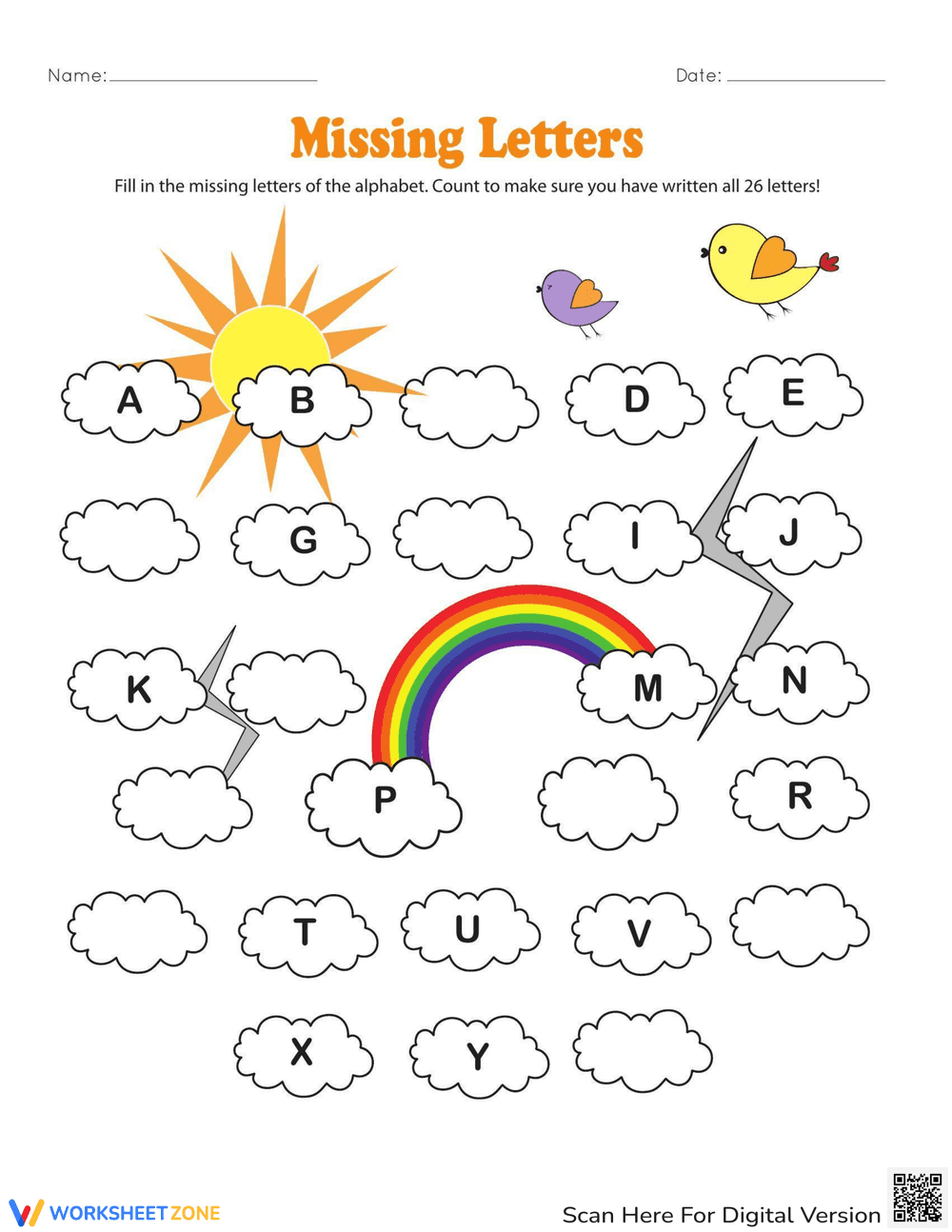
This printable Kindergarten ELA worksheet helps students practice uppercase alphabet sequencing by filling in missing letters. Young learners build foundational handwriting and letter recognition skills as they complete the A to Z cloud sequence, ensuring they can confidently print standard English characters in order.
At a Glance
- Grade: K · Subject: ELA
- Standard:
CCSS.ELA-LITERACY.L.K.1.A— Print many upper- and lowercase letters.- Skill Focus: Alphabet sequencing and letter writing
- Format: 1 page · 11 problems · Answer key included · PDF
- Best For: Independent practice and morning work
- Time: 10–15 minutes
Inside this single-page PDF, educators will find a visually engaging alphabet sequence activity featuring 26 clouds. Students must identify and write the 11 missing uppercase letters to complete the sequence from A to Z. The worksheet includes clear visual cues, such as a sun and rainbow, to keep young learners engaged. A complete answer key is provided for quick grading.
Zero-Prep Workflow
- Print (1 minute): Generate the PDF and print a class set directly from your computer.
- Distribute (1 minute): Hand out the single-page activity during morning arrival or literacy centers.
- Review (3 minutes): Use the included answer key to quickly check student sequences.
Total teacher prep time is under two minutes. The self-explanatory instructions make this resource highly suitable for emergency sub plans or independent station work.
Standards Alignment
This activity aligns directly with CCSS.ELA-LITERACY.L.K.1.A, requiring students to print many upper- and lowercase letters. By filling in the missing gaps, students demonstrate their grasp of standard alphabetical order and proper uppercase letter formation. Both standard codes can be copied directly into lesson plans, IEP goals, or district curriculum mapping tools.
How to Use It
Deploy this worksheet during morning work to establish a calm, productive routine as students arrive. Alternatively, use it as an independent literacy center activity following direct instruction on the alphabet song. As a formative assessment observation tip, watch students' pencil grip and stroke direction as they form the missing letters like C, F, H, L, O, Q, S, and W. Expected completion time ranges from 10 to 15 minutes.
Who It's For
This resource is designed for Kindergarten students mastering their uppercase alphabet. For students needing extra support, provide an alphabet strip or anchor chart at their desk to reference while working. Advanced learners can be challenged to write the corresponding lowercase letter next to each uppercase cloud. Pair this worksheet with a whole-group reading of an alphabet picture book or a direct instruction lesson on letter sounds.
Mastering alphabet sequencing and letter formation is a critical early literacy milestone for young learners. According to a recent EdReports 2024 analysis, explicit practice with letter writing significantly improves phonics acquisition and reading fluency in early elementary grades. This worksheet directly supports CCSS.ELA-LITERACY.L.K.1.A by requiring students to print many upper- and lowercase letters accurately within a structured sequence. When young learners physically write missing letters to complete the alphabet, they reinforce their orthographic mapping skills and build the muscle memory necessary for fluent handwriting. Consistent, targeted practice with resources like this missing letter activity ensures students develop the automaticity required to tackle more complex decoding and encoding tasks later in the school year. Providing these structured opportunities to complete the alphabet sequence helps solidify foundational literacy skills essential for long-term academic success.


