


























Views
Downloads


Printable Long Vowel Word Scramble Worksheet | Grade 2 ELA
Paste this activity's link or code into your existing LMS (Google Classroom, Canvas, Teams, Schoology, Moodle, etc.).
Students can open and work on the activity right away, with no student login required.
You'll still be able to track student progress and results from your teacher account.
Mastery of long vowel patterns is a foundational pillar for early literacy and decoding success. This long vowel word scramble worksheet provides a comprehensive workout for students to identify, unscramble, and correctly spell words containing various vowel teams and silent-e patterns, leading to improved reading fluency and written expression.
At a Glance
- Grade: 2 · Subject: English Language Arts
- Standard:
CCSS.ELA-LITERACY.RF.2.3.B— Know spelling-sound correspondences for additional common vowel teams- Skill Focus: Long Vowel Phonics & Spelling
- Format: 2 pages · 23 problems · Answer key included · PDF
- Best For: Literacy centers and independent phonics practice
- Time: 20–30 minutes
What's Inside
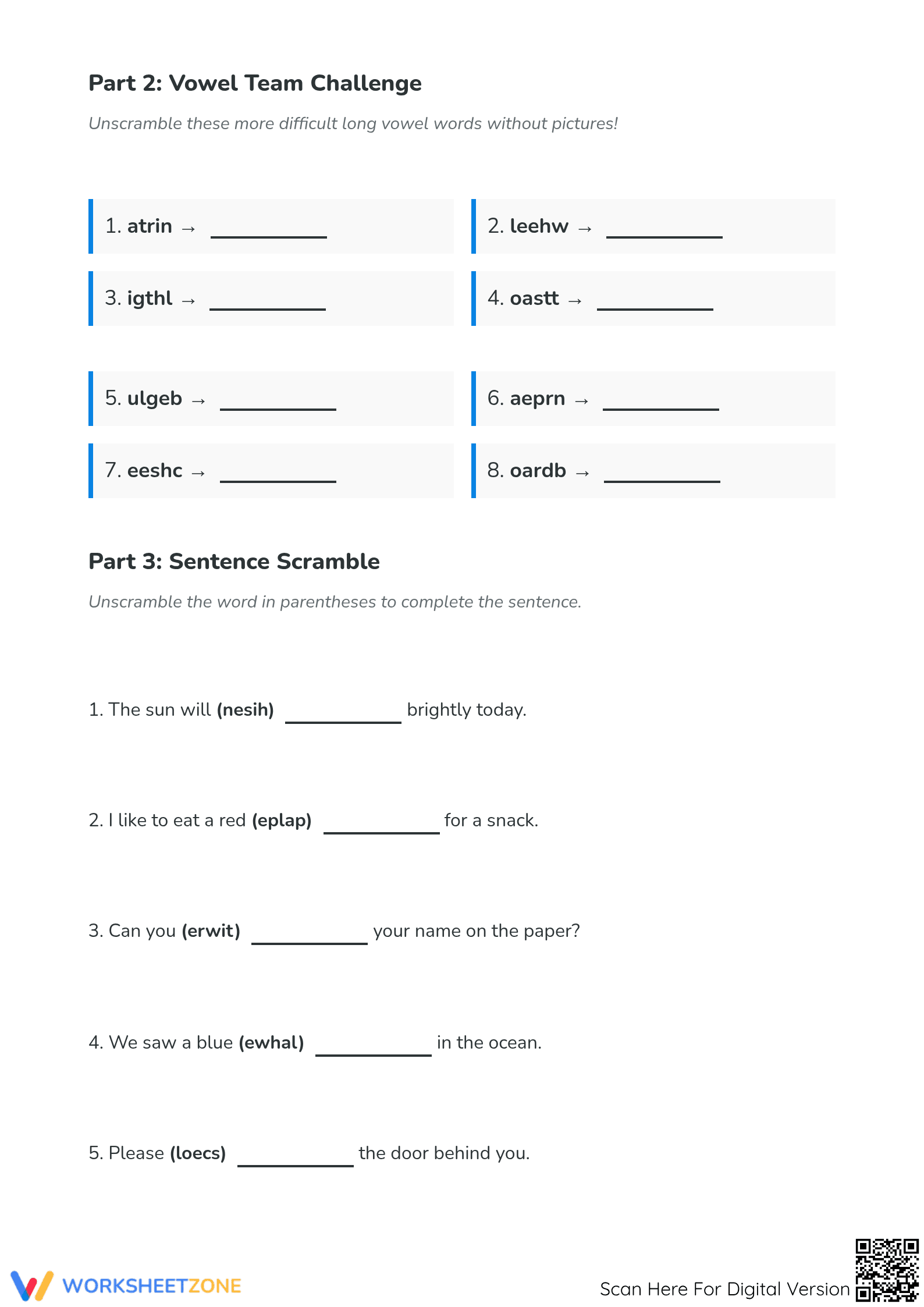
This two-page PDF resource features three distinct parts designed to build spelling confidence. It includes 10 picture-supported scrambles for visual learners, 8 advanced vowel team challenges without visual cues, and 5 sentence-completion tasks that require context-clue application. A full answer key is provided for rapid grading or student self-correction, ensuring a complete instructional package.
Skill Progression
- Guided practice: Students begin with 10 picture-scramble tasks where visual anchors support the decoding of 4-letter long vowel words like "cake" and "boat."
- Supported practice: The challenge increases in Part 2 with 8 multisyllabic or complex vowel team words that require students to rely solely on phonics rules without visual aid.
- Independent practice: Students apply their knowledge in 5 "Sentence Scramble" problems, unscrambling high-frequency words to complete meaningful sentences.
This structure follows a gradual-release model, moving from high-scaffold visual matching to independent contextual application.
Standards Alignment
Primary alignment is to CCSS.ELA-LITERACY.RF.2.3.B, which requires students to know spelling-sound correspondences for common vowel teams. It also supports RF.1.3.C by reinforcing final -e conventions. Both standard codes can be copied directly into lesson plans, IEP goals, or district curriculum mapping tools.
How to Use It
Use this worksheet during a small-group literacy rotation to observe how students handle silent-e versus vowel team transitions. It also serves as an excellent formative assessment at the conclusion of a phonics unit. Teachers should observe whether students phonetically "sound out" the scrambled letters or use the provided pictures as their primary decoding strategy. Expected completion typically takes 25 minutes.
Who It's For
Designed for Grade 2 and Grade 3 students, this resource is ideal for early readers who are transitioning from basic CVC words to more complex long vowel patterns. It pairs naturally with a Long Vowel Anchor Chart or a direct instruction lesson on Magic E and Vowel Team rules.
The acquisition of long vowel spelling patterns represents a critical shift from phonetic "invented spelling" to conventional orthographic mapping. Research by Fisher & Frey (2014) emphasizes that scaffolded practice with word-level manipulations, such as the 23 tasks in this CCSS.ELA-LITERACY.RF.2.3.B aligned resource, significantly accelerates the transition to automatic word recognition. By moving students through picture-supported decodable tasks and into contextual sentence completion, this worksheet reinforces the specific phonemic awareness required for decoding complex text. National assessments such as the NAEP frequently highlight that mastery of these foundational vowel correspondences is a high-yield predictor of long-term reading comprehension proficiency. This resource ensures that students receive the essential, repetitive exposure needed to internalize these rules and apply them fluently across various reading and writing contexts.


