




























Views
Downloads

Adding Coins Worksheet | Grade 2 Essential Math

Paste this activity's link or code into your existing LMS (Google Classroom, Canvas, Teams, Schoology, Moodle, etc.).
Students can open and work on the activity right away, with no student login required.
You'll still be able to track student progress and results from your teacher account.
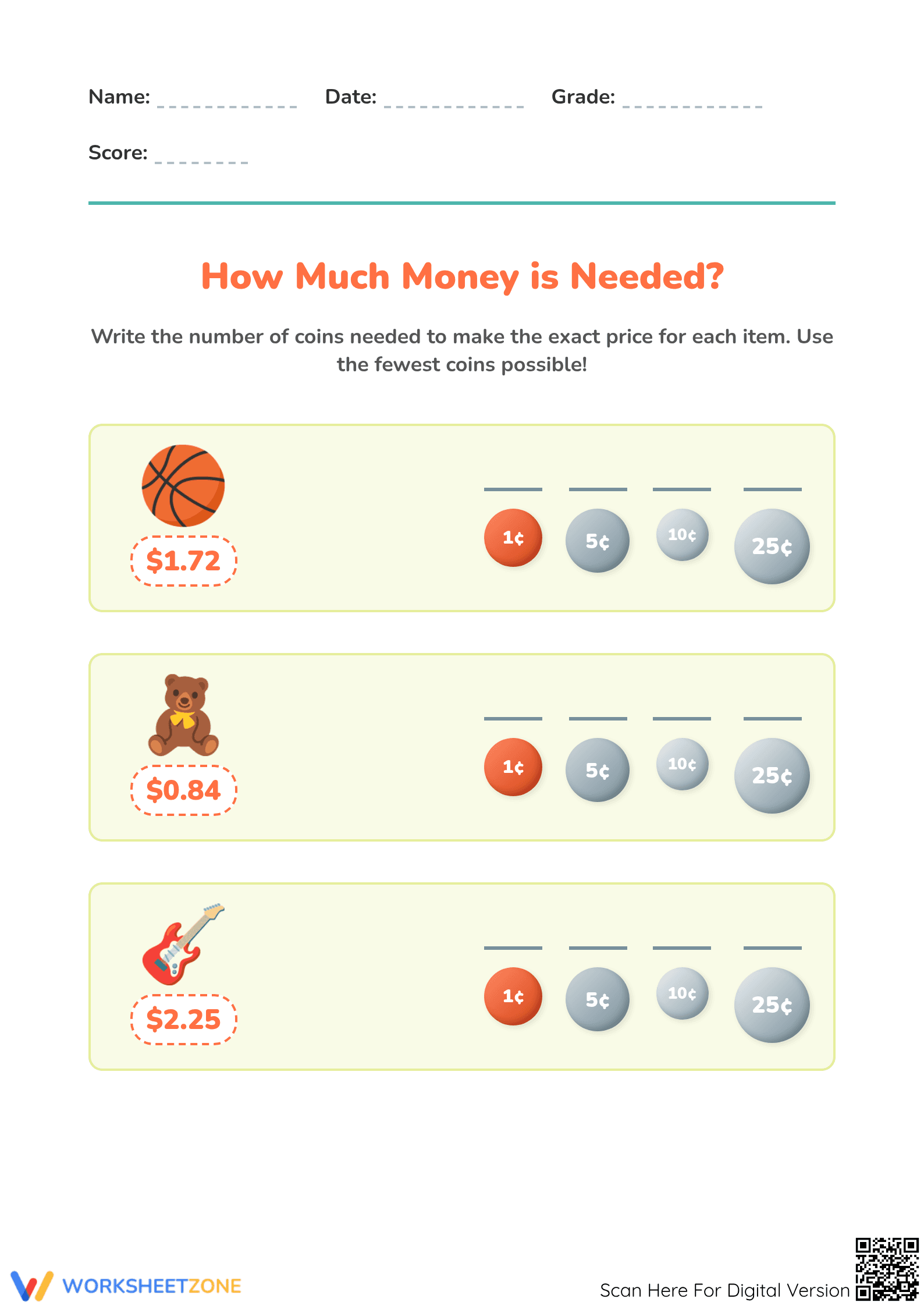
Students practice the practical application of monetary values by determining the exact combination of coins required to reach specific price points. This Grade 2 resource emphasizes efficiency and mental math, challenging learners to use the fewest coins possible for items like a basketball or a guitar, ensuring they develop a strong conceptual foundation in early math.
At a Glance
- Grade: 2 · Subject: Math
- Standard:
2.MD.C.8— Solve word problems involving dollar bills, quarters, dimes, nickels, and pennies- Skill Focus: Representing monetary values with the fewest coins possible
- Format: 2 pages · 4 problems · Answer key included · PDF
- Best For: Small group instruction or homework practice
- Time: 15–20 minutes
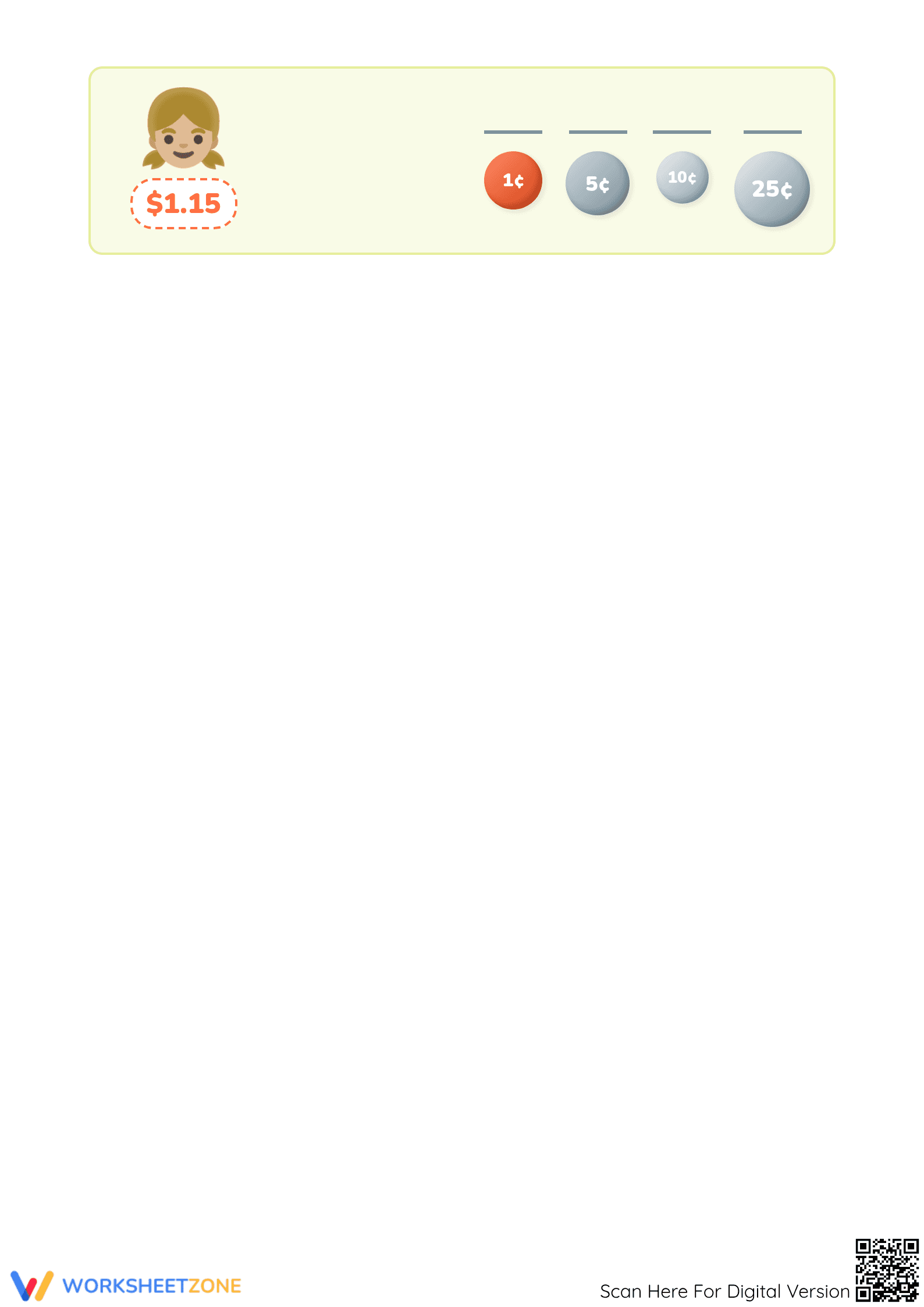
This comprehensive two-page PDF features four high-interest items with price tags ranging from $0.84 to $2.25. Each task provides clear visual prompts for pennies, nickels, dimes, and quarters, with designated lines for students to record their counts. A full answer key is provided to facilitate rapid self-correction or teacher grading, making it a reliable resource for busy educators.
- Guided practice: Students begin by identifying the values of individual coins (1¢, 5¢, 10¢, and 25¢) and comparing them to the total price shown on the item tag.
- Supported practice: Learners apply the "fewest coins" strategy by starting with the highest denomination (quarters) and working down through dimes and nickels to reach the final cents.
- Independent practice: Students solve multi-step problems requiring them to bridge from cents to dollars, such as calculating the specific coins needed for the $2.25 guitar price point.
The worksheet follows a gradual-release model, moving from familiar decimal values to complex combinations that require strategic thinking and number sense.
This resource is directly aligned with `2.MD.C.8`, which requires students to solve problems involving various denominations of currency using appropriate symbols. By focusing on the "fewest coins" constraint, it also supports mental math and place value logic within the base-ten system. Both standard codes can be copied directly into lesson plans, IEP goals, or district curriculum mapping tools.
This worksheet is ideal for math center rotations, serving as a formative assessment after a money unit. Observe if students start with quarters or pennies, guiding them toward efficient strategies. Completion is expected within 20 minutes.
This practice set is ideal for second-grade students mastering basic addition and financial math, though it also serves as excellent remediation for third-graders. It pairs naturally with physical coin manipulatives or a digital toy store passage where students "purchase" items using these exact calculations to build real-world relevance. The visual layout is accessible for English language learners and students with diverse learning needs.
Aligned with the NAEP 2024 framework, this Grade 2 worksheet builds foundational skills in coin manipulation and value representation, critical for later rational number operations. It addresses 2.MD.C.8 by requiring students to decompose dollar and cent totals into specific denominations. The activity's "fewest coins" constraint promotes efficient strategy use over rote counting, reinforcing hierarchical inclusion principles. Based on research by Fisher & Frey (2014) on gradual release of responsibility, this resource ensures mastery through rigorous, applied practice, mirroring real-world financial decisions.


