These adding money worksheets give students structured, repeated practice with the specific operations that trip them up most: aligning decimal points in vertical addition, writing currency notation correctly, and applying both skills inside word problems. Each worksheet in the set targets a distinct layer of the skill, so teachers can assign them in sequence or pull individual worksheets to address the exact gap a student is showing.
The Specific Skills Targeted
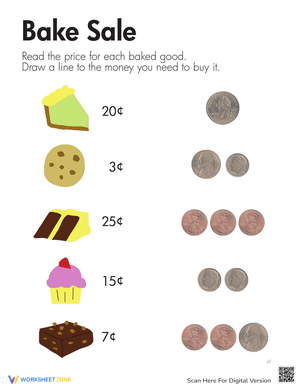
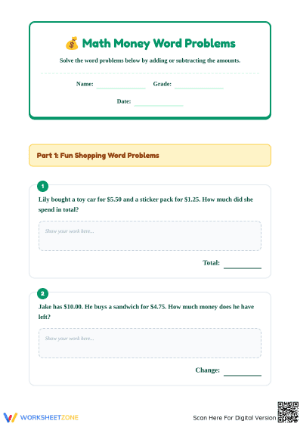
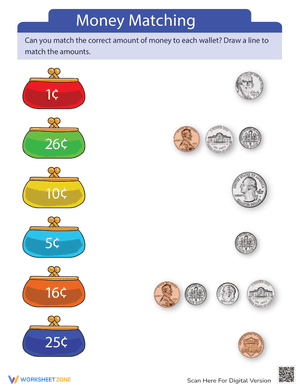
The set moves through three distinct worksheet types. The first group uses coin and bill illustrations — students count the pictured currency and record a total. The visual format keeps the concept grounded before students work with numerals alone, and it doubles as a check on coin identification, which some third graders still haven't fully consolidated. The second group shifts to vertical column addition with two or more money amounts written in standard decimal form. Students add, regroup, and record answers using correct dollar-sign notation. The third group presents word problems: a student needs to buy two items at listed prices, or a character has a set amount and wants to know if it covers a purchase. These problems ask students to extract the relevant numbers, set up the addition, and check that their answer is labeled correctly.
Mistakes Students Make That These Worksheets Help You Catch
The decimal slip is the most consistent error in student work at this stage. A student writes $13.72 in the addend but arrives at an answer of $1372 — they performed the addition correctly but dropped the decimal entirely. The vertical format on these worksheets makes that omission obvious at a glance because there's a visible gap where the decimal point and dollar sign belong.
The second pattern worth watching is dual notation: students write $0.75¢, stacking a dollar sign and a cent sign on the same value. This appears most often on word problems where students are copying numbers from a sentence, not a formatted column. It's worth pausing during whole-class instruction and putting both the correct ($0.75) and incorrect ($0.75¢) forms on the board before students work independently — seeing the contrast once tends to stick better than a correction written in the margin after the fact.
The subtler error is treating dollars and cents as two separate addition problems. A student adds the cents column, gets a sum of 115¢, writes down 15¢, and then adds the dollar column without carrying. They understand regrouping in whole-number addition but haven't yet internalized that ten dimes equal one dollar — that the carry crosses the decimal line the same way any carry crosses a place-value boundary. The vertical worksheets build that habit because they show the same structure students already know from multi-digit addition, just with a decimal point inserted.
How to Build These Worksheets Into Your Lesson Plans
The visual coin worksheets work well as a warm-up on the day you introduce decimal notation — students start with something familiar, then you connect it explicitly to the column format they're about to learn. Five to eight minutes is enough for that entry task, and it gives you a quick read on who still needs coin review before the decimal work begins.
The vertical addition worksheets fit the independent practice portion of a gradual-release lesson. Teach the decimal-alignment strategy during direct instruction, model two or three problems with think-aloud commentary, send students to try the worksheet, and circulate. Because each worksheet in this group focuses on a narrow operation rather than a mix of problem types, you can identify during that circulation window exactly where the breakdown happens — students who carry correctly but misplace the decimal, versus students who don't carry at all, need different follow-up conversations.
The word problem worksheets are a natural fit for the Friday review block or as a formative checkpoint before a unit assessment. Assign one and read the answers before Monday — students who set up the addition correctly but make computational errors need different feedback than students who can't identify which numbers to use. These worksheets give you that diagnostic layer in a single ten-minute task.
One structural change that works well: instead of assigning the word problems at desks, post the scenarios around the room as "price tags" on classroom objects. Students carry a recording sheet and a pencil, move to each station with a partner, and write the addition problem for the two items they choose. The activity covers the same computational skill as the worksheet, but the physical movement and the choice of items change the energy in the room — especially useful during the longer afternoon block when engagement tends to drop.
Adjusting the Worksheets for a Range of Learners
Students who are still building fluency with coin identification need the visual worksheets before the column addition ones. That sequencing isn't remediation — it's the correct developmental path, and 2nd or early 3rd graders often need that concrete anchor. For these students, keeping plastic coins on the desk during any of the worksheets lets them model an uncertain problem physically before committing an answer to paper.
Students who are ready for more challenge can use the word problem worksheets as a springboard for multi-step problems: instead of finding the total of two items, they calculate the total, subtract from a given amount, and determine change. That extension doesn't require a different worksheet — it's a question you write in the margin or pose verbally once the core task is complete.
Graph paper is a low-effort accommodation for students who lose track of place value in the column format. One digit per box, decimal point in its own box — the grid structure does the alignment work so students can focus on the arithmetic rather than the spatial organization of the problem.
Standard Alignment
These worksheets align with CCSS 2.MD.C.8, which expects second graders to solve word problems involving dollar bills, quarters, dimes, nickels, and pennies using dollar and cent symbols appropriately. The visual and basic column worksheets address this standard directly. For upper elementary, the worksheets connect to CCSS 4.MD.A.2, which asks fourth graders to apply decimal understanding to solve real-world money problems — the standard where coin counting formally gives way to place-value reasoning about tenths and hundredths. Teachers using these worksheets in a 3rd-grade classroom are bridging those two standards: students are past 2.MD.C.8 but approaching the decimal fluency that 4.MD.A.2 demands.
Frequently Asked Questions
Do these worksheets work for students who have not yet learned decimal notation formally?
Yes, with the right sequencing. The visual coin worksheets don't require any knowledge of decimal notation — students count currency and record a value in cents. Use those to build the concept, then introduce the dollar-sign-and-decimal format as "the grown-up way of writing the same amount." The column addition worksheets reinforce decimal alignment through repetition rather than through abstract explanation, so students encounter the notation many times before they're expected to produce it independently.
What is the best way to teach decimal alignment before students use the vertical addition worksheets?
Graph paper or pre-printed grid worksheets help students who struggle spatially. Instruct them to put one digit per box and give the decimal point its own box. The visual constraint keeps place values from drifting, which is the main mechanical error in early vertical money addition. After a few sessions on graph paper, most students internalize the alignment habit and can work on standard lined paper without the grid.
At what point should students stop using coin manipulatives alongside the worksheets?
When they no longer need them — which varies by student and is not a calendar deadline. Some students use plastic coins through most of second grade and transition away naturally as the abstract notation becomes automatic. Pulling manipulatives before a student has that automaticity tends to produce avoidance behaviors rather than faster abstraction. The worksheets work with or without physical coins on the desk, so there's no need to enforce a transition on a fixed timeline.
















 Interactive Worksheet Maker
 Quiz Maker
 Word Search Maker
 Crossword Puzzle Maker
 Word Scramble Generator
 Sentence Scramble Generator
 Handwriting Worksheet Generator
 Name Tracing Generator
 Fill In The Blank Generator