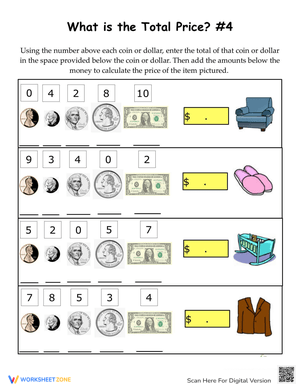
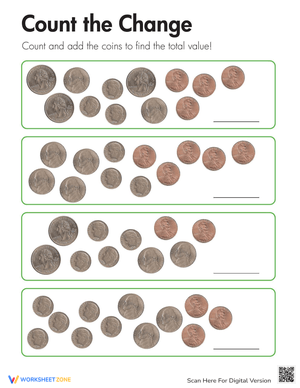
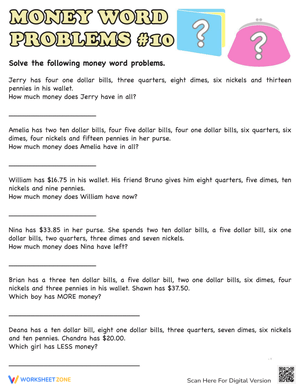
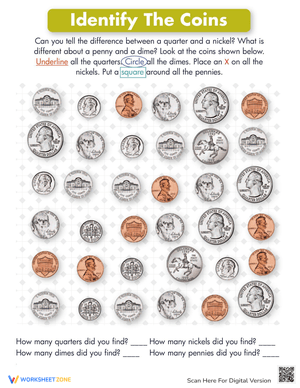
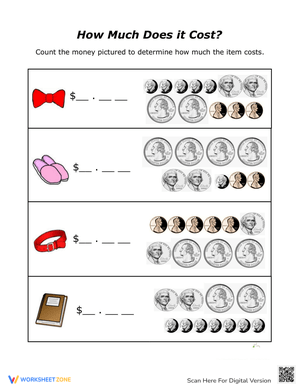
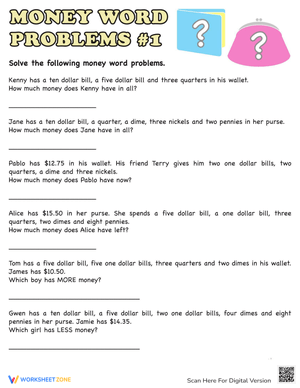
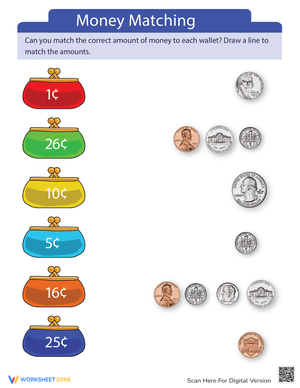
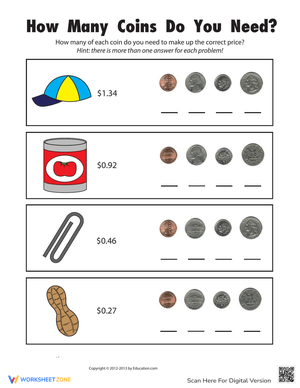
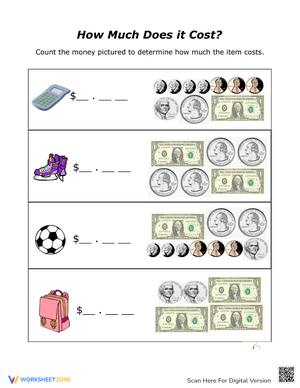
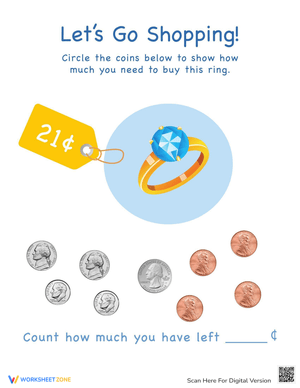
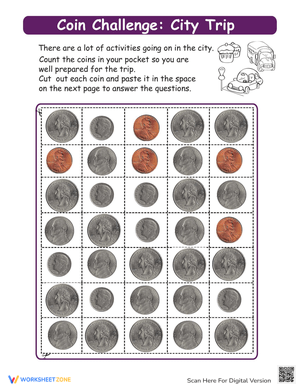
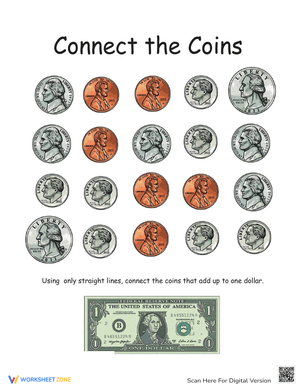
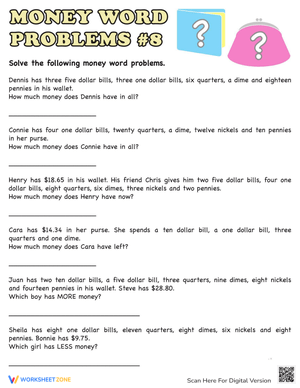
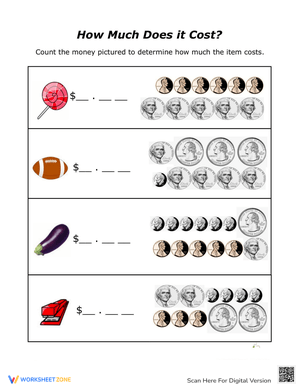
These nickels worksheets give kindergarten through second-grade teachers focused, print-ready practice for one of the trickier coins in the early money unit. The set covers visual identification, skip-counting by fives, value matching, and simple group comparisons — building the specific skills students need before mixed-coin work begins.
Why the Nickel Trips Students Up More Than the Other Coins
The nickel sits at an uncomfortable intersection for young learners: it is physically larger than a dime but worth half as much. Children this age use size as a proxy for quantity constantly — bigger cup, more juice; bigger number, more value. That logic fails them here, and no amount of telling them "size doesn't equal value" sticks until they have worked through enough practice to build the correct automatic response. These worksheets isolate the nickel long enough for that rewiring to happen before students are asked to sort it alongside dimes and quarters.
There is also the skip-counting demand. Pennies let students count by ones, a skill they arrive with. Nickels require counting by fives, which for kindergarteners and early first graders is still emerging. Asking students to apply an abstract skip-counting pattern to illustrated coin groups — where a pile of four nickels means counting 5, 10, 15, 20 rather than 1, 2, 3, 4 — is a genuine cognitive jump. Students who can recite the fives sequence from memory still stumble when the starting point is a coin image rather than a number line.
What's Inside the Set
Each worksheet targets a distinct layer of nickel understanding rather than bundling skills together in ways that obscure where a student is breaking down.
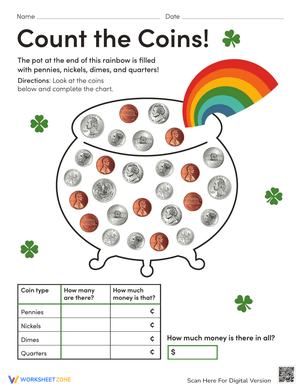
- Identification practice: Students circle or sort nickels from a field of mixed coins, working from both the obverse (Jefferson's portrait) and the reverse (Monticello). Because older nickels with the profile portrait still circulate alongside the newer forward-facing image, the set includes both versions — a detail that matters when students bring real coins to class and the illustrated version looks unfamiliar.
- Skip-counting sequences: Students fill in missing values in a 5-cent counting chain anchored to coin images, then transfer those counts to a number line. The pairing keeps the abstract sequence tied to a visual referent rather than floating free.
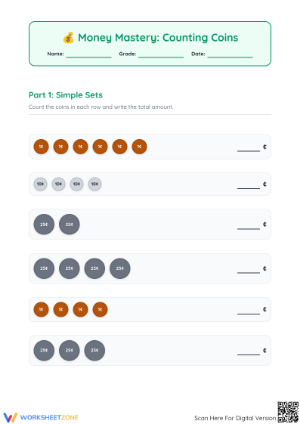
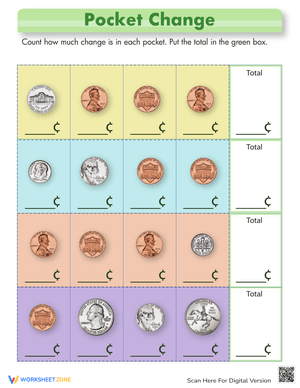
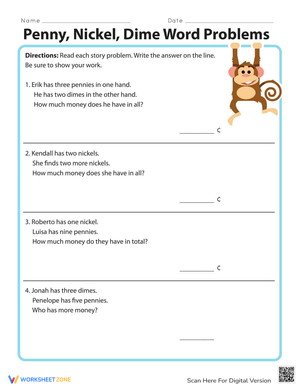
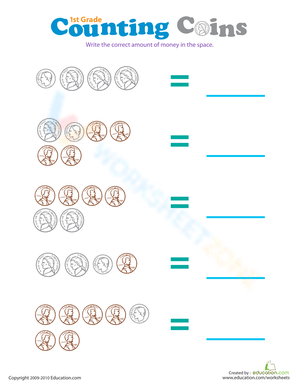
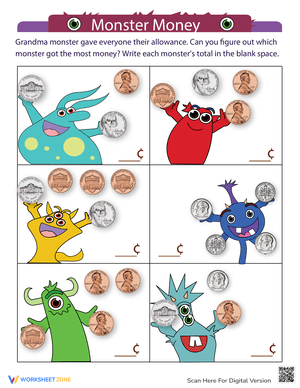
- Group value problems: Students count sets of two to eight nickels and write the total in cents, progressing from small uniform groups to slightly larger ones. Answer lines prompt the cent symbol explicitly, which addresses the common omission of the ¢ sign in early work.
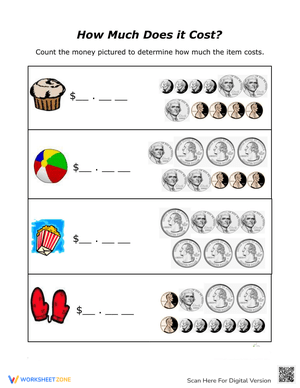
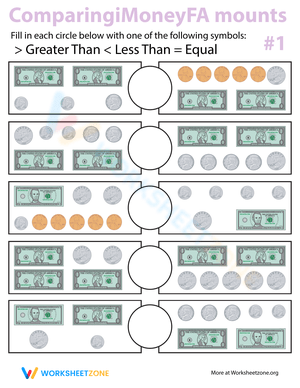
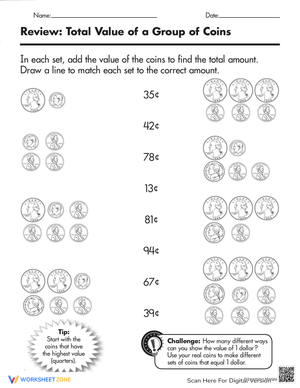
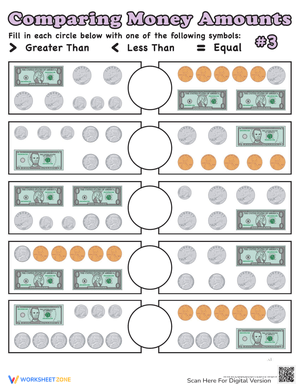
- Matching and comparison tasks: Students draw lines from coin groups to price tags, then compare two groups using greater-than and less-than symbols. The comparison format surfaces place-value thinking — a student who writes 15 ¢ < 20 ¢ correctly but says "this pile is more" pointing to the larger physical stack is still operating on size logic, and the written symbol task makes that visible.
Frequent Student Errors Worth Watching For
The most consistent error pattern is assigning the dime's value to the nickel. On identification tasks, students will circle the dime as the "five-cent coin" more often than they will invent a random wrong answer — the confusion is specific, not random. When you see this in a stack of completed worksheets, it almost always traces back to a student who learned "small silver coin" as a category before learning which small silver coin is which.
A second error appears on the skip-counting worksheets: students count coin images by ones instead of fives. Four nickel images become 4¢ rather than 20¢. This shows up even in students who perform fine on an isolated fives-counting drill, because the presence of coin images reactivates the "one object, one count" habit. Pointing to each coin while saying the five-count aloud — a brief physical anchoring step — breaks the pattern faster than re-explaining the value.
On the matching tasks, watch for students who add the numeral of nickels rather than their value: three nickels matched to 3¢ rather than 15¢. It reads like a careless mistake, but it is actually a sign that the student has not yet connected skip-counting to the coin's denomination and needs more time at the concrete level before working representationally.
Building These Worksheets Into Your Lesson Plans
The identification worksheets belong early in the unit — before any counting practice — because students who cannot reliably distinguish a nickel from a dime will produce garbage data on every subsequent task. A single focused day on heads-and-tails recognition, paired with a small tub of plastic coins at each table, sets the rest of the sequence up cleanly.
Once identification is solid, the skip-counting worksheets work well as the warm-up task during the 10 minutes before math block begins, when students are settling but not yet ready for direct instruction. Running this three or four days in a row before moving to the value-matching work gives the fives sequence enough repetition to become automatic. Teachers who skip this runway and jump straight to group-value problems find themselves re-teaching the skip-counting foundation mid-unit.
For exit tickets, a three-problem strip — one identification item, one four-nickel count, one matching task — takes under five minutes and tells you exactly which students are ready to add dimes to the mix and which need another day at the nickel-only level. That data is more actionable than a chapter quiz at the end of the unit, when re-teaching competes with forward momentum.
Adjusting the Worksheets for a Range of Learners
Students who are still building the fives-counting sequence benefit from having a small hundreds chart clipped to the top corner of the worksheet. They trace the shaded fives column as they count each coin, keeping the sequence visible rather than held in working memory. Removing the chart becomes the benchmark — when they no longer reach for it, they are ready to move on.
For students who have already mastered nickel-only counting and need more challenge, the comparison worksheets can be extended by asking them to record not just which group is larger but how many more cents the larger group contains. That difference calculation previews subtraction within 20 without leaving the money context. The group-value worksheets can also be paired with a classroom-store setup where items are priced in multiples of five cents; students determine whether they have enough nickels to buy a chosen item, which introduces the idea of sufficiency — a step toward making change — without requiring formal subtraction instruction yet.
Standard Alignment
These worksheets align to CCSS.MATH.CONTENT.2.MD.C.8, which asks second graders to solve word problems involving dollar bills, quarters, dimes, nickels, and pennies using ¢ and $ symbols appropriately. Coin identification and single-denomination counting — the focus of the early worksheets in this set — represent the foundational work that has to precede the standard's full expectation. In most district pacing guides, this standard lands in late winter or early spring of second grade, but the identification and skip-counting worksheets are appropriate from mid-kindergarten onward as readiness work. First-grade teachers using these for initial instruction are doing exactly what the standard's scaffolding demands.
Frequently Asked Questions
My students can count by fives on a number line but fall apart when counting actual nickel images. What is happening?
This is a transfer problem, not a counting problem. The fives sequence is memorized in one context — numbers in a row — but not yet applied to a new representation. Have the student point to each coin image and say "five" before counting: "Five... ten... fifteen..." rather than starting the count at 5 automatically. Once the hand motion and verbal label are linked to the coin image, the counting sequence attaches.
Should I introduce all coin types together or one at a time?
One at a time, in increasing value order: penny, nickel, dime, quarter. Mixed-coin work before single-coin mastery is the single most common pacing mistake in early money units. Students who are shaky on the nickel's value will use the penny's count-by-ones strategy on every coin, which produces wrong answers they cannot self-correct because they have no anchor to compare against.
How do I handle the fact that older and newer nickels look different?
Acknowledge it directly and briefly. Tell students that coins get redesigned over time and show them both versions side by side. The smooth edge and silver color are the reliable identifiers regardless of portrait style. Worksheets that include both portrait versions are worth selecting for precisely this reason — a student who has only ever seen Jefferson in profile will hesitate at the newer forward-facing image on a test or in real life.
At what point are students ready to move from nickel-only worksheets to mixed-coin practice?
When a student can count a group of up to eight nickels correctly, write the total with the cent symbol, and identify a nickel reliably in a mixed field — all without hesitation — they are ready. Rushing this transition because the calendar demands it is the source of most of the confusion teachers report during the dime and quarter unit.













 Interactive Worksheet Maker
 Quiz Maker
 Word Search Maker
 Crossword Puzzle Maker
 Word Scramble Generator
 Sentence Scramble Generator
 Handwriting Worksheet Generator
 Name Tracing Generator
 Fill In The Blank Generator