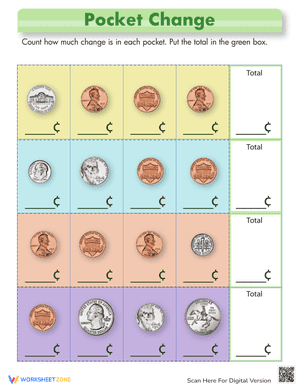
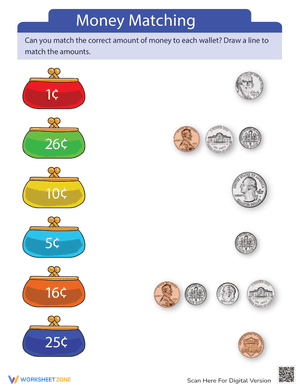
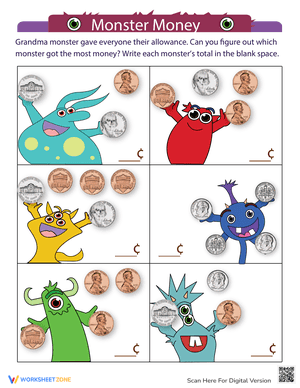
These dimes worksheets give early elementary students structured, repeated practice with one of the most conceptually tricky coins in the set — the one worth the most of the three small coins yet physically smaller than both of them. The set covers identification, value, and skip counting by tens, moving students from visual recognition to calculating the worth of groups of dimes.
Where the Dime Trips Students Up
The size-value mismatch is the central obstacle here, and it surfaces more persistently than most teachers expect. A child who correctly counts five pennies and knows a nickel equals five cents will often hand back a dime and say it's worth less than the nickel sitting next to it — because the nickel is bigger. This is not carelessness; it is completely logical thinking applied to the wrong domain. Students are applying a rule that works almost everywhere else (bigger means more) to a system where coin size and coin value are deliberately unrelated.
The silver coloring compounds the problem. Dimes and nickels look like siblings to a first grader, and distinguishing them demands close visual attention — specifically to edge texture and portrait. Several worksheets in this set isolate that comparison directly, asking students to label, sort, or circle coins based on the reeded edge of the dime versus the smooth edge of the nickel before any counting begins. Getting that visual discrimination solid is the prerequisite the rest of the set builds on.
Skills These Worksheets Build
Each worksheet targets one or two skills rather than bundling everything onto a single page. The skills addressed across the set include:
- Identifying the dime by name, value, and physical features — portrait, edge, relative size — using both front-facing and back-facing coin images so students recognize it regardless of orientation.
- Connecting the dime's value to equivalent groups: ten pennies, two nickels, and the relationship to a quarter.
- Skip counting by tens to find the total value of a group of dimes, with sequences that start at numbers other than zero to prevent students from relying on rote recitation.
- Distinguishing dimes from nickels in mixed-coin illustrations — sorting, circling, and labeling exercises that isolate the discrimination skill before students encounter full mixed-coin counting.
- Solving simple word problems where dimes appear alongside one other coin type, building toward the mixed-coin fluency that second grade standards require.
Standard Alignment
This set aligns with CCSS 2.MD.C.8, which asks students to solve word problems involving dollar bills, quarters, dimes, nickels, and pennies using $ and ¢ symbols. Dime identification and skip counting by tens are the foundational steps the standard assumes; students cannot solve mixed-coin word problems fluently if they are still uncertain which coin is the dime or if they count dimes by ones. These worksheets address the prerequisite layer directly. The set also reinforces 2.NBT.A.2 (skip counting within 1000), since counting dimes by tens is one of the most natural entry points for that standard in the primary grades.
Recommended Lesson Planning Strategies To Take Full Advantages Of These Worksheets
A single dimes worksheet works well as a five-minute warm-up during calendar math — display it, count aloud together by tens, and you've reinforced skip counting in a context that feels applied rather than abstract. The identification worksheets in particular make reliable morning work because students can begin independently while attendance is taken; the directions are visual and self-evident.
For math centers, the sort-and-label worksheets pair naturally with a small tray of real or plastic coins. Students complete the paper task and then verify with the physical coins — the tactile check is worth building in, especially for the dime-vs.-nickel discrimination work. Running the finger along the reeded edge of a real dime does more in ten seconds than a paragraph of explanation. The skip-counting worksheets fit a partner station well: one student counts while the other tracks on a number line, then they switch.
The short exit-ticket format — three to five coins to identify or count — is where formative assessment happens cleanly. After a lesson on skip counting by tens, a single worksheet row tells you which students have the pattern and which are still counting on by ones. That information shapes the next day's small-group pull, which is exactly what the format is designed to surface.
Common Mistake Of Students That Teachers Should Aware and Address
For students still working at the concrete stage, pair any worksheet with a small set of real coins and allow them to place the physical coin on top of its illustration before labeling. This removes the pure visual-discrimination demand and lets the student focus on the counting or value task. Students who need an additional scaffold for skip counting by tens benefit from a partial number line along the bottom of the worksheet — marking off 10, 20, 30 and so on gives them a checking tool without doing the work for them.
On the other end, students who have identification solid but need more challenge can be directed to the word-problem worksheets, which introduce a second coin type and require the student to distinguish and count both. Writing the total value in two forms — as cents and as a decimal dollar amount — extends the task without requiring a different worksheet altogether.
Frequently Asked Questions
At what point in the money unit should I introduce these worksheets?
Start dime identification worksheets after students are confident with pennies and nickels — typically a week or two into the money unit. Introducing the dime before the nickel-vs.-dime comparison is meaningful tends to blur all the silver coins together. Once students can reliably identify a penny and a nickel, the dime gives them a contrast problem worth solving rather than a third coin to memorize in isolation.
My students keep counting dimes by ones instead of skip counting. What helps?
This usually means the skip-counting-by-tens skill is not yet automatic outside of a number chart. Before returning to the coin worksheet, spend a few minutes on oral skip counting that starts mid-sequence — "start at 30, count by tens" — so students stop depending on the recited sequence from zero. Once the oral pattern is fluent, the worksheet counting clicks into place much faster. Some teachers also find that writing the running total under each dime as students count (10 under the first, 20 under the second) makes the skip-counting structure visible until it becomes habitual.
How do these worksheets hold up for second-language learners?
The identification and counting worksheets rely primarily on numerals and coin images rather than dense written prompts, which makes them accessible for students still building English vocabulary. The word-problem worksheets involve more language and may need read-aloud support or a bilingual prompt card alongside them. The sorting and circling tasks in the set require no written response at all, which gives emerging English learners a genuine entry point into the same mathematical work as their peers.
















 Interactive Worksheet Maker
 Quiz Maker
 Word Search Maker
 Crossword Puzzle Maker
 Word Scramble Generator
 Sentence Scramble Generator
 Handwriting Worksheet Generator
 Name Tracing Generator
 Fill In The Blank Generator