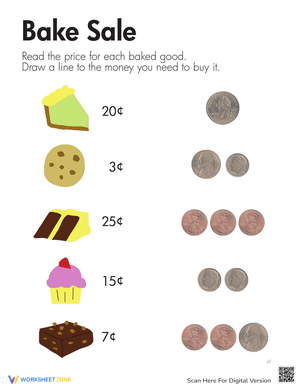
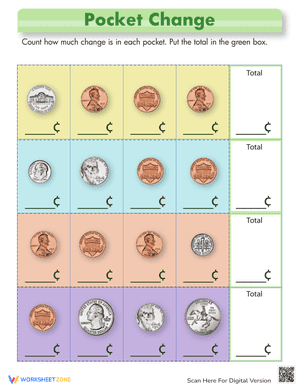
These identifying coins worksheets give kindergarten and first-grade teachers targeted, ready-to-use practice for the skill that trips up nearly every early money unit: getting students to reliably distinguish between four coins before they ever add a cent. Each worksheet isolates a specific recognition task — matching names to images, sorting by value, circling coins within a scattered set — so teachers can sequence them based on where a class actually is, not where a scope-and-sequence chart says they should be.
The Specific Skills Address By These Identifying Coins Worksheets
Coin identification demands a kind of visual discrimination that number sense alone does not build. Students learn to read coins by four physical attributes: color, diameter, thickness, and edge texture. The penny is the natural entry point — its copper color sets it apart immediately, and most kindergartners lock it in during the first lesson. The trouble comes when students move to the three silver-colored coins. Size comparisons help with the nickel and quarter, but the dime breaks the pattern entirely. It is the smallest coin in the set and the hardest to hold in memory, which is why several worksheets in the set return to dime identification specifically.
Beyond visual recognition, the worksheets build coin vocabulary (penny, nickel, dime, quarter), cent notation (1¢, 5¢, 10¢, 25¢), and portrait-to-coin association for Lincoln, Jefferson, Roosevelt, and Washington. By the end of the set, students move from labeling individual coins to working with mixed groupings — a necessary step before any counting or adding with money begins.
Standard Alignment
Coin identification sits within the K-2 measurement and data standards. In Common Core-aligned classrooms, the formal money standard appears at second grade under 2.MD.C.8, which asks students to solve word problems involving dollar bills, quarters, dimes, nickels, and pennies. But that standard assumes students arrive in second grade already able to identify coins fluently — recognition is treated as prerequisite knowledge, not part of the standard itself. That is why these worksheets are most commonly used in kindergarten and first grade, during the window before 2.MD.C.8 becomes the instructional target. States using their own frameworks rather than Common Core generally place coin recognition at the same K-1 level, with fluency expected by mid-second grade.
Common Mistake Of Students That Teachers Should Aware and Address
The dime-nickel confusion is well documented, but the underlying cause is worth naming: children in the concrete operational stage apply a size-equals-value logic that works reliably in most contexts. A bigger pile of blocks is more. A longer number line segment represents more distance. The dime violates this rule, and that violation is genuinely disorienting for a six-year-old. Several worksheets address this directly by asking students to first rank the four coins from smallest to largest by size, then rank them again by value. Seeing those two sequences side by side — and noticing they do not match — is more effective than telling students the rule.
A second persistent error: students confuse the nickel and the quarter because both are silver, larger than a dime, and share a smooth-edge texture on the nickel's side. Students who have locked in "silver and smooth = nickel" often mislabel quarters on the first mixed-recognition worksheet. Worksheets that present nickels and quarters together in isolation, without pennies or dimes as distractors, help students slow down and compare diameter rather than relying on a shortcut that sometimes works.
Activity Types Across the Set
- Name-and-value matching: Students draw lines from a coin image to its written name and cent value. This is typically the first worksheet in a sequence — low stakes, clear visual anchor, builds the vocabulary students need before any other task.
- Cut-and-sort: Mixed coin images are cut out and sorted into labeled columns. The fine motor component slows students down in a useful way — they handle each image individually rather than scanning a page, which reduces guessing.
- Mixed recognition: A scattered arrangement of all four coins fills the page; students circle or color every instance of one specified coin. This format mirrors what students eventually do with real change and is where most of the dime errors surface.
- Attribute labeling: Students annotate a large coin diagram, marking the edge, the portrait, the denomination, and the color. These worksheets work well as an introduction or a review anchor before a unit assessment.
- Simple identification with written response: A coin image appears alongside a prompt — students write the name and value. This is the lowest-support format and functions well as a quick formative check.
Recommended Lesson Planning Strategies To Take Full Advantages Of These Worksheets
The cut-and-sort worksheets earn their place at a math center because the instructions read as a visual task — students do not need the teacher present to get started. That frees up time for a guided group working on a harder skill. The matching and labeling worksheets work as morning work or as the last eight minutes of a math block when a full lesson is winding down and students need something quiet and self-directed. Several teachers keep one mixed-recognition worksheet available as an early-finisher task during the coin unit, since it is genuinely more challenging than it first appears.
Pairing the worksheets with physical coins or quality plastic manipulatives is worth the extra setup. When students place a real dime over the printed dime image and run a finger along the reeded edge, they are building a tactile memory that a printed image alone cannot provide. Students who continue to confuse dimes and nickels after several worksheet exposures almost always stabilize once they feel the edge difference on an actual coin.
Frequently Asked Questions
At what point in a money unit should I introduce mixed-coin recognition?
After students can identify each coin reliably in isolation — meaning they label it correctly without support when it appears alone on a page. Moving to mixed recognition too early often just accelerates the dime confusion, because students fall back on size-based guessing when all four coins appear together. A good checkpoint is the attribute-labeling worksheet: if a student can fill in color, edge, portrait, and value for each coin without a reference card, they are ready for mixed sets.
My students know the penny but keep mixing up the other three. What helps?
Work the dime before the quarter. The nickel-dime contrast — same silver color, very different size — gives students a concrete anchor: the small silver one is the dime. Once that is stable, introducing the quarter (larger than both, ridged edge like the dime) is easier because students have already sorted the silver coins into a reliable category. Worksheets that present only two coin types at a time are useful here — they reduce visual load and let students build each comparison step by step.
Can these worksheets support students who are learning English as a second language?
Yes, with one adjustment: coin names in English (dime, nickel, quarter) have no transparent etymology for a child still building vocabulary, so pairing each worksheet with a coin reference card that includes an image, the English name, and the cent value is worth doing. The cut-and-sort and mixed-recognition formats are well suited to ELL students because the task is primarily visual and does not depend on reading worksheet directions fluently.
















 Interactive Worksheet Maker
 Quiz Maker
 Word Search Maker
 Crossword Puzzle Maker
 Word Scramble Generator
 Sentence Scramble Generator
 Handwriting Worksheet Generator
 Name Tracing Generator
 Fill In The Blank Generator