Worksheets
Lesson Plans
Coloring Pages
Home
Activity:
Topic:
CCSS:
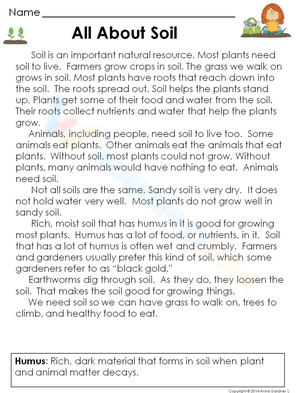
Learn the soil formation process with this educational worksheet. Explore earth science and environmental concepts. Download to understand soil composition!
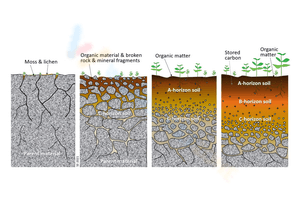
What makes up Soil? Take the Soil Formation quiz and explore the different horizons today!
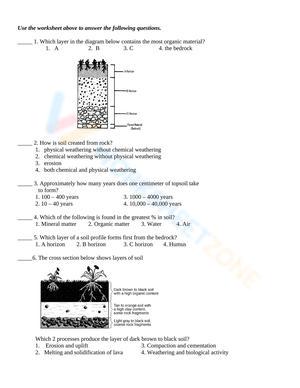
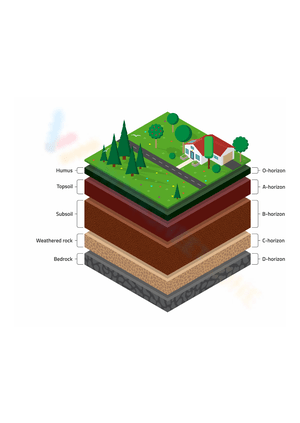
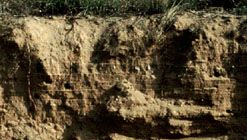
A mixture of water, air, tiny pieces of rock, and hummus. soil. A layer of soil with different physical characteristics from the layer of soil above it and the layer of soil below it. soil horizons. soil profile. The remains of decayed plants or animals in the soil. hummus. Solid rock found under soil. bedrock. p. 333The remains of decayed plants and animals. hummus. p. 333A vertical section of soil that shows the layers. soil profile. p. 333The solid rock that forms Earth's surface. bedrock. p. 333A loose mixture of rock, organic material, water, and air in which plants grow. soil . p. 333A layer in a soil profile soil horizon. p. 333A way of managing soil that reduces erosion and maintains the nutrients plants need. soil conservation
Which sequence below is listed from the smallest particle size to the largest particle size: Clay, silt, sand, gravel. Which type of soil is the smallest in particle size: Clay . Which of the following represents the best range of pH for plant growth: Weak acidic and neutral. Which range of pH is best for plant growth: . What is beneficial about topsoil: Suitable for plant growth. Which physical property causes these soils and other materials to layer in this sequence: Density. Which of the following describes a soil horizon: A layer of soil. What is soil: A mixture of weathered rock, organic matter, air, and water. Soil that allows water to pass through it is considered to be _______________: permeable. The decayed organic matter in soil is called _______________: humus
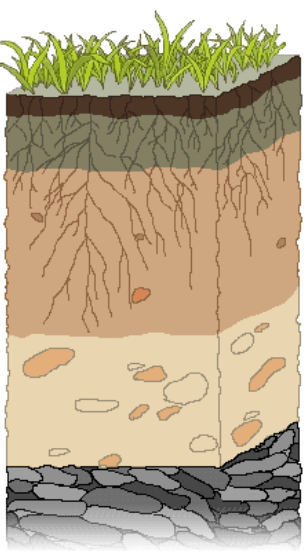
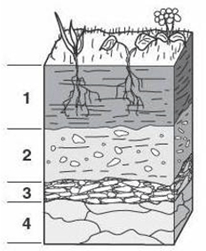
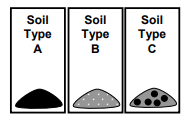
Soil is made of: all of the above. What do we call the different layers of soil: Horizons. Which soil horizon is on the bottom: bedrock. What horizon is just below the topsoil: subsoil. Which horizon is made up of partially weathered rocks: Horizon C. Which of the following is the largest particle in soil: sand. Which horizon contains a solid layer of rock: Bedrock. If soil particles are large, then : less water is retained. How do you determine the texture of soil: rub particles between fingers. The texture of soil depends mainly on: the percentage of sand, silt and clay particles.. Which horizon of soil contains leaf litter, and other organic matter: . The ___________________ the grain size, the faster the water will move through the soil: larger. Which diagram represents the soil with the greatest permeability: Choice 4. Which container has the lowest porosity: C. What is porosity: The amount of space between particles. What is permeability: The ability to allow water to flow through
What are the 3 main soil particles? Sand, silt, clay. What is the best mixture of the soil particles for growing plants? loam. Where do all soil particles originally come from? rocks . What soil particle can collect and hold the most nutrients? Clay . What is the largest soil particle? Sand. What are the three main types of rocks? Igneous, sedimentary, and metamorphic. How are sedimentary rocks formed? Through layering of sediment over time. How are igneous rocks formed? Through the cooling of lava and magma. How are metamorphic rocks formed? Through intense heat and pressure . What kind of rock is limestone? Sedimentary . What is the difference between soil and dirt? Soil is alive and dirt is dead. Why is soil important it provides us with food, clothing, and shelter. What are the four needs of soil anchorage, water, oxygen, nutrients . In an ideal soil matrix, 45% of the soil should be made of what? . In an ideal soil matrix, 5% of the soil should be made up of what? organic matter. What is hummus organic matter produced by fungus that helps hold the soil together. What holds soil particles together all of the above . Who produces globulin? Plants . The ability for soil particles and organic matter to cycle and store nutrients . What are soil horizons? layers in the soil. Where is soil Horizon O; what do you find in it? Top layer; organic matter. What is in Layer R? bedrock. What is in found in layer E Leaching of nutrients. What soil horizon do farmers like best? Horizon A. What is soil health? The ability to cycle and store water and nutrients
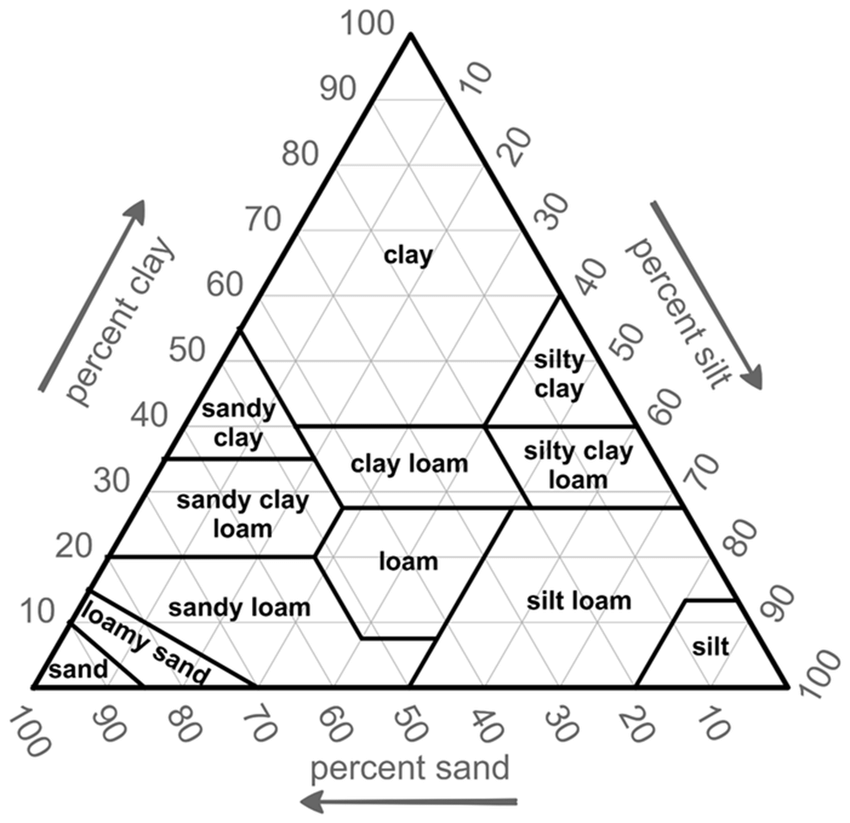
Which of the following is NOT a type of soil particle: Rock. Which soil component makes up about 5% of an ideal soil: Organic Matter. Which soil component makes up about 45% of an ideal soil: Minerals. Which soil component makes up about 25% of an ideal soil: Both A and C. What is the area between soil particles called: Pore Spaces. Which soil particle is the largest in size: Sand. Which soil particle is the smallest in size: Clay. Which soil horizon is also known as “bedrock”: R Horizon. Which soil horizon is commonly called the subsoil: B Horizon. Which soil horizon is contains decomposed plants and animals: O Horizon. What is the definition of weathering: The wearing away of something by long exposure. What category is the following?Clay 50%, Silt 20%, Sand 30%: Clay. What category is the following?Clay 20%, Silt 40%, Sand 40%: Loam. What category is the following?Clay 40%, Silt 50%, Sand 10%: Silty Clay Loam. What category is the following?Clay 10%, Silt 70%, Sand 20%: Sandy Loam
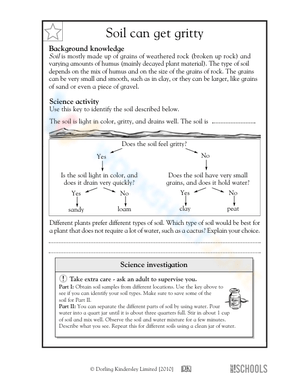
In this science worksheet, your child uses a key to determine the soil type.
Tiny organisms or living things that can sometimes cause colds are called bacteria. When a farmer adds chemicals to make plants grow more quickly, they fertilize. The wearing away of soil by rain and wind is called erosion. Items that make up other things are called ingredients. A ______ is a drawing that shows relationships. diagram. _____ is a rough, heavy ingredient of soil that dries quickly. Sand. ____ is a grainy ingredient of soil that dries more slowly than sand. Silt. To ______ means to take good care of something. conserve. ____ is a slippery and smooth ingredient of soil that dries very slowly Clay. ____ are substances that plants and animals need to live. Nutrients
The students can review the layers of soil, types of weathering, and ingredients of soil using this engaging worksheet to help them.
Explore soil science! This worksheet introduces soil composition and its importance. Download now and learn about soil! #SoilScience #EnvironmentalScience
Discover the different components of soil and their importance. This worksheet is great for earth science students. Start learning today!
Discover the different layers of soil and their characteristics. Perfect for earth science students with our soil layers worksheet. Start today!
The part of soil that is made up of broken down pieces of dead plants and animals is _______. humus. Soil with grains of rock that you can see with your eyes is known as _______. sand. _______ is a mixture of sand, clay, and humus loam. How many soil layers do we learn about in 3rd grade? 3. Which layer of soil is on the top of the earth? topsoil. Which layer of soil is the deepest? bedrock. What type of soil is found mostly on farms because it grows the best plants? loam. _____ is a soil type that can be found on the bottom of ponds, lakes, and rivers. clay. Which soil is defined by NOT being able to be seen with your eye? It can be found in river and ocean WATER. silt. Which soil can be found mostly at the beach, in a sandbox, or on a river bank? sand
What makes soil so special? Take the Properties of Soil Quiz today and learn more about this special resource!
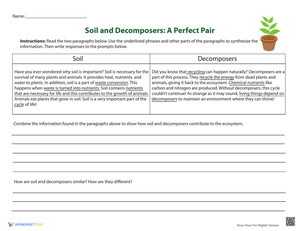
Explore soil and decomposers with this science worksheet! Learn about environmental science and the importance of ecosystems. Download Soil today!
Learn about soil science with our engaging worksheet! Discover soil types and their importance. Download now and explore! #soilscience #worksheet
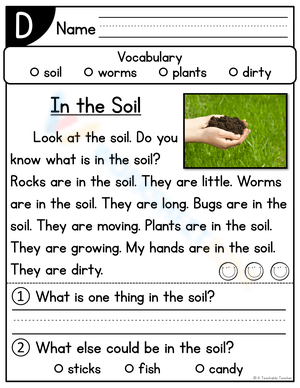
Explore the components of soil with the 'In The Soil' worksheet. Learn about what's in the soil and its importance for our enviroment. Explore today!
Do you know about the different types of garden soil? Take the Garden Soil Review quiz today and increase your knowledge!
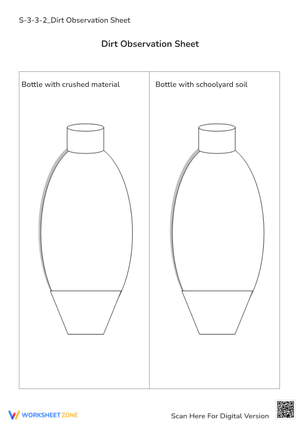
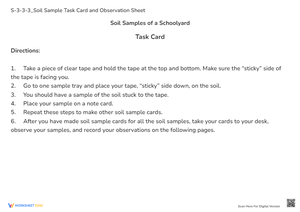
Explore soil science with this dirt observation sheet! Compare soil samples & record findings. Grades 1-4. Develop observation skills now!
Explore soil science with this hands-on activity! Collect & observe soil samples with tape & note cards. Perfect for grades 3-5. Get started now!
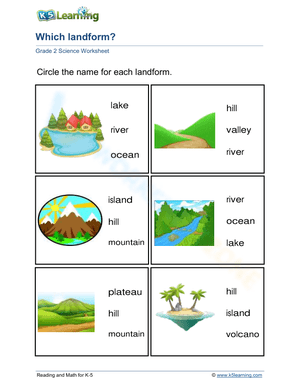
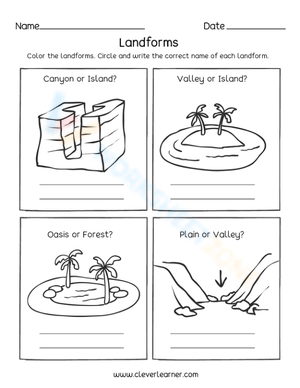
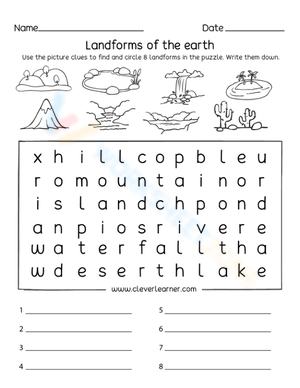
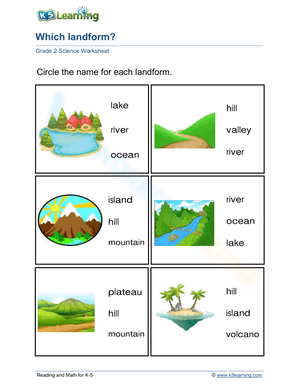
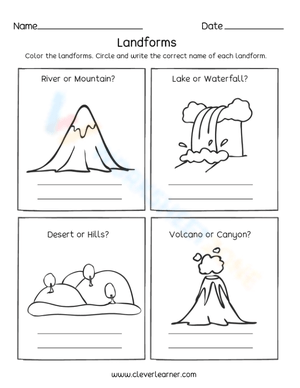
Students identify various landforms and bodies of water (mountains, valleys, cliffs, canyons, etc).
This collection is a great way for students to have fun while learning about the different types of landforms, and to build their vocabulary.
The prominence of a majestic mountain, the expanse of a sea, the roaring waterfall; dazzles the senses. The mere perception of the landforms and bodies of water on the earth leaves one awestruck. Navigate through these major landforms and bodies of water worksheets that give a vivid understanding of the concept to kids.
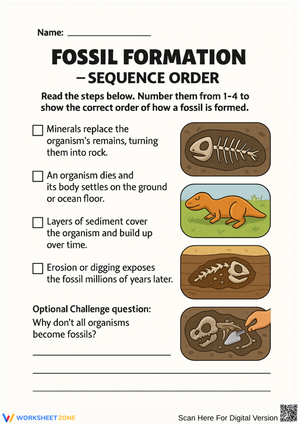
Sequence the four steps of fossil formation in this earth science worksheet. Great for Grades 3–5 and pairs with Fossils Sorting and Fossils Review activities.
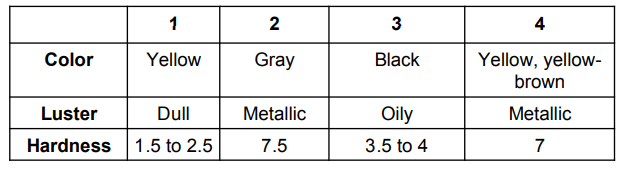
A student has collected a group of rocks. All the rocks collected ________________: are different sizes. Students sorted rocks into 4 groups.The new rock belongs in which group: Group 3. You can touch or feel a rock to describe which of the rock’s characteristics: texture. A student is testing a rock by trying to scratch it with different objects. It is a good test for answering which of the following questions? : What is the hardness of a rock?. The chart shows some properties of four different rocks.Which of the following rocks can be grouped together using their luster: 2 and 4 . A student is investigating the textures of soils. Which soil feels the roughest: sand. Sophia is blindfolded. She feels a soil. It feels powdery, soft, and she cannot feel any particles in between her fingers. What soil is she most likely feeling? : clay. Which is the best type of soil for growing vegetables: loam. Which type of soil feels smooth when you rub it between your fingers: clay. Use the picture to answer the following questionWhich statement explains how the features MOST LIKELY formed: Wind made the arch by weathering rock.. Which BEST describes the action of wind and waves on a beach: They decrease the size of the sand particles.. When water runs down a hill of loose soil, it will cause what change to the soil: Soil from the top of the hill will be moved to the bottom.. Students observed that in one corner of the playground was a patch of smooth, flat soil. After several days, they noticed that ripples had formed across the sand. What was the most likely cause of this change: Wind blowing. What happens when strong winds blow sand against large rocks: Tiny pieces of rock break off.. Dunes are large piles of sand that move slowly on beaches. What causes the dunes to move from place to place? : Blowing winds
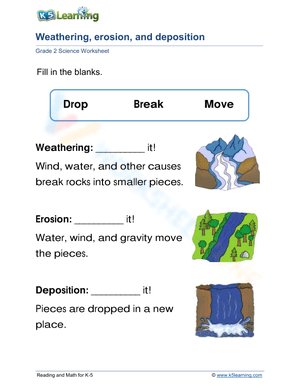
Weathering breaks down natural materials into smaller pieces which are carried to different places (erosion) where they are deposited (deposition). These earth science worksheet reviews this process which constantly changes our landscapes.
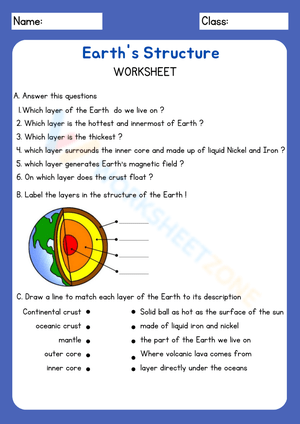
Earth’s structure worksheet for Grade 4–5 students to practice identifying, labeling, and understanding the layers of the Earth through diagrams and questions.
Find perfect worksheets
Grade + Topic search
Select your Grade level, Topic and Subject to find worksheets instantly or you can use keyword below to search what you need.
Make your own worksheets