


























Views
Plays
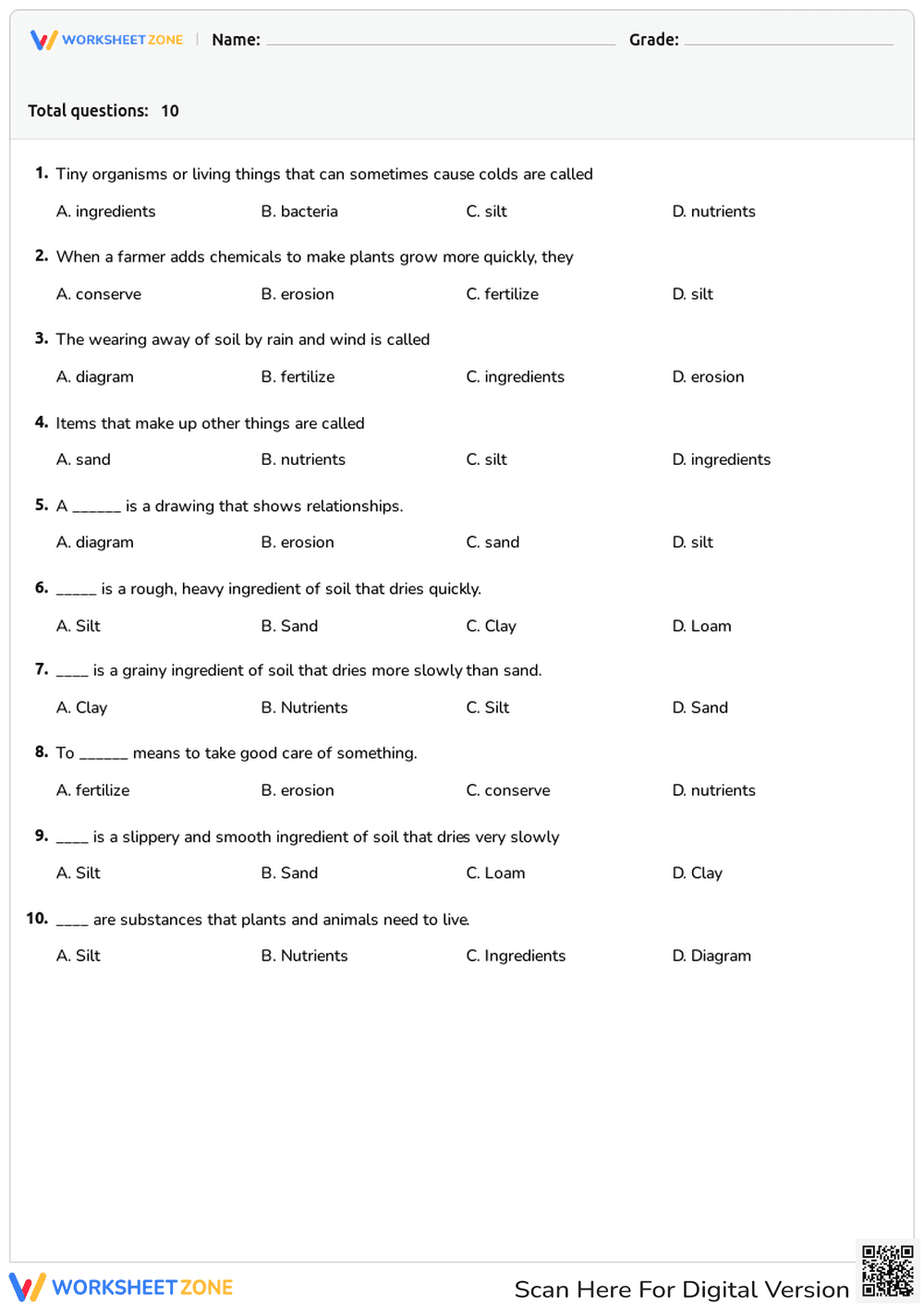

Soils Vocabulary Review | Essential Grade 2 Science
Paste this activity's link or code into your existing LMS (Google Classroom, Canvas, Teams, Schoology, Moodle, etc.).
Students can open and work on the activity right away, with no student login required.
You'll still be able to track student progress and results from your teacher account.
This Soils Vocabulary Review worksheet provides students with a focused opportunity to master essential earth science terminology. By identifying key concepts like erosion, nutrients, and soil composition, learners build a foundational understanding of how land changes and what plants need to thrive. It is designed for immediate classroom application and vocabulary mastery.
At a Glance
- Grade: 2 · Subject: Science
- Standard:
2-ESS2-1— Compare multiple solutions designed to slow or prevent wind or water from changing land- Skill Focus: Soil properties and earth science vocabulary
- Format: 1 page · 10 problems · Answer key included · PDF
- Best For: Quick assessment or vocabulary reinforcement
- Time: 10–15 minutes
What's Inside
This resource features 10 carefully crafted multiple-choice questions on a single page. Each question targets a specific vocabulary term related to soil science, including biological factors like bacteria, chemical processes like fertilization, and physical properties of sand, silt, and clay. A comprehensive answer key is provided to facilitate rapid grading or student self-correction.
Zero-Prep Workflow
- Print: Open the PDF and print the single-page review for your class (30 seconds).
- Distribute: Hand out the copies as a morning warm-up, exit ticket, or independent practice session (1 minute).
- Review: Use the included key to go over answers as a whole group, providing immediate feedback (5 minutes).
The total teacher preparation time is under 2 minutes, making it an ideal choice for substitute plans or unexpected schedule shifts.
Standards Alignment
The primary alignment for this resource is `2-ESS2-1`, which focuses on understanding land changes and the properties of earth materials. By identifying terms like erosion and conservation, students demonstrate their grasp of how wind and water interact with different soil types. Additionally, it supports `2-PS1-1` by requiring students to classify materials like clay and sand based on their observable properties. Both standard codes can be copied directly into lesson plans, IEP goals, or district curriculum mapping tools.
How to Use It
Use this worksheet as a formative assessment after a hands-on lesson exploring different soil textures. It works effectively during the "Explain" phase of a 5E instructional model to solidify academic language. Teachers should observe if students can distinguish between the drying times of sand versus clay, as this indicates a deeper understanding of material properties. Completion typically takes between 10 and 15 minutes.
Who It's For
This resource is tailored for second-grade students but is also appropriate for third-grade review or advanced first-grade learners. It is particularly helpful for English Language Learners (ELLs) who need explicit practice with science-specific Tier 3 vocabulary. This worksheet provides the necessary scaffolding for students to transition from basic observation to technical scientific description.
Effective science instruction requires a balance between hands-on exploration and the mastery of academic language. According to the RAND AIRS 2024 report, students who engage with structured vocabulary reinforcement alongside inquiry-based activities show a 22% higher retention rate of complex scientific concepts. This Soils Vocabulary Review addresses the need for linguistic precision in the earth sciences by isolating ten critical terms, including erosion and nutrient cycles. By aligning with the 2-ESS2-1 standard, the worksheet ensures that students are not just memorizing definitions but are building the conceptual framework necessary to understand land stability and agricultural science. Research from Fisher & Frey (2014) emphasizes that "word-conscious" classrooms utilize frequent, low-stakes assessments to bridge the gap between everyday language and technical discourse. This 10-question tool serves as a reliable instrument for measuring that progress within a standard elementary science curriculum.


