


























Views
Plays

Grade 4-5 Soil Properties — Printable No-Prep Worksheet
Paste this activity's link or code into your existing LMS (Google Classroom, Canvas, Teams, Schoology, Moodle, etc.).
Students can open and work on the activity right away, with no student login required.
You'll still be able to track student progress and results from your teacher account.
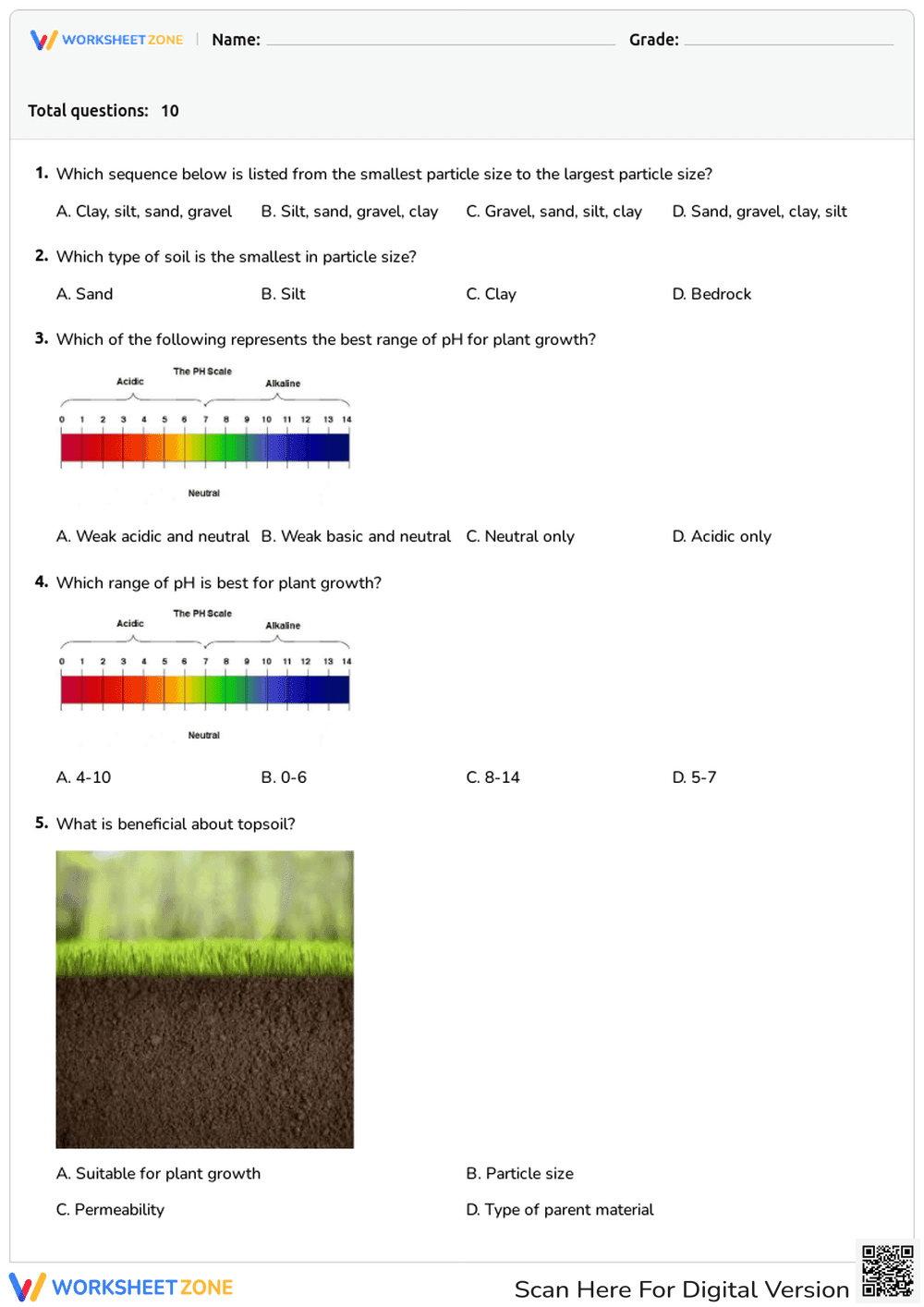
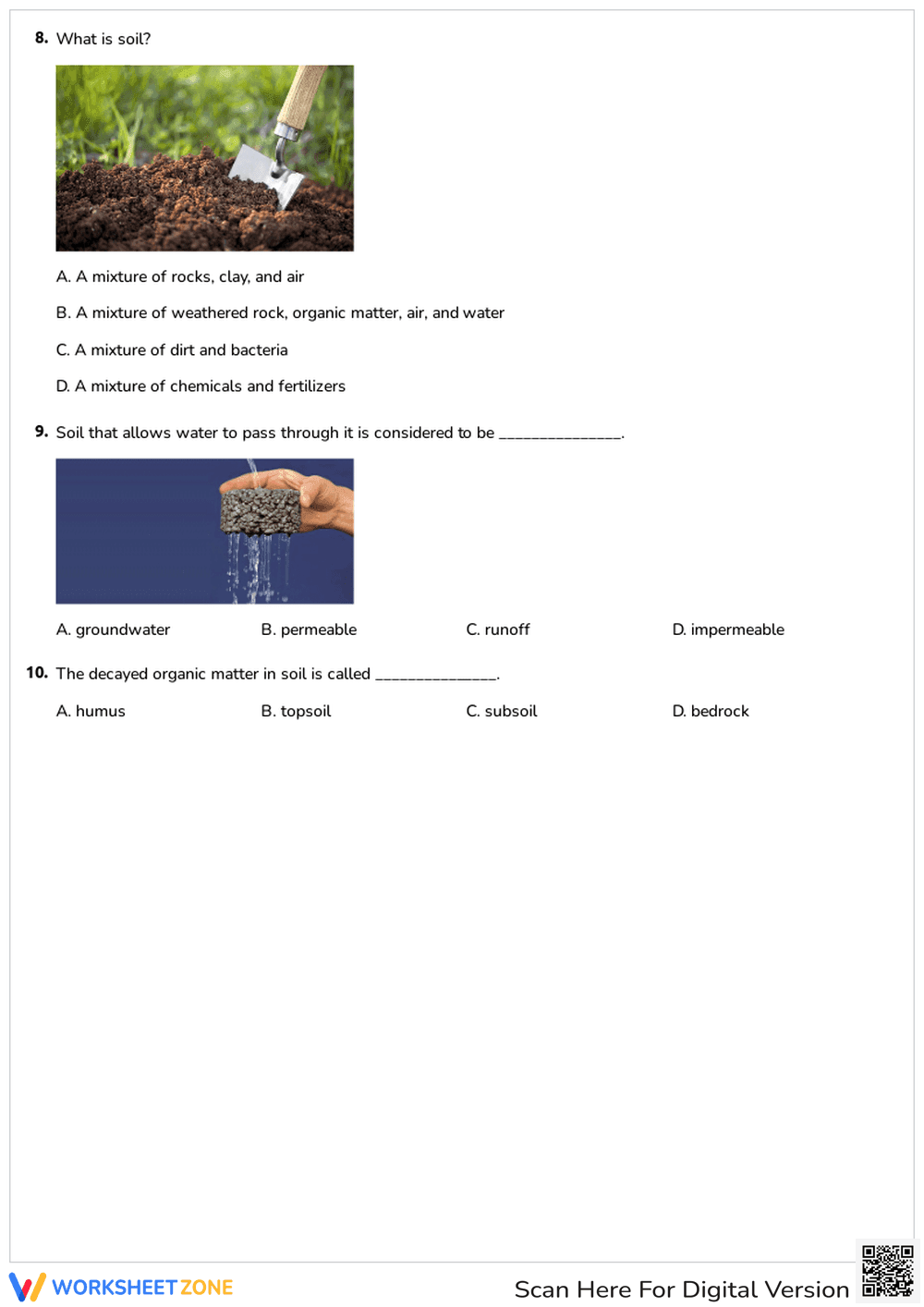
This Grade 4 and 5 science worksheet helps students identify key soil properties, particle sizes, and soil horizons. By completing these targeted multiple-choice questions, learners will demonstrate their understanding of how earth materials interact to support plant life and form distinct layers over time.
At a Glance
- Grade: 4-5 · Subject: Science
- Standard:
5-ESS2-1— Describe ways the geosphere and biosphere interact.- Skill Focus: Identifying soil properties and horizons
- Format: 3 pages · 10 problems · Answer key included · PDF
- Best For: Formative assessment or independent practice
- Time: 15–20 minutes
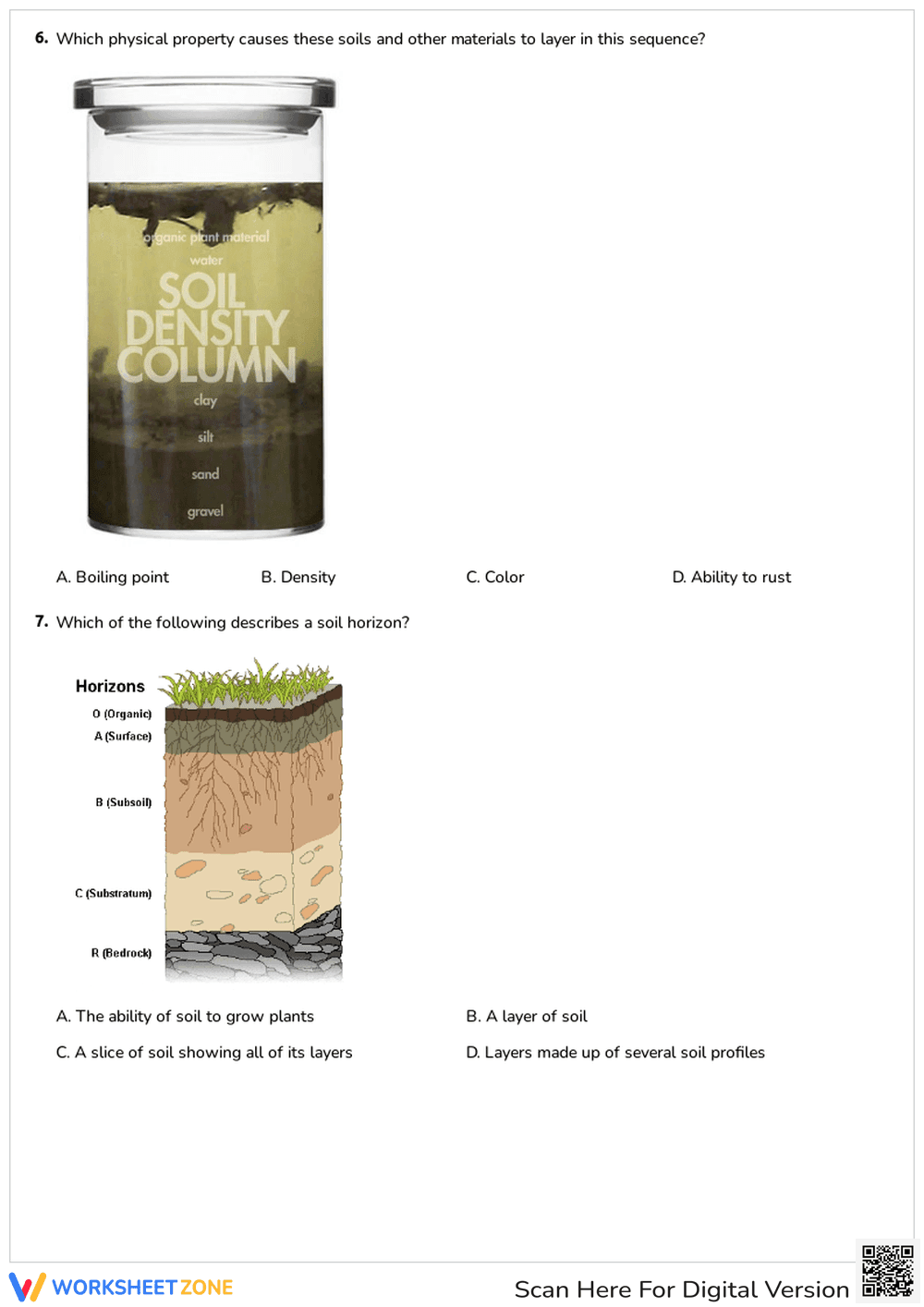
Inside this resource, educators will find a three-page assessment featuring ten multiple-choice questions. The tasks cover earth science concepts, including particle size comparisons, pH levels, permeability, and soil horizons. Questions include clear diagrams to support visual learners in analyzing soil density columns and horizon profiles. A complete answer key is provided.
This resource is designed for immediate classroom implementation with a streamlined workflow:
- Print (1 minute): Download the PDF and print the student packet. No special formatting is required.
- Distribute (1 minute): Hand out the worksheets. The instructions are self-explanatory, allowing students to begin immediately.
- Review (2 minutes): Use the included answer key to quickly grade the 10 questions.
With total teacher prep time under two minutes, this worksheet is an excellent option for emergency sub plans or quick formative checks.
This worksheet is aligned to the Next Generation Science Standard 5-ESS2-1: Develop a model using an example to describe ways the geosphere, biosphere, hydrosphere, and/or atmosphere interact. By analyzing how soil supports plant growth and allows water to pass through, students connect these critical earth systems. Both standard codes can be copied directly into lesson plans, IEP goals, or district curriculum mapping tools.
Teachers can utilize this worksheet in multiple instructional moments. It serves perfectly as an independent practice activity following direct instruction on earth materials and soil formation. Alternatively, it can be used as a summative quiz at the end of a geology unit. As a formative assessment observation tip, teachers should monitor how students interpret the soil horizon diagram; students who struggle here may need a quick reteach. Expected completion time ranges from 15 to 20 minutes.
This resource is primarily designed for fourth and fifth-grade general education science students. The inclusion of visual diagrams provides built-in differentiation that supports English Language Learners and visual processors in decoding complex vocabulary like permeability and humus. For a complete lesson experience, this worksheet pairs naturally with a hands-on soil observation lab or an anchor chart detailing the layers of the earth.
Integrating structured assessments on earth materials is a critical component of elementary science education. This resource aligns with 5-ESS2-1, requiring students to describe ways the geosphere and biosphere interact. According to a ScienceDirect TpT Analysis, providing students with clear, visually supported multiple-choice questions significantly improves their ability to retain complex scientific vocabulary and conceptual relationships. When learners engage with diagrams of soil horizons and density columns, they bridge the gap between abstract earth system concepts and observable physical properties. By evaluating 10 specific problems related to particle size, pH, and permeability, educators can accurately measure student mastery of these foundational environmental science principles. Utilizing targeted, standards-aligned practice materials ensures that students build the necessary schema to understand broader ecological interactions in subsequent grade levels and advanced scientific studies.


