




























Views
Downloads
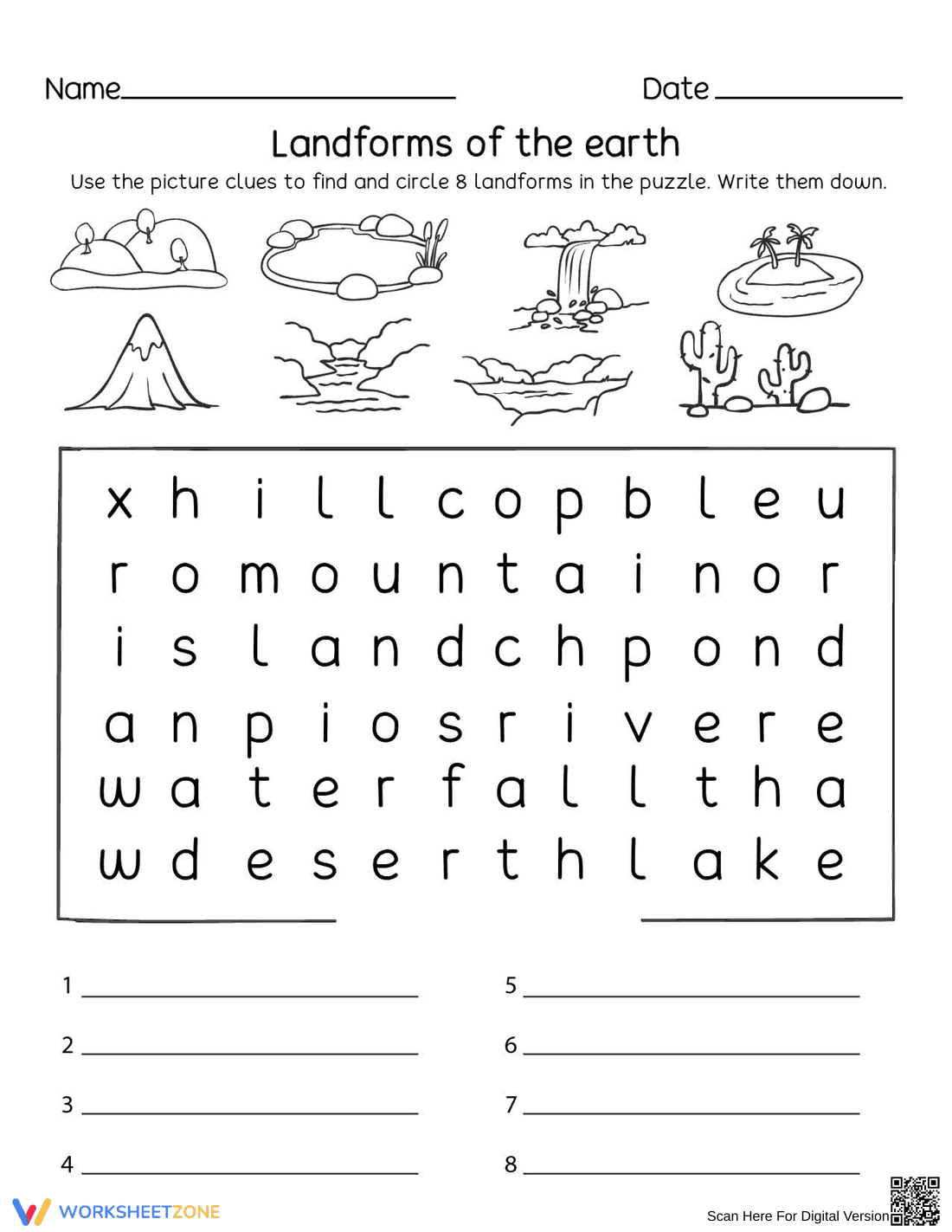

Printable Landforms of the Earth Word Search | Grades K-2

Paste this activity's link or code into your existing LMS (Google Classroom, Canvas, Teams, Schoology, Moodle, etc.).
Students can open and work on the activity right away, with no student login required.
You'll still be able to track student progress and results from your teacher account.
This Landforms of the Earth word search worksheet helps early elementary students identify and name common physical features found on our planet. By matching visual picture clues to hidden words in a puzzle, learners build essential science vocabulary and spatial recognition skills. It is an ideal resource for introducing Earth's surface features in a fun, engaging way.
At a Glance
- Grade: K–2 · Subject: Science
- Standard:
2-ESS2-2— Represent the shapes and kinds of land and bodies of water- Skill Focus: Landform identification and vocabulary
- Format: 1 page · 8 problems · Answer key included · PDF
- Best For: Independent practice and zero-prep sub plans
- Time: 15–20 minutes
This single-page PDF features 8 high-quality illustrations of landforms including mountains, deserts, and waterfalls. Students use visual clues to locate terms within a clear word search grid. Numbered lines provide space for students to practice spelling as they record their discoveries. A complete answer key is provided for quick grading and immediate feedback.
This resource allows for a zero-prep, three-step classroom integration. First, print the single-page PDF (30 seconds). Second, distribute the worksheets as a morning work assignment or science center activity (1 minute). Finally, use the answer key to review results or allow students to self-correct (1 minute). Total teacher prep time is under two minutes, perfect for sub plans.
The primary alignment is `2-ESS2-2`, which requires students to develop a model to represent the shapes and kinds of land and bodies of water in an area. By identifying landforms like hills, rivers, and lakes through picture clues, students are building the foundational mental models necessary for geographic literacy. Both standard codes can be copied directly into lesson plans, IEP goals, or district curriculum mapping tools.
Assign this worksheet during the elaborate phase of a science lesson to reinforce vocabulary. It also serves as a formative assessment tool; observe if students can independently pair the visual representation with the text. Most students will complete the dual-task of finding and writing words within 20 minutes, allowing for a smooth transition to the next instructional block.
This worksheet is specifically tailored for Kindergarten, First Grade, and Second Grade learners. The inclusion of picture clues provides necessary scaffolding for emerging readers, while the word search offers a challenge for more advanced students. It pairs naturally with a classroom anchor chart showing real-world photos of the landforms featured in the puzzle.
According to the RAND AIRS 2024 report, vocabulary acquisition is a critical predictor of success in Earth Science. This worksheet utilizes a dual-coding approach—combining imagery with word search tasks—to deepen the connection between a landform's name and its physical characteristics. Research from Fisher & Frey (2014) emphasizes that word-solving puzzles bridge the gap between initial exposure and independent usage of academic language. By requiring students to find and write words, the resource enforces multi-sensory learning. This alignment with 2-ESS2-2 ensures students engage with the Representing Land and Water performance expectation. The activity supports 8 targeted landform terms, providing necessary repetition for mastery in early elementary settings. Students move from recognition to production through the writing task, solidifying their understanding of Earth's diverse physical features before moving to complex map reading.


