


























Views
Downloads

Essential Landforms Worksheet | Grade K-2 Science
Paste this activity's link or code into your existing LMS (Google Classroom, Canvas, Teams, Schoology, Moodle, etc.).
Students can open and work on the activity right away, with no student login required.
You'll still be able to track student progress and results from your teacher account.
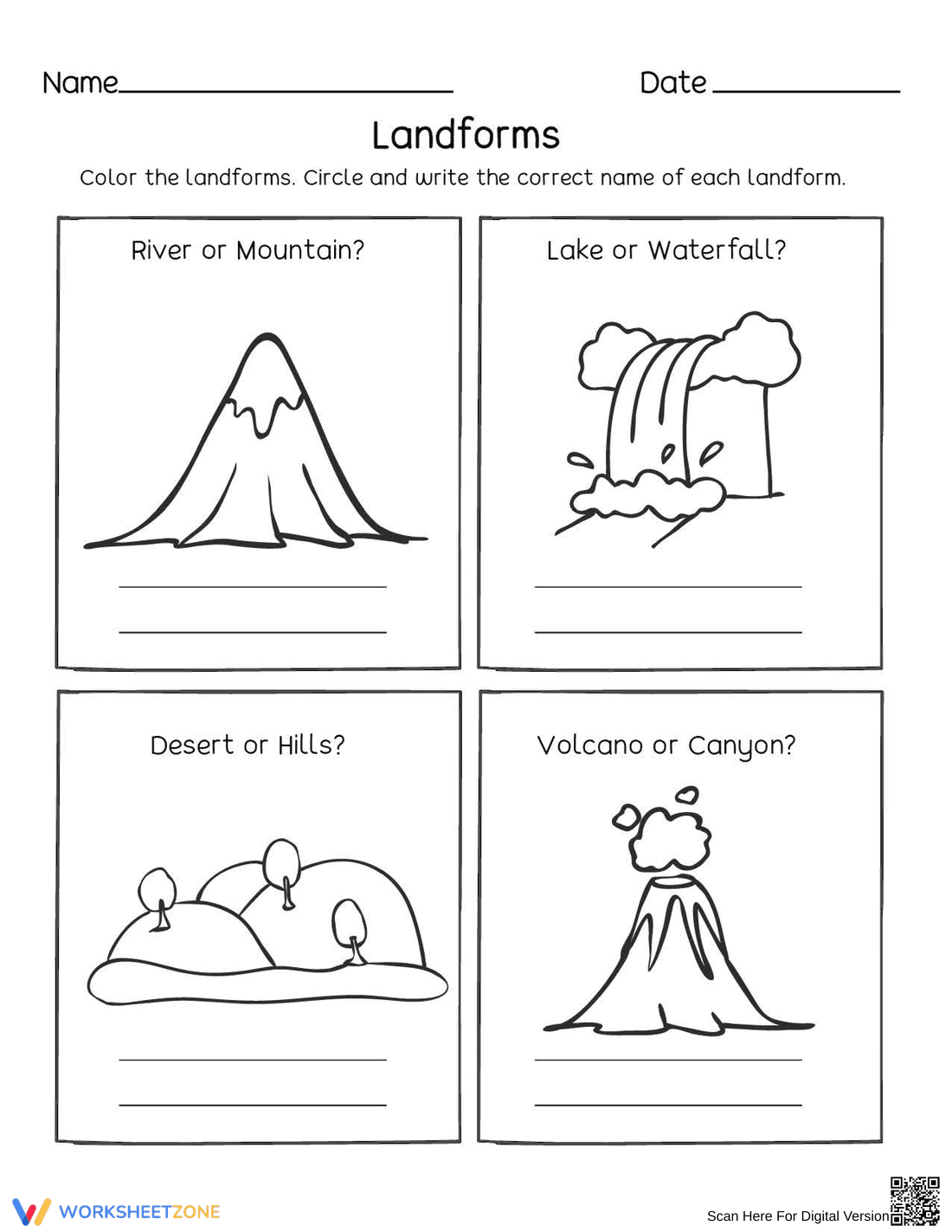
This essential landforms worksheet helps primary students identify and name geographic features through interactive visual recognition. By combining coloring, circling, and writing, the activity solidifies vocabulary acquisition while reinforcing observation skills. Students demonstrate their understanding of Earth’s surface by distinguishing between mountains, waterfalls, and volcanoes in a clear, zero-prep format.
At a Glance
- Grade: K-2 · Subject: Science
- Standard:
2-ESS2-2— Identify and represent the shapes and kinds of land and water- Skill Focus: Landform identification and vocabulary
- Format: 1 page · 4 problems · Answer key included · PDF
- Best For: Introduction to Earth science or review
- Time: 15–20 minutes
What's Inside
This one-page PDF features four quadrants, each presenting a high-quality illustration of a specific landform. Students are prompted to choose between two options, circle the correct term, and practice fine motor skills by writing the word on primary-ruled lines. The black-and-white line art is designed for coloring, providing a multi-sensory approach to learning about the natural world and Earth's diverse surface features.
Zero-Prep Workflow
The zero-prep design makes this resource a reliable tool for busy educators. Print the single-page document (30 seconds) and distribute it to students. Second, provide crayons for the interactive component (1 minute). Finally, review responses as a quick exit ticket (1 minute). This streamlined process requires under three minutes of total teacher preparation time.
Standards Alignment
The activity is primarily aligned with 2-ESS2-2, which requires students to develop a model to represent the shapes and kinds of land and water in an area. By identifying features like waterfalls and hills, students build knowledge necessary for more complex topographical analysis. It also supports CCSS.ELA-LITERACY.L.K.5.A through category sorting. Both standard codes can be copied directly into lesson plans, IEP goals, or district curriculum mapping tools to ensure compliance.
How to Use It
Incorporate this worksheet during the "Explain" phase of a 5E science lesson on Earth's systems. It serves as an excellent formative assessment to check for misconceptions between similar features, such as hills and mountains. For a more interactive experience, have students observe a "think-aloud" on one quadrant before completing the remaining three independently. Expect most Grade 1 students to finish in approximately 15 minutes, allowing time for coloring and vocabulary review.
Who It's For
This resource is tailored for Kindergarten through Grade 2 students, including English Language Learners who benefit from visual-to-text pairing. The simple sentence structures and clear font make it accessible for beginning readers. It pairs naturally with a classroom anchor chart showing real-world photographs of landforms or a short video clip demonstrating the difference between a volcano and a mountain landscape.
Scientific literacy in the primary grades depends heavily on the integration of visual models and direct vocabulary instruction, as emphasized in recent educational research. According to Fisher & Frey (2014), the use of scaffolds like word banks and writing prompts within a gradual release of responsibility framework significantly improves student retention of domain-specific terminology. This worksheet applies those principles by requiring students to recognize, select, and then produce the name of landforms like volcanoes and canyons. By engaging in 4 specific identification tasks, students move from passive observation to active classification, a critical cognitive step in meeting NGSS 2-ESS2-2 benchmarks. The combination of coloring and writing ensures that the material is processed through multiple neural pathways. This evidence-based approach provides teachers with a high-utility tool that bridges the gap between simple identification and mastery of complex Earth science concepts.


