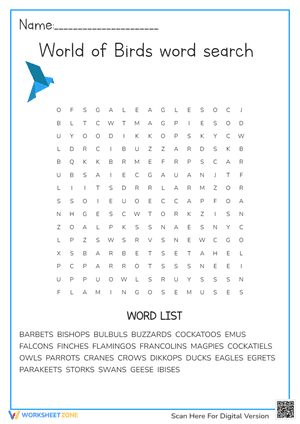
When you are teaching a unit on birds, habitats, or animal life cycles, students need repeated exposure to specialized vocabulary before those words stick. A bird word search gives students a low-pressure way to encounter terms like beak, talon, wing, migration, and habitat again and again as they scan the letter grid. Because the puzzle format asks students to locate exact spellings, it doubles as spelling reinforcement without feeling like a spelling drill.
This makes a bird word search a natural companion to a science read-aloud, a nonfiction text set on birds, or an ELA unit that pairs informational text with vocabulary-building activities. You can hand it out after introducing new terms or use it as a review tool once students have already met the words in context.
Formative Assessment With a Bird Word Search
While a word search is not a substitute for a full vocabulary quiz, it can serve as a light formative check. If a student cannot locate or spell a bird-related term correctly within the grid, that is a useful signal that the word needs more direct instruction. Circulating while students work and noting which words cause the most hesitation gives you real-time data to adjust your next mini-lesson or small-group pull.
One study on word search puzzles and vocabulary noted measurable improvement in student vocabulary performance when puzzles were used as part of a structured teaching sequence rather than as a standalone activity, which supports pairing the puzzle with a brief vocabulary check-in rather than using it in isolation.
Classroom Implementation
To get the most out of a bird word search, introduce the word list first with quick definitions or picture cues, especially for terms like talon or migration that may be unfamiliar. Give students a time limit of five to eight minutes so the task stays focused rather than dragging on. Consider having students write a sentence using two or three found words on the back of the page, which extends the activity from pure recognition into application.
For multilingual learners or students who need extra support, pre-highlight two or three words in the grid so they experience early success before tackling the rest of the list independently. This keeps the activity accessible without lowering the vocabulary target for the rest of the class.
Frequently Asked Questions
1. What grade levels are bird word search puzzles best suited for?
Bird word search puzzles work best for grades 1-5, since this range covers students who are building independent reading and spelling skills while also studying animals, habitats, and life cycles in science.
2. How can teachers connect a bird word search to a science unit?
Choose word lists that mirror the vocabulary already used in your bird or habitat unit, such as beak, talon, wing, migration, and habitat, so the puzzle reinforces the same terms students are hearing in read-alouds and lessons.
3. How long should a bird word search activity take in a classroom block?
Most bird word searches fit into a five-to-ten minute window, making them well suited for morning work, early-finisher stations, or a short warm-up before a science lesson.
4. Can a bird word search be used for vocabulary assessment rather than just practice?
It works best as a light formative check rather than a formal assessment. Watching which words students struggle to find gives you a quick signal about which terms need more direct instruction.
5. What bird-related vocabulary words work best for elementary-level puzzles?
Concrete, high-frequency terms tied to bird anatomy and behavior, such as beak, talon, wing, feather, nest, and migration, tend to work best because they connect directly to what students are learning in a bird or habitat unit.















 Interactive Worksheet Maker
 Quiz Maker
 Word Search Maker
 Crossword Puzzle Maker
 Word Scramble Generator
 Sentence Scramble Generator
 Handwriting Worksheet Generator
 Name Tracing Generator
 Fill In The Blank Generator