


























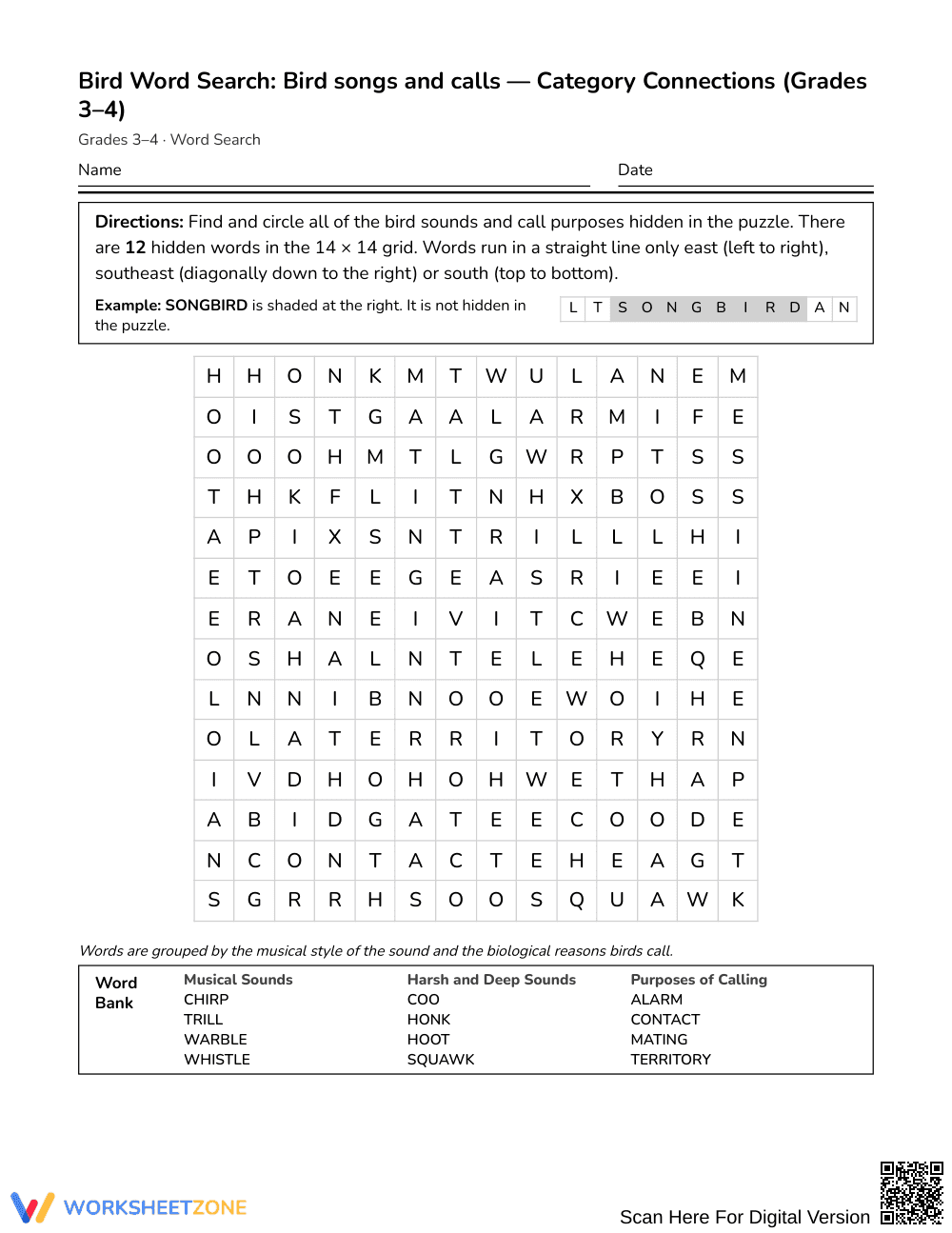

Ready Bird Songs and Calls Word Search | Grades 3–4 Science
Paste this activity's link or code into your existing LMS (Google Classroom, Canvas, Teams, Schoology, Moodle, etc.).
Students can open and work on the activity right away, with no student login required.
You'll still be able to track student progress and results from your teacher account.
This bird songs and calls word search reinforces essential animal communication vocabulary for elementary life science units. Students locate key acoustic adaptation terms while exploring how animals share information, defend space, and attract mates. The engaging puzzle format deepens domain-specific spelling and retention without requiring instructional setup or prep time.
At a Glance
- Grade: Grades 3–4 · Subject: Science
- Standard: Not standards-assessed — vocabulary enrichment
- Skill Focus: Bird songs and calls
- Format: 1 pages · 12 words · Answer key included · PDF
- Best For: Science centers, morning work, sub plans
- Time: 15–25 minutes
What's Inside: A clean, one-page puzzle featuring 12 science vocabulary terms categorized into distinct biological themes. The student page provides categorized word banks that sort sounds by acoustic qualities and behavioral purposes. A comprehensive three-page solution key shows exact letter placements, giving teachers an efficient visual reference for quick verification.
Puzzle Mechanics: Words are embedded in a clear 14 by 14 letter grid. Hidden vocabulary runs exclusively in three beginner-friendly orientations: East (left to right), Southeast (diagonal down-right), and South (top to bottom). Terms are arranged into three meaningful conceptual categories—Musical Sounds, Harsh and Deep Sounds, and Purposes of Calling—helping learners connect phonetic sound types to functional animal behaviors.
Standards Alignment: This activity serves as science vocabulary enrichment and is not aligned to a specific state or national standard. It supports foundational literacy and thematic understanding within general animal adaptation units by building familiarity with specialized communication terms.
How to Use It: Deploy this activity after direct instruction on sensory adaptations to reinforce auditory signals, or place it in an independent science station during station rotations. For a quick formative assessment observation, ask students to pronounce each circled term and explain whether it represents an alarm, territory, or musical call before turning in their sheet. Learners typically finish the activity within 15 to 25 minutes.
Who It's For: Designed for third and fourth-grade learners exploring life science topics like ecosystems and animal survival. It offers accessible spelling reinforcement for English learners and developing readers through structured directional search patterns. Pair this puzzle with an audio recording lesson of regional bird calls or an animal adaptations anchor chart to connect printed terms with real-world sounds.
Targeted vocabulary puzzles provide valuable exposure to complex scientific language by combining orthographic practice with conceptual grouping. According to Fisher & Frey (2014), intentional domain-specific vocabulary acquisition functions best when students repeatedly interact with categorized content words across multiple instructional contexts. This 12-word science search presents elementary learners with foundational biological terminology—including mating, territory, alarm, and contact—anchored directly to animal communication systems. By organizing search terms into musical classifications and behavioral purposes across a 14 by 14 grid, the task strengthens contextual retention and word recognition without cognitive overload. Educators can reliably implement this printable activity during independent work periods, science stations, or substitute teacher assignments to reinforce essential acoustic concepts while fostering student confidence and focus.


