































Complete Bird Life Cycles Word Search | Grades 6–7 Science

Paste this activity's link or code into your existing LMS (Google Classroom, Canvas, Teams, Schoology, Moodle, etc.).
Students can open and work on the activity right away, with no student login required.
You'll still be able to track student progress and results from your teacher account.
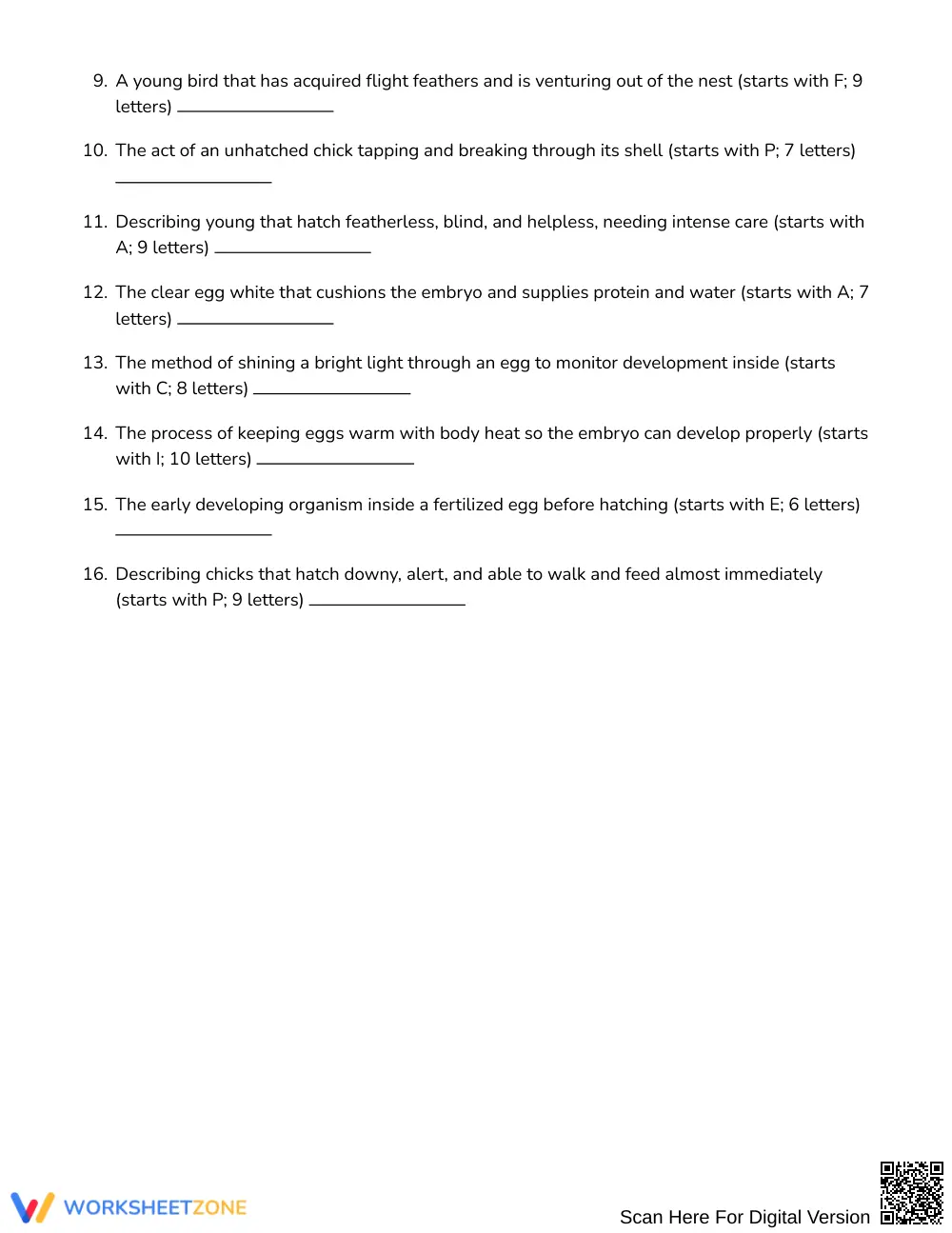
This bird life cycles word search reinforces foundational avian biology terminology for middle school learners. Designed for Grades 6–7 science classes, the activity requires students to identify 16 specialized terms related to avian development and egg anatomy by solving descriptive scientific clues, strengthening retention and reading comprehension in an engaging puzzle format.
At a Glance
- Grade: Grades 6–7 · Subject: Middle School Science
- Standard: Not standards-assessed — vocabulary enrichment
- Skill Focus: Avian egg anatomy and developmental life cycles terminology
- Format: 3 pages · 16 words · Complete answer key included · Printable PDF
- Best For: Life science vocabulary review, unit reinforcement, and early finishers
- Time: 25–35 minutes
What's Inside
This 3-page printable science activity provides a complete vocabulary-building challenge centered on avian reproduction. Rather than scanning for a standard word list, students read 16 rigorous content clues describing key biological concepts—such as the protective chalaza, calcium shell structures, and altricial developmental stages. A full 3-page answer key clearly highlights every hidden term across the puzzle grid, making grading straightforward for teachers and enabling quick student self-checking.
How the Puzzle Works
The activity challenges students through a dense 18 × 18 letter grid containing 16 hidden vocabulary words. Words are hidden in all eight possible compass directions: north, northeast, east, southeast, south, southwest, west, and northwest. Because the worksheet operates as a no-bank challenge, learners must first deduce each target word from its contextual clue before finding it in the letter matrix, requiring genuine retrieval practice rather than passive letter matching.
Standards Alignment
This science resource is designed purely for vocabulary enrichment and is not aligned to a specific state or national standard. It supports core life science units on organism growth, embryonic development, and animal reproduction by deepening familiarity with essential scientific terminology.
How to Use It
Incorporate this puzzle after direct instruction on bird anatomy to consolidate new vocabulary, or assign it during independent study as an active review before a unit exam. For formative assessment, circulate as students analyze the clues to observe whether they can identify developmental structures like the yolk sac or brood patch without consulting notes. Most middle school students complete the entire clue-solving and word-finding process within 25 to 35 minutes.
Who It's For
This worksheet is tailored for Grades 6–7 science students studying vertebrate reproduction, ornithology, or life cycles. For learners needing additional support, teachers can provide an initial letter hint for each clue, while advanced learners can write original sentences contrasting altricial and precocial species. Pair this activity directly with an illustrated avian egg anatomy diagram or a hands-on egg dissection lab.
Domain-specific vocabulary acquisition forms the backbone of scientific literacy in middle school life science. According to Fisher & Frey (2014), intentional exposure to technical terminology through varied retrieval tasks substantially enhances long-term comprehension and conceptual understanding. Although this enrichment word search is not standards-assessed, solving scientific clues requires active recall of specialized definitions—such as incubation, pipping, and albumen—rather than passive scanning. Research demonstrates that pairing contextual definitions with puzzle-based searches prompts cognitive engagement, reinforcing memory pathways for intricate developmental biology concepts. Middle school students who routinely engage with complex terms in structured retrieval formats show improved fluency during subsequent informational text reading and inquiry discussions. This 16-word activity offers educators a targeted, evidence-informed tool to consolidate bird life cycle concepts without increasing instructional overhead, giving adolescent learners a productive mechanism to solidify essential scientific vocabulary during biology units.


