































Essential Bird Habitats Word Search | Grades 6–7 Science

Paste this activity's link or code into your existing LMS (Google Classroom, Canvas, Teams, Schoology, Moodle, etc.).
Students can open and work on the activity right away, with no student login required.
You'll still be able to track student progress and results from your teacher account.
This bird habitats word search reinforces specialized ecological terminology through active definition retrieval and spatial scanning for Grades 6–7 science students. Rather than relying on a simple word bank, learners interpret ecological descriptions to deduce target terms before searching the grid, strengthening environmental science vocabulary and biome comprehension.
At a Glance
- Grade: Grades 6–7 · Subject: Science
- Standard: Not standards-assessed — vocabulary enrichment
- Skill Focus: Bird habitats and biomes
- Format: 3 pages · 16 words · Answer key included · PDF
- Best For: Science vocabulary reinforcement and early finishers
- Time: 25–35 minutes
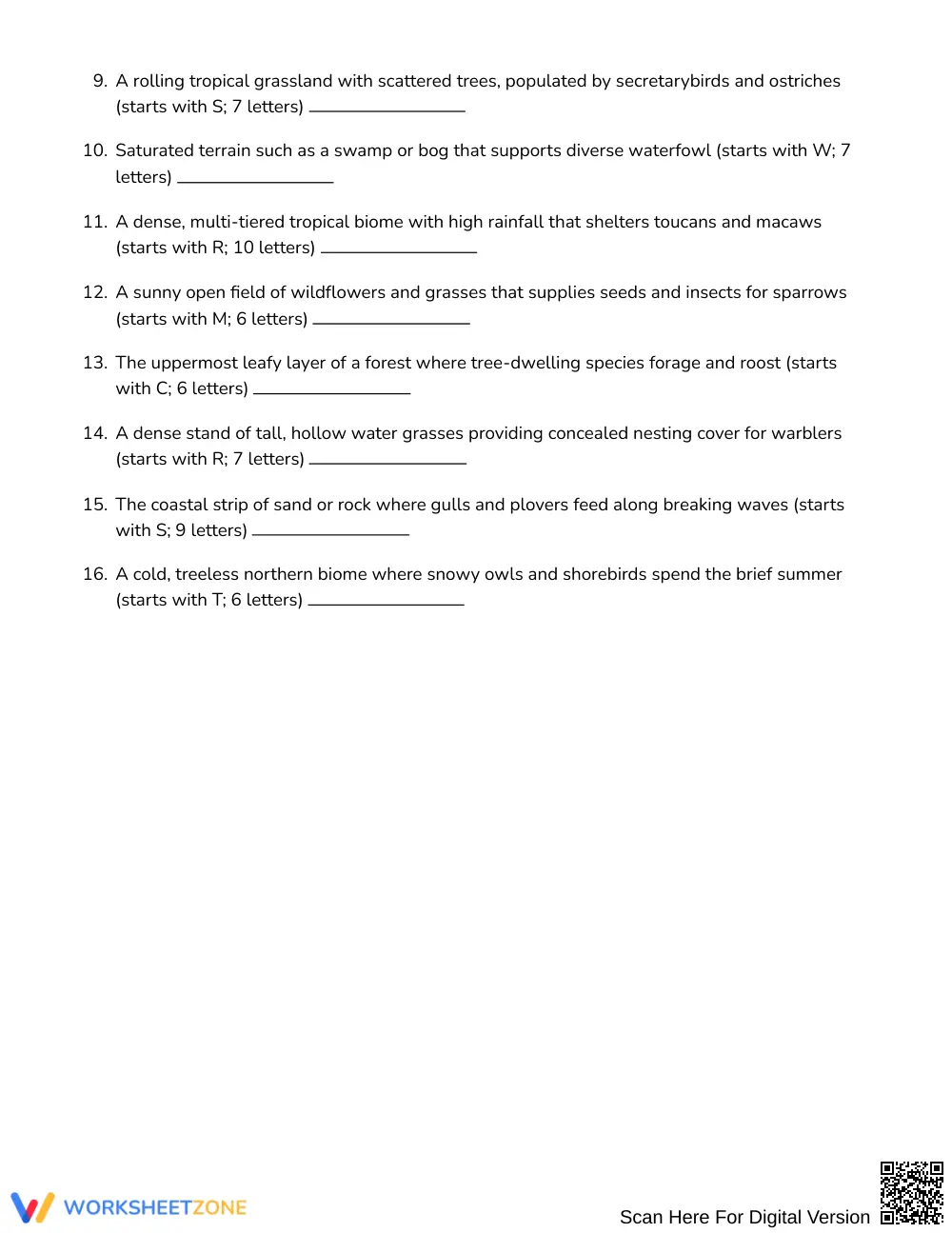
The 3-page printable PDF features an 18-by-18 letter grid accompanied by 16 rigorous habitat clues without an exposed word list. Students encounter technical descriptions of diverse ecosystems—including estuaries, taiga, reedbeds, and alpine cliffs—pairing avian adaptations with physical terrain. A full-size 4-page answer key clearly highlights all hidden target words across the grid for rapid verification.
This no-bank challenge requires students to read each clue, deduce the corresponding ecological term, and locate the 16 words hidden within an 18-by-18 letter matrix. Hidden vocabulary runs in all eight compass directions: north, northeast, east, southeast, south, southwest, west, and northwest, including backward and diagonal placements. By withholding a pre-printed word bank, the activity demands accurate retrieval of scientific definitions before search strategies begin.
This resource serves as targeted vocabulary enrichment and is not aligned to a specific state or national content standard. It reinforces essential life science terminology related to biomes, ecosystems, and animal adaptations through contextual clue deciphering, supporting general middle school earth science and biology literacy.
Deploy this word search during an ecology unit immediately following direct instruction on terrestrial and aquatic biomes. It functions effectively as a collaborative partner review or an engaging station activity. During independent seatwork, circulate to observe whether students deduce terms directly from habitat clues like salinity and canopy structure or need prompt support. Anticipate a completion window of 25 to 35 minutes.
Designed for middle school learners in Grades 6–7, this activity provides rigorous academic language practice for general science classes, gifted enrichment, and independent study. Teachers can scaffold the task for English language learners by pre-highlighting key defining words within the clue text. Pair this word search with an avian adaptation anchor chart or a bird migration reading passage.
Middle school science vocabulary acquisition depends on repeated, meaningful encounters with disciplinary terms rather than rote memorization. Research synthesized in Fisher & Frey (2014) highlights that integrating retrieval practice with context clues significantly enhances lexical retention and conceptual transfer in adolescent learners. By requiring students to analyze descriptive habitat characteristics—such as tidal salinity in estuaries or canopy layers in tropical rainforests—before locating hidden terms, this activity transforms a traditional puzzle into an active retrieval task. Finding 16 words across an 18-by-18 grid reinforces orthographic mapping alongside domain-specific ecological concepts. According to evidence documented by Fisher & Frey (2014), purposeful clue-driven vocabulary tasks support reading comprehension across informational science texts, bridging introductory biome identification with complex ecological reasoning. This resource delivers structured terminology reinforcement across 3 printable pages to build lasting science literacy.


