Why Relative Dating Worksheets Belong in Your Earth Science Unit
When middle schoolers first look at a diagram of stacked rock layers, most of them see a striped cliff, not a timeline. Relative dating worksheets turn that cliff into a readable sequence of events. Instead of memorizing dates, students learn to reason about which layer formed first, which fault cut through later, and where a gap in the record hides missing time. That reasoning is the center of Earth science, and it transfers directly to the evidence-based explanations your standards ask for.
These worksheets work because they give students a concrete, repeatable task: order the events shown in a cross-section. A well-built set starts with clean, undisturbed layers and gradually adds intrusions, folds, and unconformities. By the time students finish, they can defend a full geologic history using only the clues in the diagram, which is exactly the skill you want them carrying into a unit test or lab.
The Five Principles Students Practice
Strong relative dating practice rests on five principles, and good worksheets isolate each one before combining them:
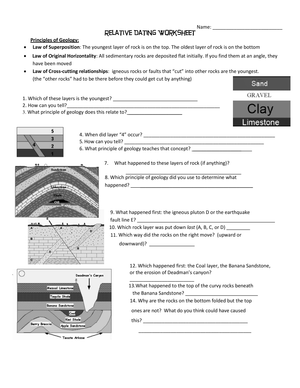
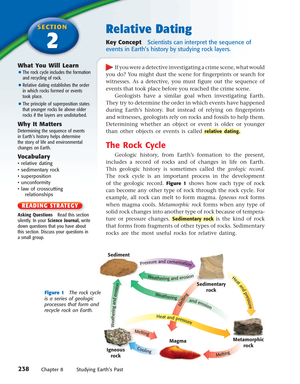
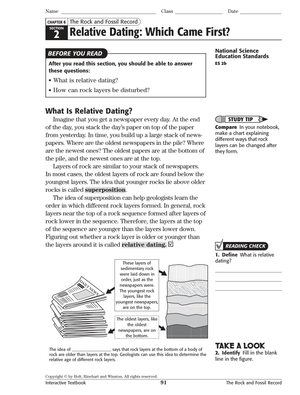
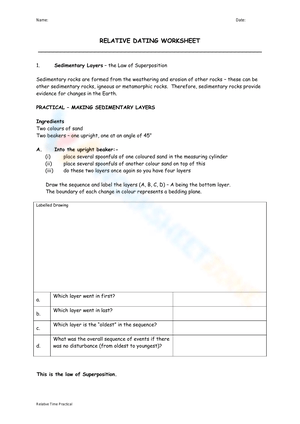
- Superposition: in undisturbed layers, the oldest rock sits at the bottom and the youngest at the top.
- Original horizontality: sediment settles in flat layers, so tilted or folded beds signal later deformation.
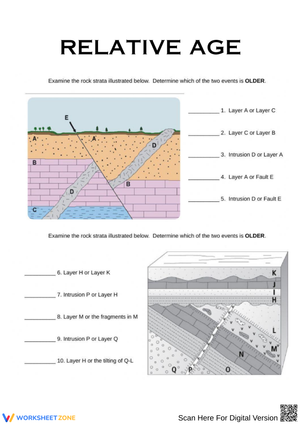
- Cross-cutting relationships: any fault or intrusion is younger than the rock it cuts through.
- Inclusions: rock fragments trapped inside a layer are older than the layer that contains them.
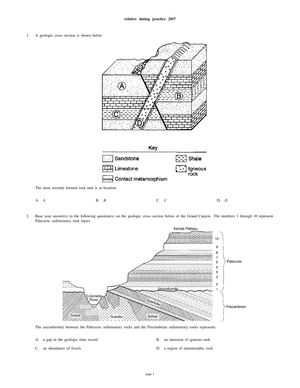
- Unconformities: a buried erosion surface marks missing time and a break in the record.
Sequencing these on paper builds the vocabulary and the habit of mind students need before they ever touch numerical ages. Ask students to name the principle behind every ordering choice so the worksheet becomes a reasoning log, not a matching game.
Building Toward NGSS MS-ESS1-4
Relative dating is not a stand-alone topic; it is the reasoning engine behind a specific performance expectation, so worksheet practice should always point back to it.
The instructional move most teachers miss is that MS-ESS1-4 rewards explanation, not just correct ordering. A student who labels layers A through F in the right sequence but cannot say why the fault is younger has finished the worksheet without meeting the standard. Build a short "because" column beside every diagram so each ordering decision travels with the principle that justifies it. In practice, teachers who add that single column see far fewer students freeze on the constructed-response item, because the worksheet already trained the sentence stem the test demands.
According to the K12 LibreTexts entry on the principles of relative dating, geologists determine the order of events without assigning exact numerical ages, relying on superposition, cross-cutting relationships, inclusions, and unconformities. NGSS standard MS-ESS1-4 then asks students to use that same rock strata evidence to organize Earth's 4.6-billion-year history.
Pairing Rock Strata with the Fossil Record
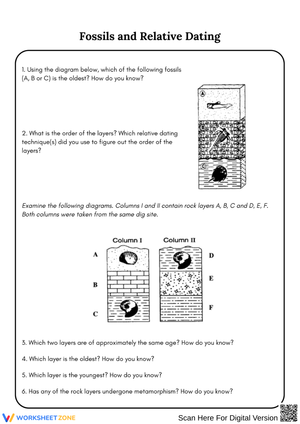
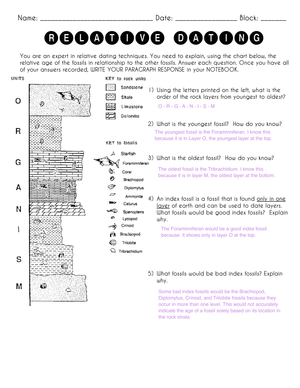
Relative dating gets more powerful when rock layers and fossils appear on the same page. Index fossils let students correlate layers across two separated outcrops, which is a genuinely different skill from ordering one column. When a distinctive fossil shows up in the same relative position at two sites, students can argue that those layers formed during the same interval, even though the columns look different.
This is where Earth science and life science quietly connect. A worksheet that asks students to match fossil bands across cliffs reinforces both the fossil record and the sequencing logic, and it sets up later conversations about extinction and change over time. Keep the numbers off these pages; the goal is still order and correlation, not calculated ages.
Classroom Implementation
Fold relative dating worksheets into a predictable weekly rhythm so students know what mastery looks like. A workable sequence spans about a week:
- Day 1: model one diagram under a document camera, thinking aloud through superposition and original horizontality.
- Day 2: students complete a scaffolded worksheet with a partner, filling the "because" column together.
- Day 3: introduce cross-cutting relationships and inclusions with a slightly harder diagram.
- Day 4: add unconformities and run a short formative check to sort students for the next day.
- Day 5: differentiated practice, with a full-history diagram for extension and a superposition-only reteach for support.
Use the worksheets as formative assessment, not homework compliance. A quick exit slip that asks students to order three events and justify one of them tells you in two minutes who is ready for absolute dating and who still needs another undisturbed-stack repetition. That data makes your next-day grouping decisions almost automatic.
Frequently Asked Questions
1. What grade level typically covers relative dating and the law of superposition?
Relative dating and the law of superposition are usually taught in middle school Earth science, most often in grades 6 through 8, though the reasoning is sometimes previewed earlier and revisited in high school geology.
2. How do relative dating worksheets align with NGSS MS-ESS1-4?
They build the core skill MS-ESS1-4 assesses: constructing an explanation from rock strata evidence. Worksheets that require students to justify each ordering decision map directly onto the standard's demand for evidence-based reasoning about Earth's history.
3. What is the difference between relative dating and absolute dating in a classroom context?
Relative dating establishes the order in which events happened without exact ages, using principles like superposition. Absolute dating, such as radiometric dating, assigns numerical ages. Most middle school units master relative dating first, then introduce absolute methods.
4. What rock layer skills should students show before moving to cross-cutting relationships?
Students should confidently apply superposition and original horizontality to a clean, undisturbed stack, correctly labeling oldest and youngest, before you add faults or intrusions that require cross-cutting reasoning.
5. How can teachers use relative dating worksheets for review before a unit test?
Use a mixed-diagram worksheet as a formative check, then sort students into a reteach group and an extension group. A short exit slip asking them to order and justify events gives you fast, actionable data.












 Interactive Worksheet Maker
 Quiz Maker
 Word Search Maker
 Crossword Puzzle Maker
 Word Scramble Generator
 Sentence Scramble Generator
 Handwriting Worksheet Generator
 Name Tracing Generator
 Fill In The Blank Generator