If a student searches for a definition of half-life the night before a quiz, that is a sign the concept has not landed yet. Half-life worksheets give physical science, chemistry, and physics teachers a way to move students from a vague notion of radioactive decay to a working quantitative model. The core idea is simple to state: half-life is the time required for half of a radioactive samples atoms to decay, and each isotope has its own fixed half-life. The challenge is getting students to apply that idea across multiple steps, multiple half-lives, and word problems that hide the math inside a real-world scenario.
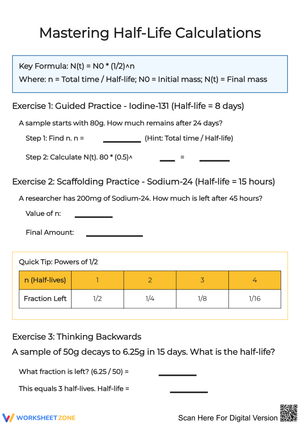
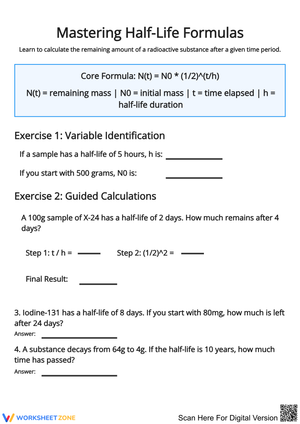
Well-built worksheets sequence practice so students first identify the half-life and elapsed time in a problem, then calculate how many half-lives have passed, and only then compute the remaining quantity. That scaffolding matters more than the topic itself for classes where exponents and fraction reasoning are still shaky.
The Formula Students Actually Need to Apply
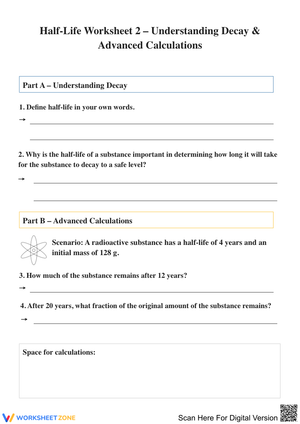
Most half-life problems reduce to one relationship: remaining amount equals initial amount times one-half raised to the power of elapsed time divided by half-life. Worksheets that isolate this formula and walk through it with small, whole-number half-life counts before introducing fractional or non-whole exponents tend to produce fewer computational errors. A useful worksheet progression looks like this:
- Problems with 1-3 whole half-lives and simple starting quantities like 100 grams or 800 atoms
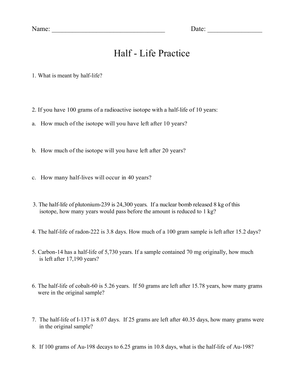
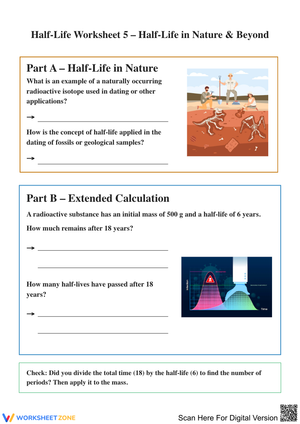
- Problems requiring students to first calculate the number of half-lives from elapsed time and a given half-life value
- Mixed problems that ask students to solve for elapsed time, half-life, or initial amount given the other two variables
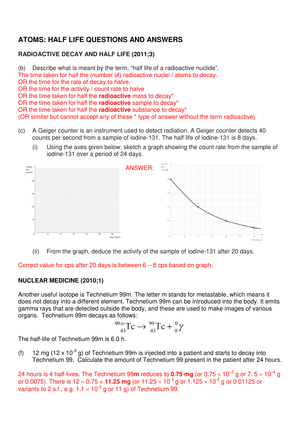
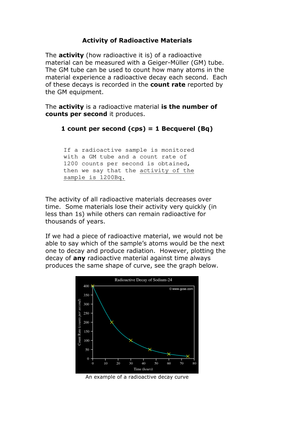
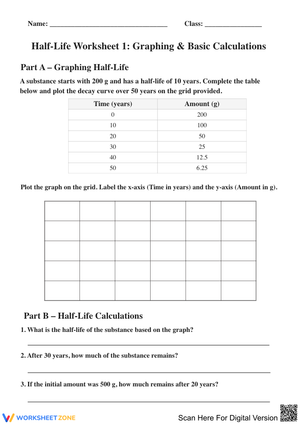
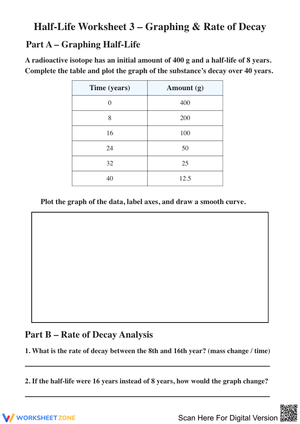
- Graphing tasks where students plot remaining quantity against time to visualize the decay curve
Separating these stages on the worksheet, rather than mixing all four in one column of problems, helps teachers spot exactly where a student's understanding breaks down.
Starting with a Hands-On Decay Simulation
Before assigning a calculation-heavy worksheet, many chemistry and physical science teachers run a simulation activity using candies, coins, or dice. Students start with a set number of pieces, toss them, remove the ones that land on a designated decayed side, and record how many remain after each round. This models the random, exponential nature of decay in a way that a static formula cannot. Classes that run a physical decay simulation before the calculation worksheet tend to produce far fewer arithmetic sign errors and near-zero linear-decay drawings, because students have already seen firsthand that the curve bends rather than falls in a straight line.
After the simulation, students can graph their own class data next to the theoretical curve from the worksheet formula. That comparison is a natural bridge into the more abstract math that follows.
Connecting Practice to Real Isotopes
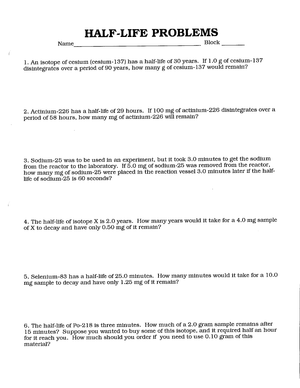
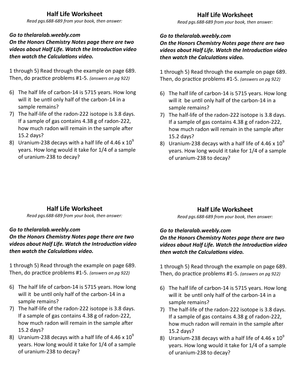
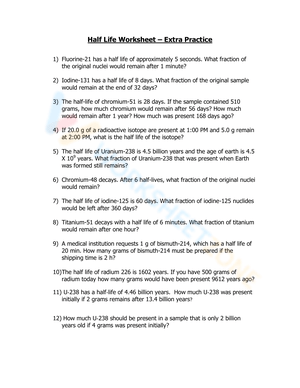
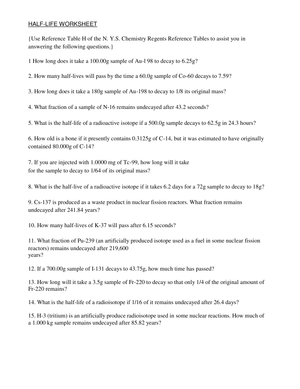
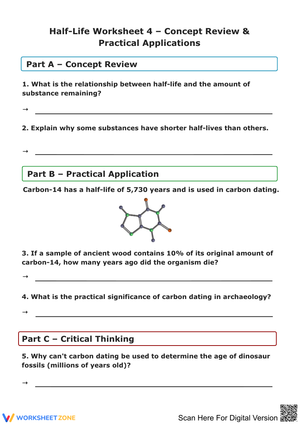
Half-life worksheets land better with students when the numbers are attached to something concrete instead of a generic Isotope X. Carbon-14 is the most common example, with a half-life of about 5,730 years, and it shows up repeatedly in worksheet problems about dating fossils, bones, or archaeological artifacts. Medical isotopes with much shorter half-lives, used in diagnostic imaging or treatment, offer a contrasting example that shows students half-life ranges from fractions of a second to thousands of years depending on the isotope.
A well-designed worksheet uses at least two isotopes with very different half-life scales in the same problem set, since students who only practice with carbon-14 sometimes assume all half-lives run in the thousands of years, which causes confusion later when a medical or industrial isotope problem uses hours or days instead.
Aligning Worksheet Practice with NGSS HS-PS1-8
For high school physical science and chemistry teachers working toward standards-based instruction, half-life worksheets support the Next Generation Science Standards performance expectation HS-PS1-8, which requires students to develop models illustrating nuclear composition changes and energy released during fission, fusion, and radioactive decay, according to the Next Generation Science Standards HS-PS1-8 documentation. Worksheets that pair a decay calculation with a short written explanation of what is physically happening to the nucleus push students past pure computation and into the modeling language the standard calls for.
Resources such as the EPA RadTown Radioactive Atom Activity 5: Half-Life and the AACT Simulation Activity: Half-Life Investigation offer classroom-tested activity structures that pair naturally with worksheet-based calculation practice, giving teachers a hands-on complement to the paper-and-pencil problems.
Frequently Asked Questions
1. What grade level or course typically covers half-life worksheets?
Half-life worksheets are most common in high school physical science, chemistry, and physics courses, particularly in units on nuclear or atomic structure that align with standards like NGSS HS-PS1-8.
2. What prior math skills do students need before tackling half-life problems?
Students benefit from comfort with basic exponents, fractions, and simple algebraic rearrangement before working through multi-step half-life word problems.
3. How can teachers make half-life practice more hands-on rather than purely computational?
Pairing a physical decay simulation, such as tossing candies, coins, or dice, with the calculation worksheet gives students a concrete model of exponential decay before they see the formula in the abstract.
4. How do half-life worksheets align with NGSS HS-PS1-8?
They support the modeling and quantitative reasoning called for in HS-PS1-8, which asks students to represent nuclear composition changes and energy released during radioactive decay.
5. How can half-life worksheets be used for review, intervention, or enrichment?
The same worksheet structure can be adjusted in complexity to serve as pre-test review, targeted small-group intervention, or an extension task for students ready to explore additional isotopes.












 Interactive Worksheet Maker
 Quiz Maker
 Word Search Maker
 Crossword Puzzle Maker
 Word Scramble Generator
 Sentence Scramble Generator
 Handwriting Worksheet Generator
 Name Tracing Generator
 Fill In The Blank Generator