




























1 / 3
0
Views
0
Downloads


Save
0 Likes
Share
Advanced Relative Dating
0 Views
0 Downloads

Paste this activity's link or code into your existing LMS (Google Classroom, Canvas, Teams, Schoology, Moodle, etc.).
Students can open and work on the activity right away, with no student login required.
You'll still be able to track student progress and results from your teacher account.
Information
Description
What It Is:
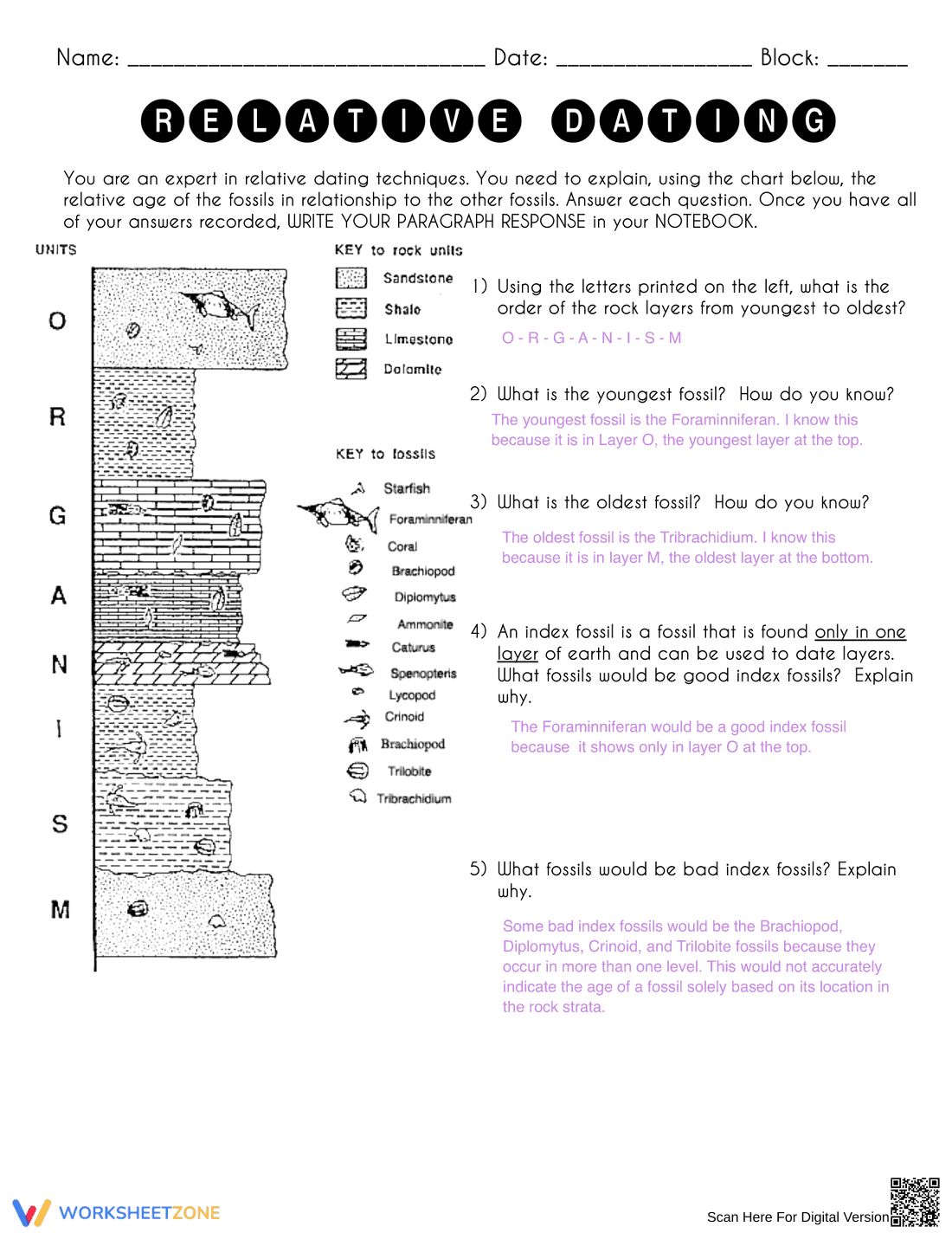
This is an educational worksheet focused on relative dating in geology. It features a diagram of rock layers labeled with letters (O, R, G, A, N, I, S, M) and keys for rock types (Sandstone, Shale, Limestone, Dolomite) and fossils (Starfish, Foraminiferan, Coral, Brachiopod, Diplomyus, Ammonite, Calanus, Spirifer, Lycopod, Crinoid, Brachiopod, Trilobite, Tribrachidium). The worksheet includes five questions that require students to determine the relative age of rock layers and fossils based on their position in the diagram and the concept of index fossils.
Grade Level Suitability:
This worksheet is suitable for middle school (grades 6-8) and early high school (grades 9-10). It requires students to understand basic geological concepts like rock strata, fossil identification, and relative dating principles, which are typically introduced in these grade levels.
Why Use It:
This worksheet helps students develop critical thinking skills by analyzing a visual representation of rock layers and fossils. It reinforces the understanding of relative dating principles, index fossils, and the interpretation of geological data. It encourages students to explain their reasoning and justify their answers.
How to Use It:
Students should first study the diagram of rock layers and the accompanying keys. Then, they should answer the questions by analyzing the diagram and applying their knowledge of relative dating. The questions prompt them to identify the oldest and youngest layers and fossils, explain the concept of index fossils, and identify fossils that would not be useful as index fossils. Students should record their answers and write a paragraph response in their notebook.
Target Users:
This worksheet is designed for students learning about geology, paleontology, and Earth science. It is particularly useful for students studying relative dating techniques and the use of fossils in determining the age of rock layers. It's also helpful for teachers looking for engaging activities to reinforce these concepts.
This is an educational worksheet focused on relative dating in geology. It features a diagram of rock layers labeled with letters (O, R, G, A, N, I, S, M) and keys for rock types (Sandstone, Shale, Limestone, Dolomite) and fossils (Starfish, Foraminiferan, Coral, Brachiopod, Diplomyus, Ammonite, Calanus, Spirifer, Lycopod, Crinoid, Brachiopod, Trilobite, Tribrachidium). The worksheet includes five questions that require students to determine the relative age of rock layers and fossils based on their position in the diagram and the concept of index fossils.
Grade Level Suitability:
This worksheet is suitable for middle school (grades 6-8) and early high school (grades 9-10). It requires students to understand basic geological concepts like rock strata, fossil identification, and relative dating principles, which are typically introduced in these grade levels.
Why Use It:
This worksheet helps students develop critical thinking skills by analyzing a visual representation of rock layers and fossils. It reinforces the understanding of relative dating principles, index fossils, and the interpretation of geological data. It encourages students to explain their reasoning and justify their answers.
How to Use It:
Students should first study the diagram of rock layers and the accompanying keys. Then, they should answer the questions by analyzing the diagram and applying their knowledge of relative dating. The questions prompt them to identify the oldest and youngest layers and fossils, explain the concept of index fossils, and identify fossils that would not be useful as index fossils. Students should record their answers and write a paragraph response in their notebook.
Target Users:
This worksheet is designed for students learning about geology, paleontology, and Earth science. It is particularly useful for students studying relative dating techniques and the use of fossils in determining the age of rock layers. It's also helpful for teachers looking for engaging activities to reinforce these concepts.


