


























1 / 7
0
Views
0
Downloads


0.0
0
Save
0 Likes
Share
Relative Dating: An Introductory Worksheet
0 Views
0 Downloads
Paste this activity's link or code into your existing LMS (Google Classroom, Canvas, Teams, Schoology, Moodle, etc.).
Students can open and work on the activity right away, with no student login required.
You'll still be able to track student progress and results from your teacher account.
Information
Description
What It Is:
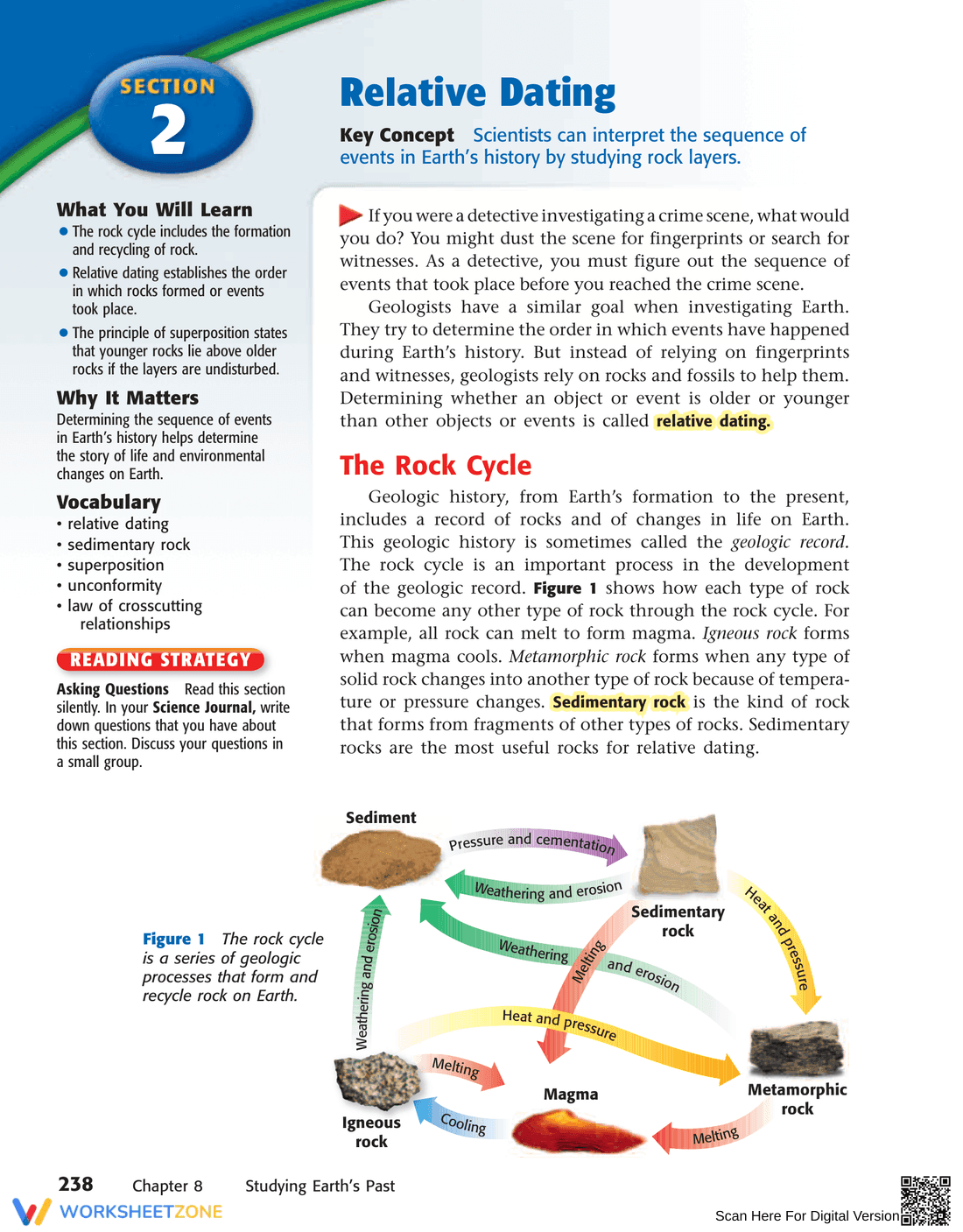
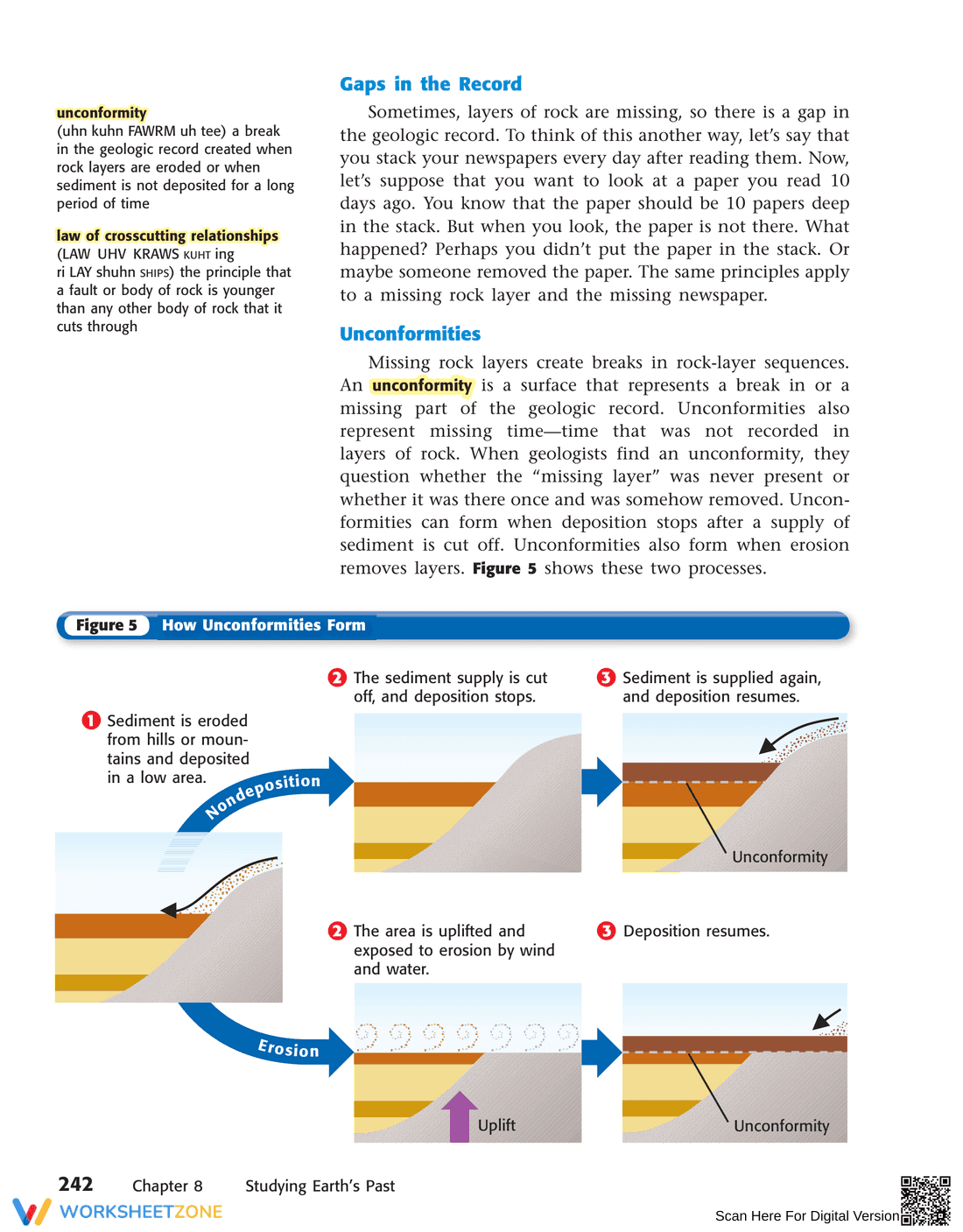
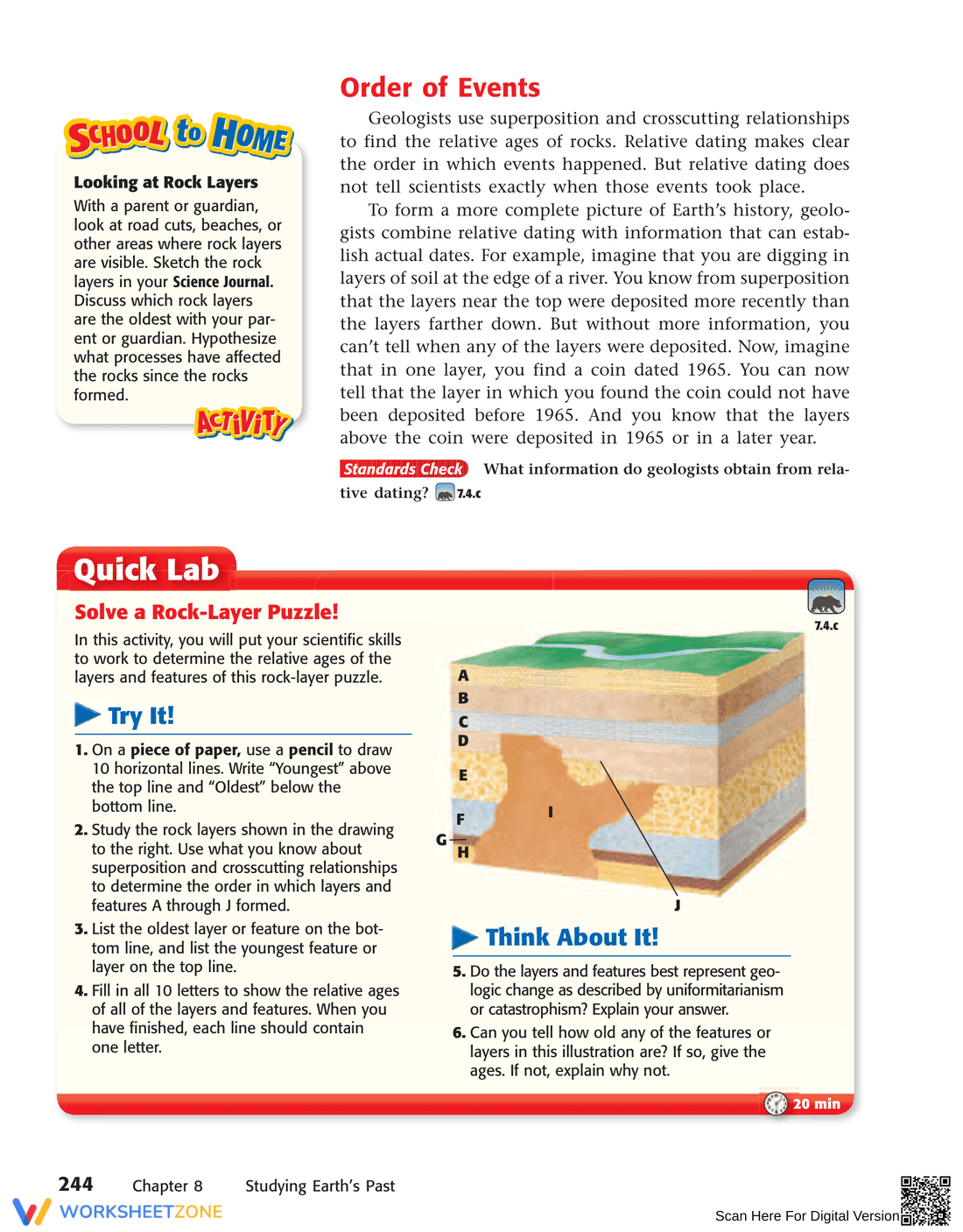
This is a science worksheet page focusing on 'Relative Dating' and 'The Rock Cycle.' It includes informational text explaining how scientists determine the sequence of events in Earth's history by studying rock layers. Vocabulary terms like 'relative dating,' 'sedimentary rock,' and 'superposition' are defined. A diagram labeled 'Figure 1' illustrates the rock cycle, showing the transformation of sediment, sedimentary rock, magma, igneous rock, and metamorphic rock through processes like weathering, erosion, heat, and pressure. There is also a reading strategy section about asking questions and a 'What You Will Learn' section mentioning the rock cycle and superposition.
Grade Level Suitability:
This worksheet is suitable for grades 6-9. The concepts of relative dating, the rock cycle, and geological processes require a basic understanding of Earth science, typically introduced in middle school. The vocabulary and reading comprehension level are also appropriate for these grades.
Why Use It:
This worksheet helps students understand the principles of relative dating and the cyclical nature of rock formation. It clarifies how geologists interpret Earth's history by examining rock layers. The diagram of the rock cycle provides a visual aid to grasp the relationships between different rock types and the processes that transform them. It introduces important earth science vocabulary and encourages critical thinking.
How to Use It:
Students should first read the informational text about relative dating and the rock cycle. They should then study the diagram of the rock cycle, paying attention to the processes that connect different rock types. The vocabulary section should be reviewed to ensure understanding of key terms. The reading strategy section suggests asking questions to promote deeper comprehension. The worksheet can be used as an introduction to the topic, a reinforcement activity, or a review tool.
Target Users:
This worksheet is designed for middle school students studying Earth science, geology, or environmental science. It is also suitable for teachers looking for supplemental materials to teach the concepts of relative dating and the rock cycle. Homeschooling parents teaching earth science can also benefit from this resource.
This is a science worksheet page focusing on 'Relative Dating' and 'The Rock Cycle.' It includes informational text explaining how scientists determine the sequence of events in Earth's history by studying rock layers. Vocabulary terms like 'relative dating,' 'sedimentary rock,' and 'superposition' are defined. A diagram labeled 'Figure 1' illustrates the rock cycle, showing the transformation of sediment, sedimentary rock, magma, igneous rock, and metamorphic rock through processes like weathering, erosion, heat, and pressure. There is also a reading strategy section about asking questions and a 'What You Will Learn' section mentioning the rock cycle and superposition.
Grade Level Suitability:
This worksheet is suitable for grades 6-9. The concepts of relative dating, the rock cycle, and geological processes require a basic understanding of Earth science, typically introduced in middle school. The vocabulary and reading comprehension level are also appropriate for these grades.
Why Use It:
This worksheet helps students understand the principles of relative dating and the cyclical nature of rock formation. It clarifies how geologists interpret Earth's history by examining rock layers. The diagram of the rock cycle provides a visual aid to grasp the relationships between different rock types and the processes that transform them. It introduces important earth science vocabulary and encourages critical thinking.
How to Use It:
Students should first read the informational text about relative dating and the rock cycle. They should then study the diagram of the rock cycle, paying attention to the processes that connect different rock types. The vocabulary section should be reviewed to ensure understanding of key terms. The reading strategy section suggests asking questions to promote deeper comprehension. The worksheet can be used as an introduction to the topic, a reinforcement activity, or a review tool.
Target Users:
This worksheet is designed for middle school students studying Earth science, geology, or environmental science. It is also suitable for teachers looking for supplemental materials to teach the concepts of relative dating and the rock cycle. Homeschooling parents teaching earth science can also benefit from this resource.


