




























1 / 8
0
Views
0
Downloads




0.0
0
Save
0 Likes
Share
Geology Worksheet: Understanding Relative Dating
0 Views
0 Downloads

Paste this activity's link or code into your existing LMS (Google Classroom, Canvas, Teams, Schoology, Moodle, etc.).
Students can open and work on the activity right away, with no student login required.
You'll still be able to track student progress and results from your teacher account.
Information
Description
What It Is:
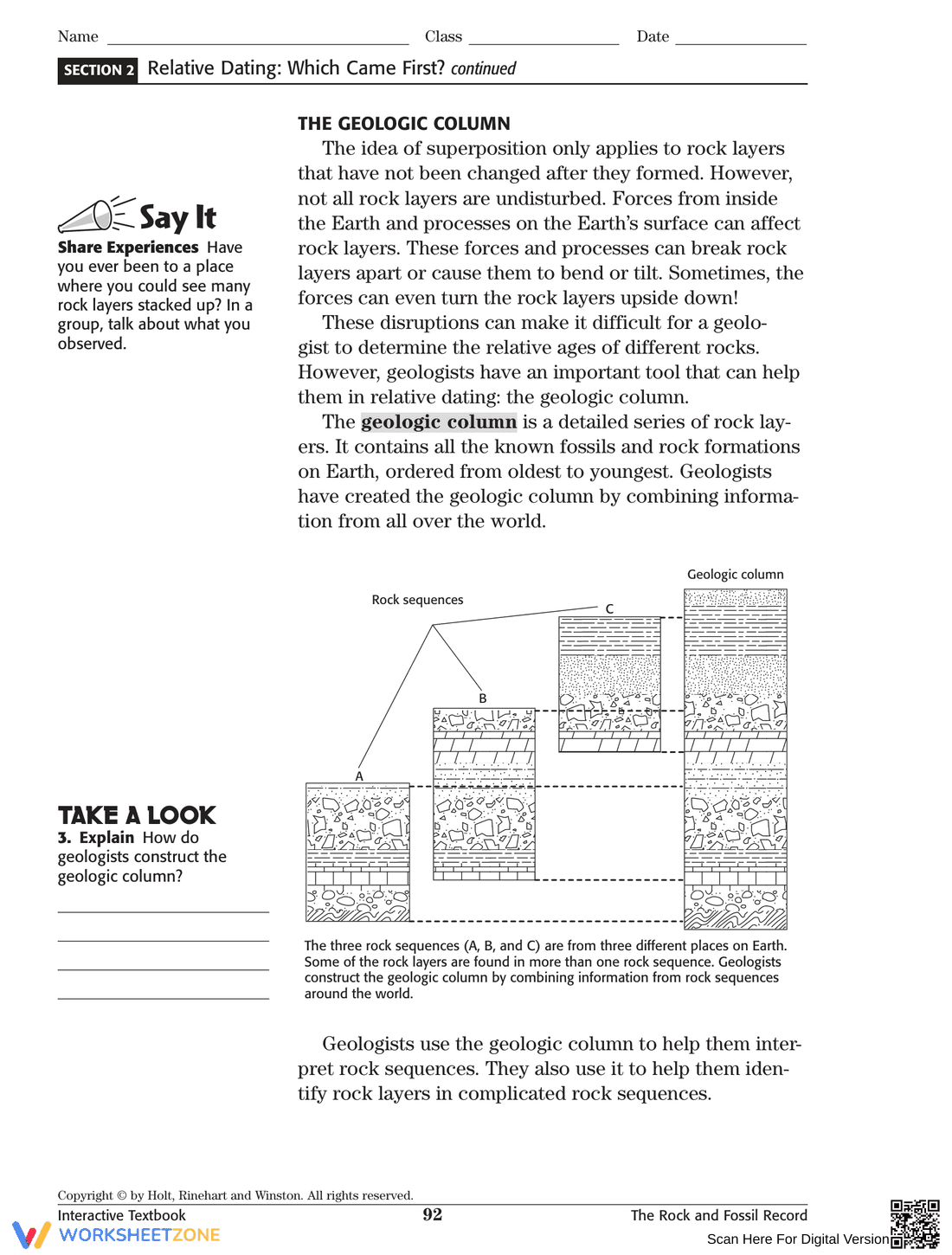
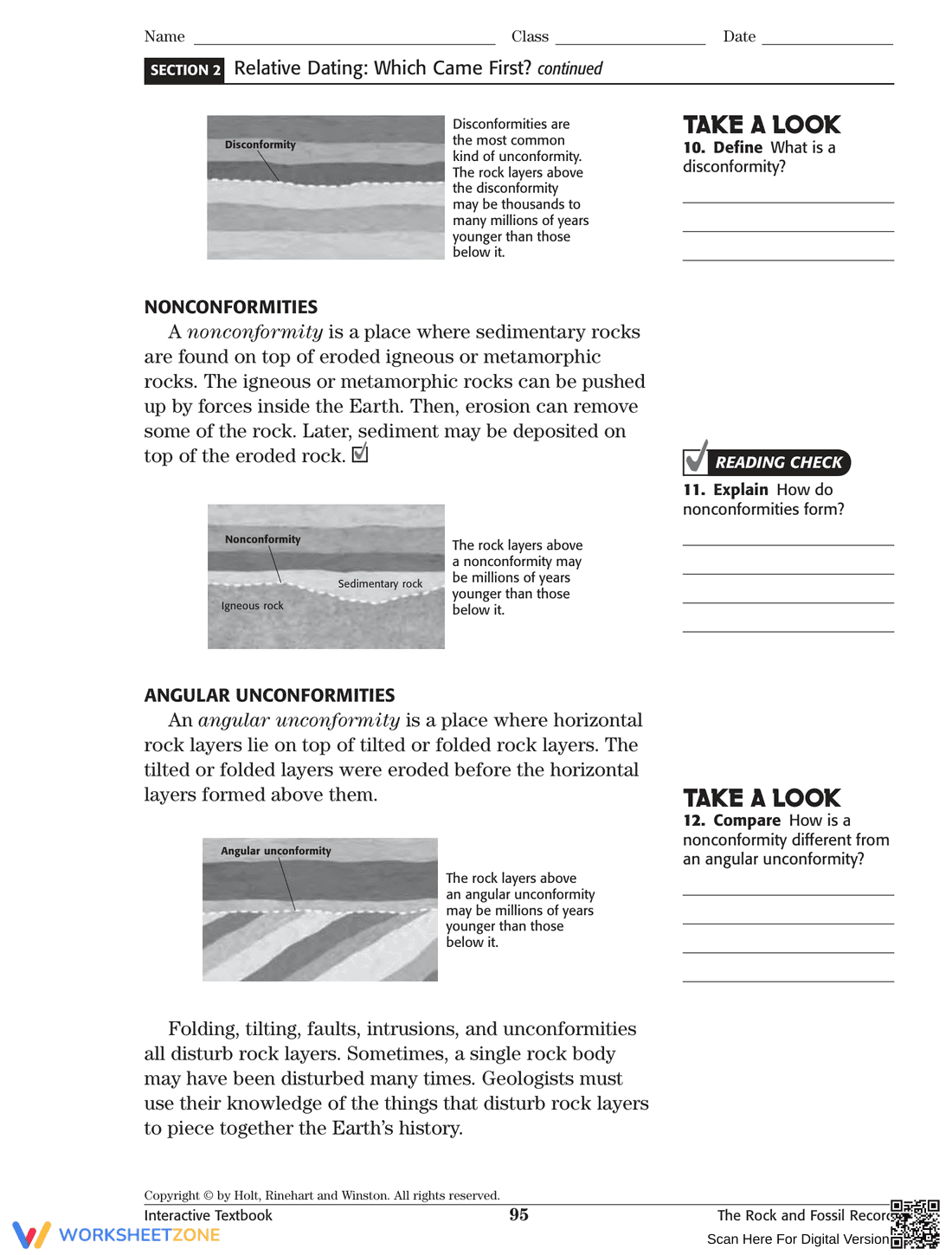
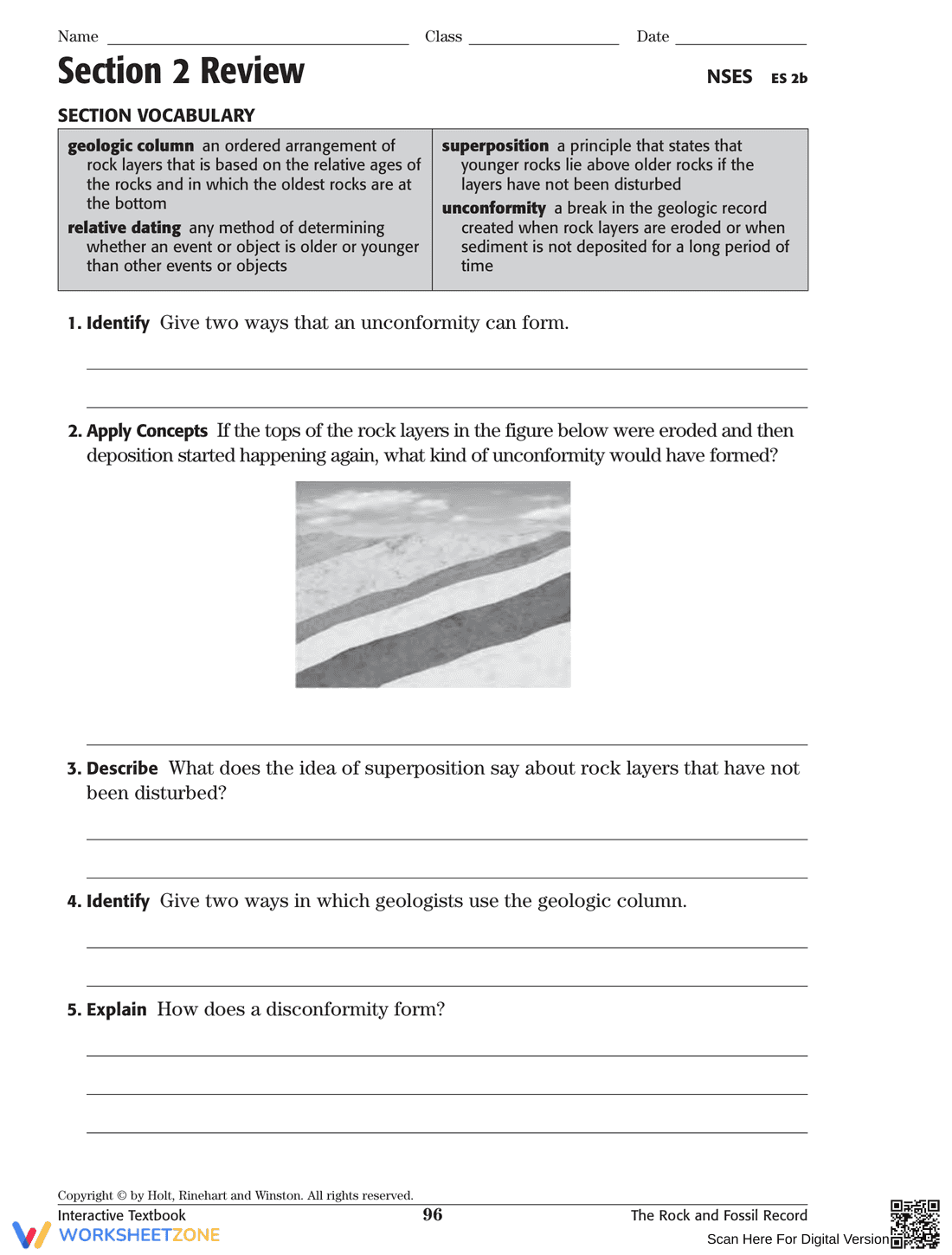
This is a science worksheet about relative dating in geology. It explains the concept of relative dating using an analogy of stacking newspapers. It includes a reading passage explaining superposition, a 'Reading Check' question asking students to define relative dating, and a 'Take a Look' activity where students fill in the blank to identify the relative age of rock layers. The worksheet features diagrams comparing layers of newspapers to layers of sedimentary rock.
Grade Level Suitability:
This worksheet is suitable for middle school (grades 6-8) or early high school (grade 9) earth science. The reading level and concepts presented are appropriate for these grades. The analogy to newspapers makes the concept more accessible to younger learners.
Why Use It:
This worksheet helps students understand the principle of relative dating and superposition in geology. It reinforces reading comprehension skills and provides a visual aid to connect abstract concepts to everyday experiences. It also introduces key vocabulary like 'superposition' and 'relative dating'.
How to Use It:
Students should first read the 'Before You Read' questions to focus their attention. Then, they should read the passage about relative dating and superposition. After reading, they should answer the 'Reading Check' question and complete the 'Take a Look' activity by filling in the blank. The 'Study Tip' suggests a notebook activity to compare different ways rock layers can be changed.
Target Users:
This worksheet is designed for students learning about geology, earth science, or rock formation. It is particularly useful for students who benefit from visual aids and real-world analogies. It can also be used as a review or reinforcement activity.
This is a science worksheet about relative dating in geology. It explains the concept of relative dating using an analogy of stacking newspapers. It includes a reading passage explaining superposition, a 'Reading Check' question asking students to define relative dating, and a 'Take a Look' activity where students fill in the blank to identify the relative age of rock layers. The worksheet features diagrams comparing layers of newspapers to layers of sedimentary rock.
Grade Level Suitability:
This worksheet is suitable for middle school (grades 6-8) or early high school (grade 9) earth science. The reading level and concepts presented are appropriate for these grades. The analogy to newspapers makes the concept more accessible to younger learners.
Why Use It:
This worksheet helps students understand the principle of relative dating and superposition in geology. It reinforces reading comprehension skills and provides a visual aid to connect abstract concepts to everyday experiences. It also introduces key vocabulary like 'superposition' and 'relative dating'.
How to Use It:
Students should first read the 'Before You Read' questions to focus their attention. Then, they should read the passage about relative dating and superposition. After reading, they should answer the 'Reading Check' question and complete the 'Take a Look' activity by filling in the blank. The 'Study Tip' suggests a notebook activity to compare different ways rock layers can be changed.
Target Users:
This worksheet is designed for students learning about geology, earth science, or rock formation. It is particularly useful for students who benefit from visual aids and real-world analogies. It can also be used as a review or reinforcement activity.


