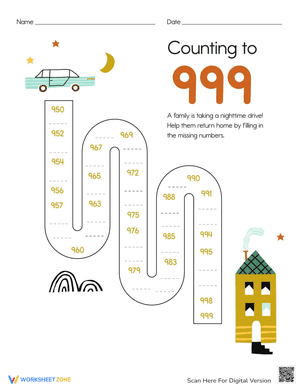
These writing three digit numbers worksheets give second-grade teachers a ready-to-use set of practice materials built around the three representations students are expected to move between fluently: standard form, expanded form, and word form. Each worksheet targets a specific format or skill combination, so teachers can pull exactly what a lesson calls for rather than sorting through a packet to find what fits.
What Each Worksheet Covers
The set addresses the full range of skills tied to three-digit place value. Some worksheets present a number in one form and ask students to produce the other two — a format that works efficiently as a warm-up or exit ticket because it surfaces which representation a student is still working through. Others use base-ten block diagrams: students count hundreds flats, tens rods, and ones cubes, then write the number in standard form. This bridge from visual model to abstract notation is especially important early in a unit, before students have internalized what each digit position means.
Several worksheets focus specifically on numbers with zeros in the tens or ones place — 508, 370, 800, 406 — because these are the cases where second graders most reliably make errors. Isolating these numbers in dedicated practice lets students build automatic recognition of the zero placeholder without the cognitive interference of switching between zero and non-zero examples mid-page.
Standard Alignment
These worksheets address CCSS.MATH.CONTENT.2.NBT.A.3, which requires second graders to read and write numbers to 1,000 using base-ten numerals, number names, and expanded form. In instructional terms, this standard usually appears in the second quarter of second grade, after students have worked with two-digit addition and subtraction and before multi-digit computation begins. The three forms are not ends in themselves — they build the place-value understanding that multi-digit addition will rely on heavily by mid-year, which is why fluency here matters before that work starts.
Frequent Student Errors Worth Watching For
The zero placeholder problem is the most consistent source of mistakes in this unit, and it takes a specific form that teachers should know to look for. A student who correctly writes 452 in expanded form as 400 + 50 + 2 will often write 406 as 400 + 6, omitting the tens position entirely rather than writing 400 + 0 + 6. The zero disappears because it carries no value in the student's mind — it's not nothing, it's absent. That same reasoning produces 46 instead of 406 in standard form. These are not careless errors; they reflect a genuine conceptual gap about what placeholders do.
Expanded form produces a second common mistake that is easy to overlook in grading: students write 4 + 5 + 2 instead of 400 + 50 + 2, using the face value of each digit rather than its place value. The number looks broken apart correctly, but the place-value reasoning hasn't transferred. In word form, expect to see "four hundred and fifty-two" — the word "and" belongs at the decimal point, not between hundreds and tens, and most second graders will insert it because it sounds natural. Brief attention to that convention before worksheets go out saves a lot of correction later.
Building These Worksheets Into Your Lesson Plans
These worksheets fit most naturally into a gradual-release sequence spread across eight to ten days. Start with the visual base-ten block worksheets during guided practice on days one and two, while students still have physical manipulatives nearby. Introduce expanded form on days three and four using translation worksheets that move in one direction only — standard to expanded — before asking students to work in reverse. Add word form in days five and six, and hold the zero-placeholder worksheets for days seven and eight when students have enough fluency with non-zero numbers to isolate the harder cases without becoming overwhelmed.
A short daily routine accelerates consolidation across the unit. Write a three-digit number on the board each morning and give students ninety seconds to write it three ways on a sticky note before instruction begins. Collect the notes and sort them quickly into three stacks — all correct, one error, two or more errors — while students transition to the next activity. That sort takes about two minutes and tells you whether to pull the zero-placeholder worksheet or move toward the mixed-format review sheet that afternoon.
Adapting the Set for a Range of Learners
Students who are still developing fluency work better with worksheets that include a place-value chart printed at the top of the page. That scaffold reduces the working memory load so students can focus on the representation task rather than tracking digit positions in their heads. Limit their practice to numbers without zeros until the three-form translation is reliable — then introduce zeros as a distinct instructional step, not an incidental challenge.
Students who have already consolidated the core skill benefit from the blank row at the bottom of some worksheets, where they generate their own three-digit number and write it in all three forms. Self-generated examples push toward deeper ownership of the concept. You can also pair these students and have them swap papers, check each other's expanded form, and discuss any disagreements — a brief peer-review moment that surfaces reasoning in a way independent practice does not.
Frequently Asked Questions
What types of practice formats are included across the worksheets?
The set includes multi-format translation worksheets (one form given, two to produce), base-ten block diagrams that students interpret and record, zero-placeholder focused sheets, and cut-and-paste matching activities where students connect standard, expanded, and word form representations. Different worksheets suit different instructional moments — the translation sheets work well as exit tickets, the block diagrams fit guided practice, and the matching activities run cleanly as math center rotations.
How do I explain expanded form to a student who keeps writing 4 + 5 + 2 instead of 400 + 50 + 2?
Go back to the hundreds flat, tens rod, and ones cube. Place three hundreds flats on the table and ask the student what they're worth — 300, not 3. That moment of connecting the physical object to its value is usually where the confusion breaks. Once students see that the flat is worth 300, writing 300 in the expanded form feels logical rather than arbitrary. Use the manipulatives alongside the worksheet until students can explain in their own words why the digits change value depending on position.
Why do second graders skip zeros when writing numbers like 406 in standard form?
In everyday experience, zero signals absence — nothing. A child who has no tens genuinely reasons that there is nothing to write there. The placeholder function of zero is a mathematical convention that runs against that intuition, and it takes deliberate practice with numbers like 506, 370, and 800 before the automatic recognition sets in. Worksheets that group these numbers together rather than scattering them across a general practice page give students the repetition density that actually changes the habit.
When in the school year should I introduce these worksheets?
Most second-grade pacing guides place the three-digit number work in the second quarter, typically October through November in a traditional calendar. That timing puts it after students have reviewed two-digit place value and before the class moves into three-digit addition with regrouping, where the same place-value concepts appear under higher computational demand.
















 Interactive Worksheet Maker
 Quiz Maker
 Word Search Maker
 Crossword Puzzle Maker
 Word Scramble Generator
 Sentence Scramble Generator
 Handwriting Worksheet Generator
 Name Tracing Generator
 Fill In The Blank Generator