


























Views
Downloads
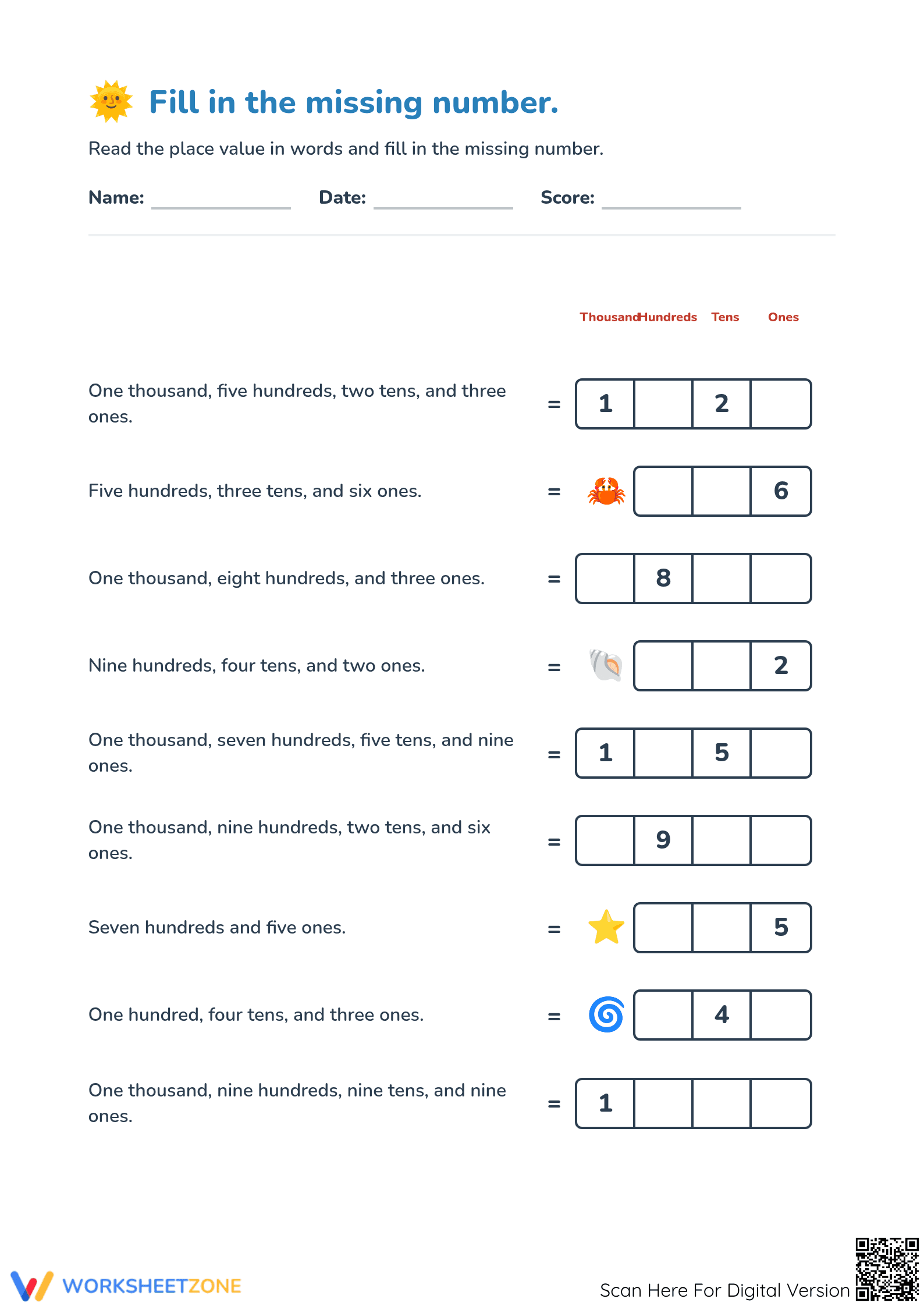


Essential Place Value Fill-In Worksheet | Grade 2 Math
Paste this activity's link or code into your existing LMS (Google Classroom, Canvas, Teams, Schoology, Moodle, etc.).
Students can open and work on the activity right away, with no student login required.
You'll still be able to track student progress and results from your teacher account.
This essential Grade 2 place value worksheet helps students bridge the gap between reading number words and writing digits correctly. By translating phrases into numerals, children solidify their understanding of the base-ten system. This activity ensures students can identify hundreds, tens, and ones, preparing them for complex multi-digit arithmetic.
At a Glance
- Grade: 2 · Subject: Math
- Standard:
2.NBT.A.3— Read and write numbers to 1000 using base-ten numerals, number names, and expanded forms- Skill Focus: Translating multi-digit number words into their corresponding numerical place values
- Format: 2 pages · 10 problems · Answer key included · PDF
- Best For: In-class independent practice, homework, or formative assessment checks
- Time: 15–20 minutes of focused classroom time
What's Inside
This 2-page resource features 10 tasks where students read a number written in expanded words (e.g., "Five hundreds, three tens, and six ones") and fill in the missing digits in a numeral box. The layout is clean and includes fun beach-themed icons like crabs and seashells to keep learners engaged. An answer key is provided for quick grading or self-correction.
Zero-Prep Workflow
This resource is designed for immediate classroom implementation with zero preparation required. Print the 2-page PDF (30 seconds), distribute it to students (1 minute), and review the answers using the included key (5 minutes). This format makes it an ideal choice for substitute lesson plans, morning work, or "fast-finisher" folders when you need an instructional activity on short notice.
Standards Alignment
This worksheet aligns with 2.NBT.A.3, which requires students to read and write numbers to 1000 using base-ten numerals and number names. It also supports 2.NBT.A.1 by reinforcing that digits in a three-digit number represent hundreds, tens, and ones. Both standard codes can be copied directly into lesson plans, IEP goals, or district curriculum mapping tools.
How to Use It
Use this worksheet as a mid-lesson check during your unit on base-ten. After teaching digit values, assign this task to observe if students can translate written descriptions into numerical form. Watch for students who struggle with "zero" as a placeholder (e.g., "Seven hundreds and five ones"). Completion typically takes 15 to 20 minutes for most second graders.
Who It's For
This resource is tailored for Grade 2 but works for Grade 1 advanced learners or Grade 3 students needing a refresher. It is effective for English Language Learners (ELLs) who need practice connecting math vocabulary with numerical symbols. Pair this with a place-value anchor chart or base-ten blocks for students who require support before moving to abstract representation.
RAND AIRS 2024 highlights that frequent, low-stakes practice with number name translation is a critical component of developing mathematical fluency in early elementary grades. This worksheet directly addresses the cognitive demand of 2.NBT.A.3 by requiring students to decode linguistic structures into quantitative values. Research by Fisher & Frey (2014) supports this gradual release of responsibility, where students move from teacher-led examples to independent digit placement. By engaging with 10 specific problems, students build the "place value sense" necessary for regrouping and multi-step arithmetic. This printable provides the structured repetition needed to ensure that the relationship between hundreds, tens, and ones becomes intuitive. Educators can rely on this standard-aligned tool to provide evidence of student mastery in number sense and operations, ensuring a solid foundation for third-grade standards involving larger numbers and rounding.


