What labeling mixed numbers worksheets cover
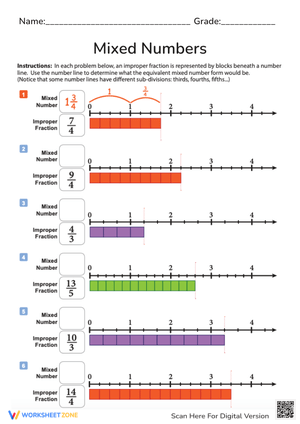
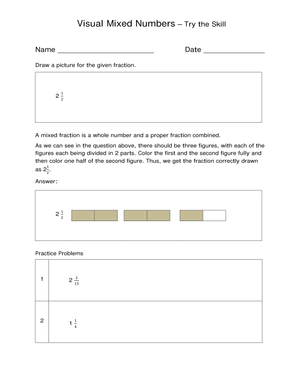
When students work through labeling mixed numbers worksheets, they practice naming a quantity like 2 3/4 and placing it in the right spot on a number line or matching it to a visual model. For US grade 3 and grade 4 teachers, this is the bridge skill between recognizing fractions and operating on them. A student who can label 1 2/3 on a partitioned line understands that the mixed number is one whole plus two of three equal parts, not two separate numbers written side by side. That understanding is exactly what a fraction unit needs before addition and subtraction appear. These worksheets give you a low-prep way to check whether that number sense is in place, and they surface the small misreads that quietly derail later lessons.
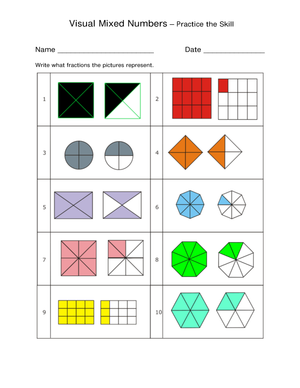
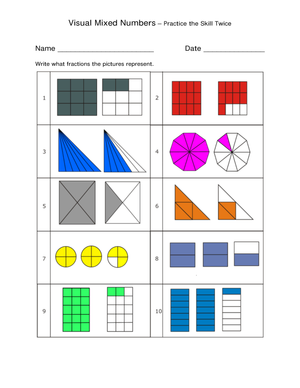
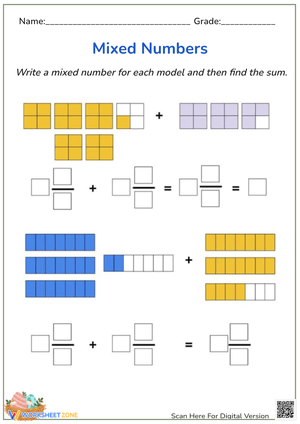
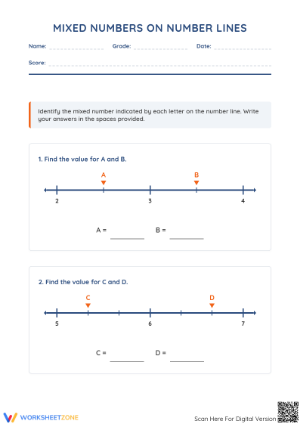
They also fit neatly into formats you already use. Some worksheets pair a mixed number with a shaded area model, others focus purely on number-line placement, and stronger sets ask students to generate their own label from an unmarked point. Choosing the format on purpose lets you target the exact part of the skill your class is missing.
Where labeling mixed numbers fits in the fraction sequence
Labeling mixed numbers is usually introduced as a grade 3 to grade 4 skill, and it sits directly on top of the number-line model students already know. Before they can add or subtract mixed numbers, they need to see 3 1/2 as three whole units and one half of a fourth unit, all measured against equal partitions. Grade 4 fraction standards keep denominators limited to 2, 3, 4, 5, 6, 8, 10, 12, and 100, so your worksheets can scale difficulty without ever leaving the range students are expected to master.
According to the Common Core State Standards for Grade 4 Number and Operations-Fractions, standard 4.NF.A.2 has students reason about fractions on a number line built by partitioning a whole into b equal parts. That model, one whole split into equal pieces, is the exact structure a mixed number sits on and what standard 4.NF.B.3 later builds on.
Sequencing worksheet practice from one whole to many
The most reliable way to use these worksheets is to move in a deliberate order rather than handing students a mixed page all at once. Start with worksheets that partition a single whole and ask students to label points between 0 and 1, then between 1 and 2, so they get used to counting equal parts before a whole number is ever attached. Next, bring in pages that show two or three wholes on one line and ask for a label like 2 1/4, where the student has to name the whole-number part and the fractional part together.
From there, move to worksheets that mix formats: some points already labeled, some blank, some starting the line at a number other than 0. That last variation matters because it forces students to read the scale instead of assuming the line begins at zero. Closing the sequence with worksheets that pair a mixed number to its improper-fraction form sets up the conversions students will lean on during addition and subtraction.
The labeling errors that trip students up
Two mistakes show up again and again. The first is miscounting partitions: a student sees a line divided into eighths but counts the tick marks instead of the spaces, landing one step off. The second, and more stubborn, is mislabeling the whole-number part when the number line does not start at 0. If a line runs from 2 to 4, a student may still call the first labeled point 1 something because they defaulted to counting from zero.
In practice, the off-by-one whole-number error is far more damaging than a miscounted fraction, because it survives the conversion to an improper fraction and corrupts every later step. A student who labels 3 1/4 as 2 1/4 will convert to 9/4 instead of 13/4, and the arithmetic that follows looks correct while the answer is wrong. That is why a two-minute labeling check on a line that starts at a nonzero value catches more downstream errors than a full page of routine practice starting at 0.
Targeted worksheets fix both errors by isolating them. A page of nonzero-start lines trains scale-reading, and a page that asks students to circle the whole first, then the fraction, slows the read enough to prevent the off-by-one slip.
Teacher Tips for using these worksheets in numbers lessons
Treat a short labeling worksheet as a warm-up on the day before you teach mixed-number addition. Five well-chosen points tell you whether the class is ready or whether you need a reteach block first. Have students say the label out loud as a full sentence, such as two and three-fourths, so the whole and the part stay linked in their language, not just on paper.
When you review answers, ask students to justify one label by pointing to the partitions they counted. That single habit exposes the miscount and the nonzero-start error faster than marking the page right or wrong. Keep a few blank number lines on hand so a student who mislabels can redraw the partitions and self-correct, and use the grade 4 denominator set of 2, 3, 4, 5, 6, 8, 10, and 12 to keep the difficulty honest without introducing fractions outside the expected range.
Frequently asked questions
1. What grade level are labeling mixed numbers worksheets for?
They fit grade 3 and grade 4 most naturally. The number-line labeling skill is typically introduced in grade 3 and formalized in grade 4, before students take on adding and subtracting mixed numbers. Fifth-grade teachers also use them for review or intervention when students arrive without solid fraction number sense.
2. How do these worksheets support later fraction operations?
Labeling a mixed number correctly is what makes CCSS 4.NF.B.3 addition and subtraction possible. Students convert a mixed number to an improper fraction to operate, and that conversion depends on reading the whole and the part accurately. A worksheet that locks in labeling removes a hidden source of wrong answers later.
3. What is the most common mistake students make?
Mislabeling the whole-number part when the line does not start at 0. A student defaults to counting from zero and lands one whole off. Because the error carries through the improper-fraction conversion, it is worth catching early with lines that deliberately begin at a nonzero value.
4. How can teachers use these worksheets for intervention?
Use a narrow denominator range, lines that start at 0, and one mixed number per line, then have the student say each label aloud and point to the partitions counted. Add a nonzero start only after the basic move is reliable. Short, focused pages beat long mixed ones for reteaching.













 Interactive Worksheet Maker
 Quiz Maker
 Word Search Maker
 Crossword Puzzle Maker
 Word Scramble Generator
 Sentence Scramble Generator
 Handwriting Worksheet Generator
 Name Tracing Generator
 Fill In The Blank Generator