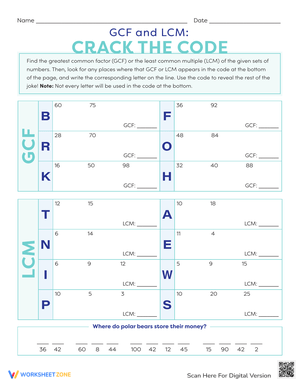
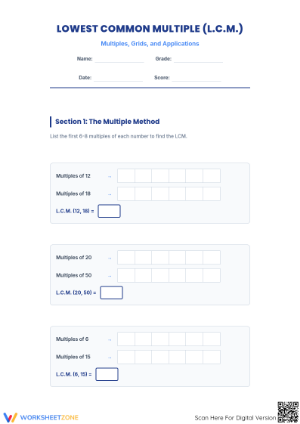
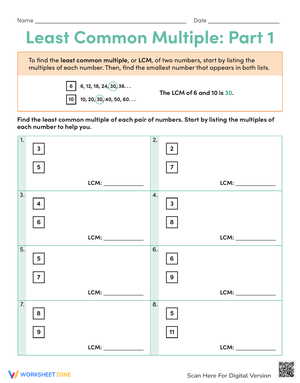
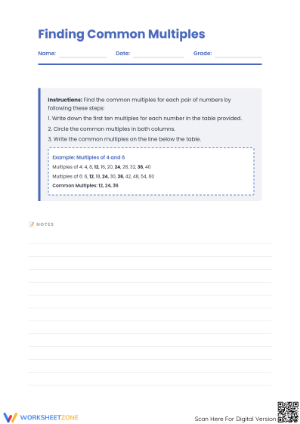
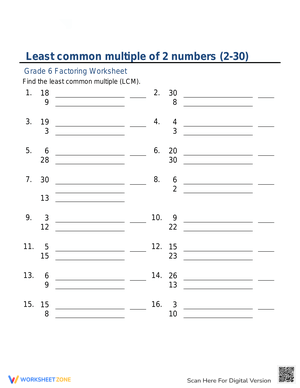
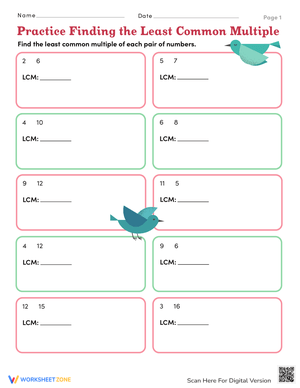
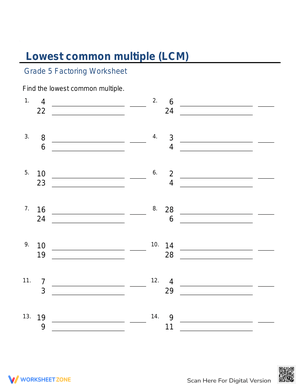
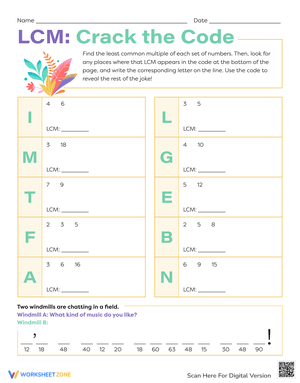
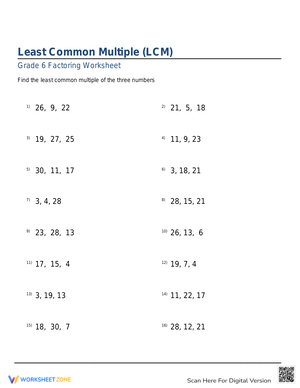
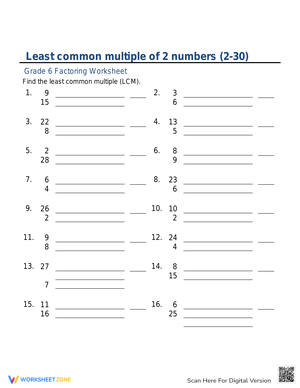
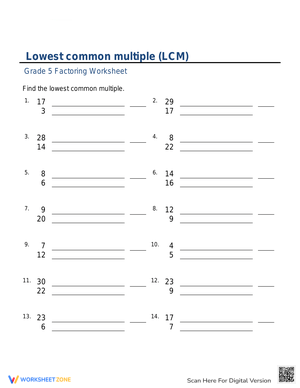
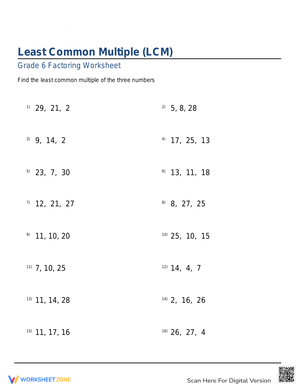
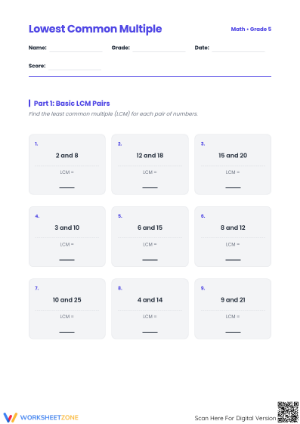
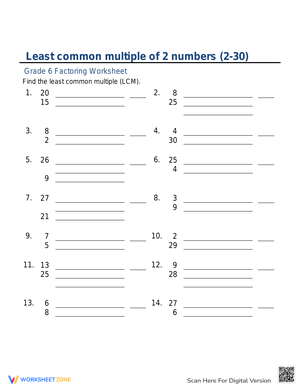
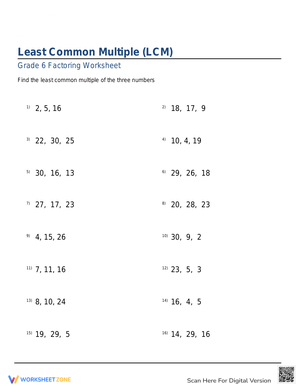
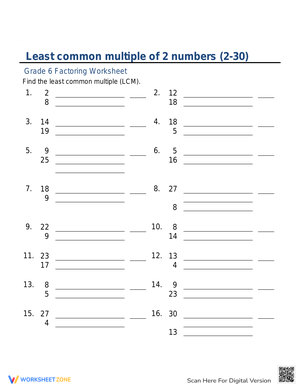
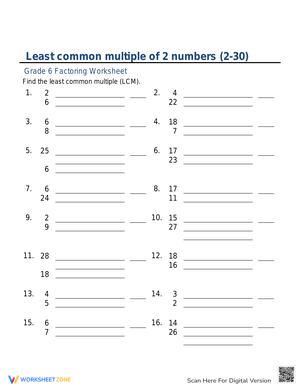
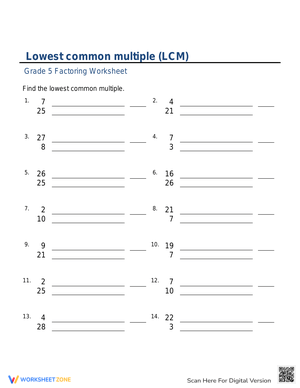
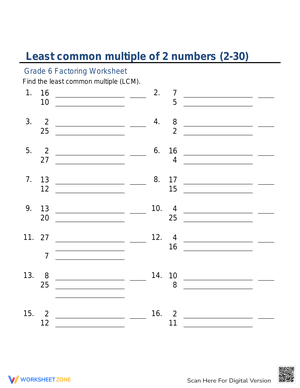
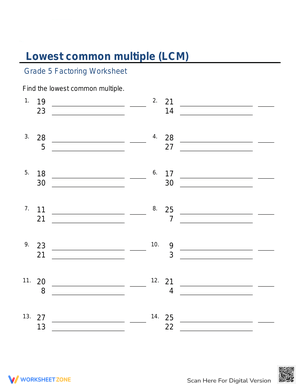
These least common multiple worksheets give 5th and 6th grade teachers structured, ready-to-print practice that moves students from skip-counting multiples to efficient prime factorization — the two skills that make LCM stick. The set covers foundational listing methods, the ladder (division) method, and word problems that require students to identify when LCM is the right tool.
What Students Practice Across the Set
Each worksheet targets a specific approach so teachers can sequence instruction deliberately rather than throwing all three methods at students at once. The listing-multiples worksheets ask students to write out sequences for two numbers, mark shared values, and circle the smallest — a procedure that mirrors the mental work students will eventually internalize. Separate worksheets introduce prime factorization, where students build factor trees, identify the highest power of each prime factor, and multiply to find the LCM. The ladder method gets its own worksheet as well: students write two or three numbers in a row, divide out shared primes step by step, and multiply the outer column. Later worksheets in the set mix all three methods and add word problems, including schedule-based scenarios where students determine when two repeating events will coincide.
One worksheet focuses specifically on distinguishing LCM from GCF, which matters because CCSS.Math.Content.6.NS.B.4 pairs the two skills. Students read a problem prompt, decide whether the situation calls for a multiple or a factor, and then execute the right procedure — a decision-making step that most single-skill drill sheets skip entirely.
Why This Format Works for This Skill at This Grade
CCSS.Math.Content.6.NS.B.4 places LCM in 6th grade for a specific reason: students are about to spend significant time adding and subtracting fractions with unlike denominators, and they need an efficient way to find the least common denominator. Listing multiples of 3 and 4 is manageable; listing multiples of 8 and 15 before a timed test is not. The factorization and ladder methods reduce that cognitive load — once the algorithm is procedurally fluent, it frees up working memory for the fraction operation itself.
Worksheets support this particular skill well because LCM acquisition is procedural before it becomes conceptual. Students need repetition across method types to build fluency, and they need enough volume of practice to encounter the edge cases — numbers that share no common prime factors, three-number problems, LCM where one number is a multiple of the other — before those cases show up on an assessment. Spaced practice across separate worksheets, rather than a single dense page, distributes that exposure more effectively.
Frequent Student Errors Worth Watching For
The most persistent confusion is directional: students hear "least" and reach for something small, which pulls them toward factors instead of multiples. You'll see this on paper when a student is asked for the LCM of 4 and 6 and writes 2. They found the GCF. The word "least" is doing the wrong work in their heads — they're treating it as a synonym for "smallest number associated with these two numbers," which is exactly what a factor is. Worth addressing this before students ever touch a worksheet, because the error sets quickly.
A second pattern shows up during the prime factorization method: students who can build a factor tree correctly will still find the wrong LCM because they add exponents instead of taking the maximum. Asked for the LCM of 8 and 12, they'll note that 8 = 2³ and 12 = 2² × 3, then write 2⁵ × 3 = 96 instead of 2³ × 3 = 24. The listing method rarely produces this error; the factorization method surfaces it reliably. These worksheets include enough factorization problems that you'll catch it early.
Recommended Lesson-Planning Strategies for These Worksheets
Sequence the worksheets so students spend two days on listing multiples before you introduce any algorithm. The listing method is slow and doesn't scale, but it makes the definition of LCM concrete — students can see the shared multiples and point to the smallest one. Once that visual is in place, the ladder method and prime factorization feel like shortcuts rather than arbitrary procedures, and students are more willing to learn them.
The word-problem worksheet works well as a Thursday independent practice after three days of procedural work. By that point students know how to find the LCM mechanically; what they need is practice parsing a sentence, extracting the two numbers, and deciding that LCM is what the problem is actually asking for. Friday is a good day for the LCM-vs.-GCF worksheet, which functions as both review and low-stakes formative assessment before any quiz. For warm-up use, the listing-multiples worksheets cut into horizontal strips work cleanly — students can complete one or two problems in the 6–8 minutes between morning meeting and the first lesson block.
Frequently Asked Questions
Which method should I teach first?
Start with listing multiples. It's the slowest method, but it gives students a concrete image of what a common multiple actually is before you introduce any algorithm. Students who skip straight to prime factorization can execute the steps correctly and still not understand what they're finding. Two days on the listing worksheets before you introduce the ladder method is usually enough to build that foundation.
My students keep confusing LCM with GCF. What helps?
The confusion is almost always semantic — "least" reads as "smallest" and "greatest" reads as "largest," so students mix up which operation they're doing. A direct comparison with paired examples helps more than re-explaining the definitions: show the LCM and GCF of the same two numbers side by side, then ask which one is larger than or equal to both original numbers (the LCM) and which is smaller than or equal to both (the GCF). The dedicated LCM-vs.-GCF worksheet in this set gives students decision-making practice that drills are alone can't provide.
Can these worksheets be used before the fractions unit?
Yes — these worksheets work well as a standalone number theory unit in early 6th grade, before fractions instruction begins. Teaching LCM in isolation, without the pressure of simultaneous fraction work, gives students time to develop procedural fluency. When least common denominator appears several weeks later, students who practiced on these worksheets recognize the underlying structure immediately rather than learning two things at once.
What do I do with students who already know how to find LCM?
Move them directly to the three-number word problems and the LCM-vs.-GCF worksheet. If they finish those quickly, ask them to verify their answers using a second method. A student who finds LCM by listing multiples and then confirms it with prime factorization — and can explain why both methods give the same result — has the depth of understanding the standard actually requires.













 Interactive Worksheet Maker
 Quiz Maker
 Word Search Maker
 Crossword Puzzle Maker
 Word Scramble Generator
 Sentence Scramble Generator
 Handwriting Worksheet Generator
 Name Tracing Generator
 Fill In The Blank Generator