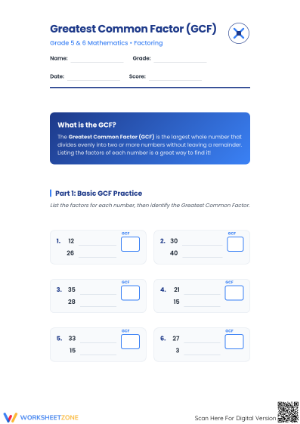
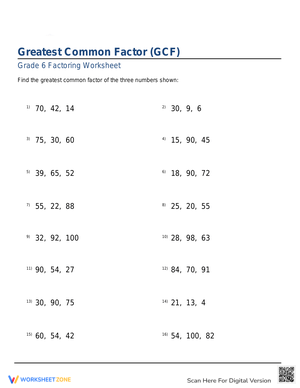
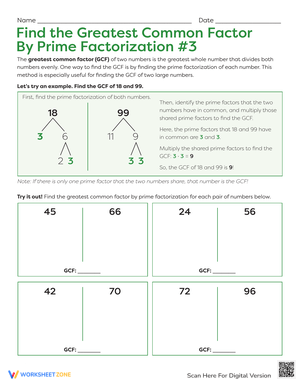
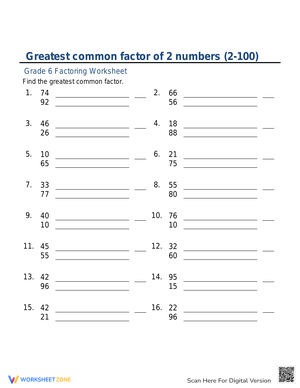
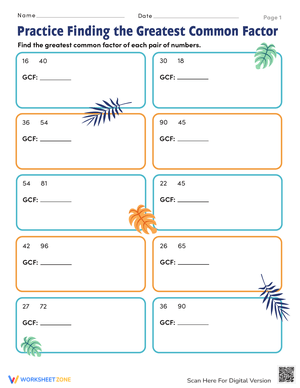
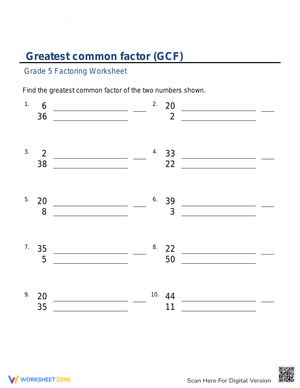
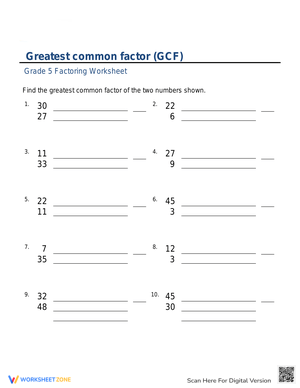
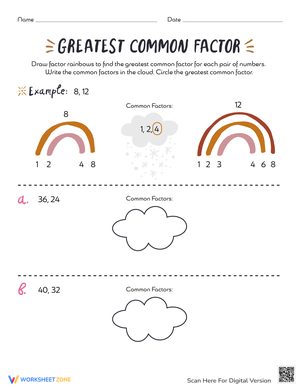
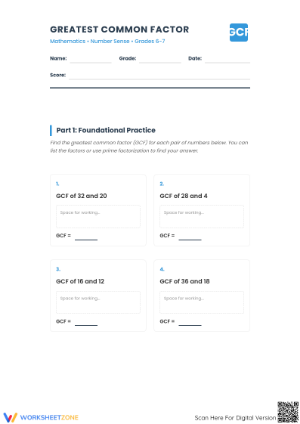
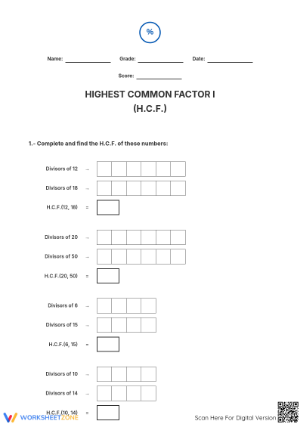
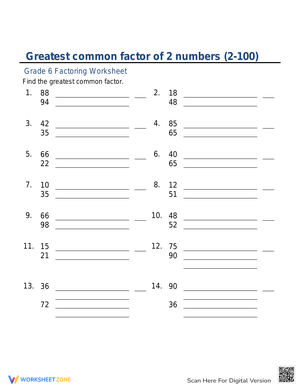
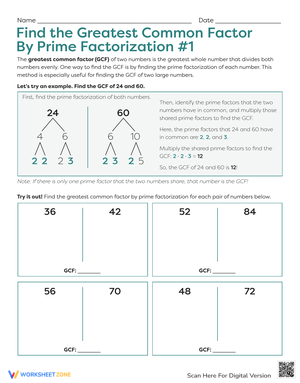
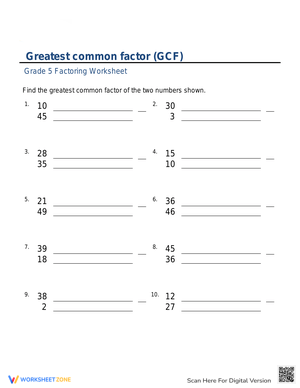
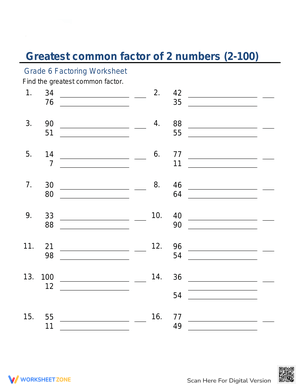
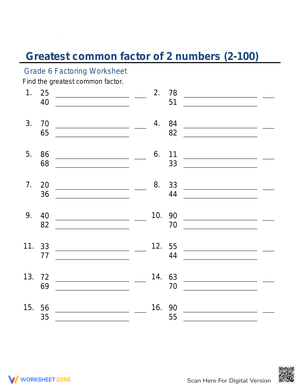
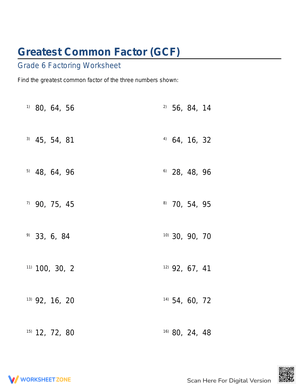
These greatest common factor worksheets give teachers in grades 4 through 7 a structured way to move students from "I know my multiplication facts" to "I can find the GCF of 48 and 72 without listing every factor." Each worksheet targets a specific method or application — listing factors, building factor trees, applying the Euclidean algorithm, or connecting GCF to fraction simplification — so teachers can sequence practice deliberately rather than assigning a mixed bag and hoping it sticks.
The Specific Skills Targeted
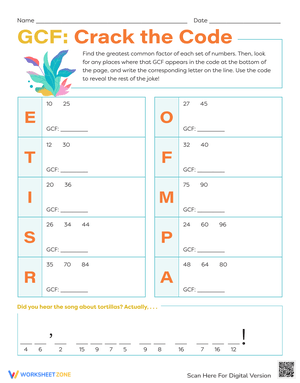
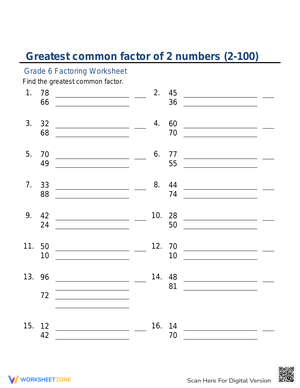
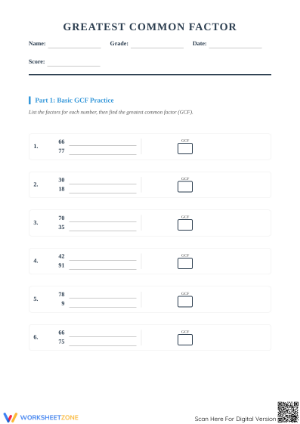
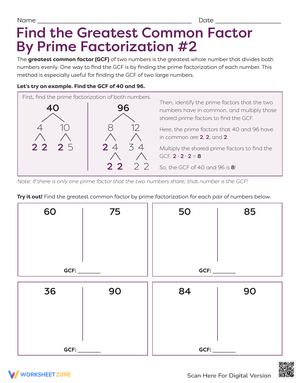
The set covers three distinct methods for finding greatest common factor, and that distinction matters. The listing method works cleanly for numbers under 50 and serves as an entry point — students write out all factors of each number, circle the shared ones, and identify the largest. Prime factorization worksheets ask students to build factor trees, then pull out the shared prime factors and multiply. A student finding the GCF of 24 and 36 should arrive at 2 × 2 × 3 = 12; these worksheets make that calculation visible and traceable when something goes wrong. For advanced students in grades 6 and 7, a handful of worksheets introduce the Euclidean algorithm — dividing repeatedly and using each remainder as the next divisor until the remainder reaches zero. Most sixth graders won't need that method, but it's a meaningful extension for students who have already internalized the other two.
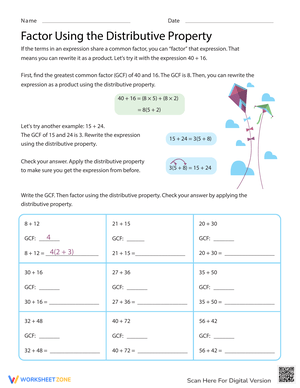
Beyond computation, several worksheets tie GCF directly to applications: simplifying fractions in a single step, rewriting sums using the distributive property (expressing 36 + 8 as 4(9 + 2), for instance), and solving word problems where students have to recognize that a GCF situation is even in play. That last skill — reading a problem and deciding whether GCF or LCM is the right tool — is where students most often get derailed, and the word problem worksheets address it directly.
Standard Alignment
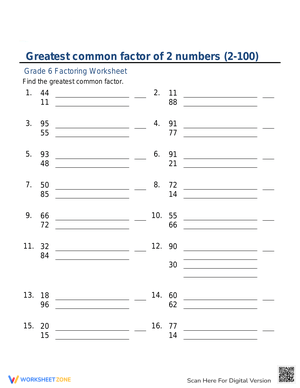
The core greatest common factor standard is CCSS 6.NS.B.4, which asks students to find the GCF of two whole numbers less than or equal to 100 and to use that skill to apply the distributive property — rewriting a sum like 28 + 14 as 14(2 + 1). In instructional terms, that means GCF isn't the endpoint; it's the mechanism that unlocks a different algebraic idea. Worksheets that stop at "find the GCF" address only half the standard. The worksheets in this set that combine GCF computation with distributive property practice cover the full expectation in 6.NS.B.4 and provide the groundwork students need when they begin factoring expressions in pre-algebra. For fifth-grade teachers introducing factors and divisibility under 5.NBT standards, the listing-method and factor tree worksheets provide appropriate scaffolding ahead of the formal sixth-grade standard.
Frequent Student Errors Worth Watching For
The most reliable mistake: students confuse factor with multiple and end up listing multiples when the problem asks for factors. A student working on GCF of 8 and 12 will write "8, 16, 24..." instead of "1, 2, 4, 8." This error appears even after the listing method has been introduced and practiced, because the vocabulary hasn't fully settled. Worksheets that ask students to label their work — writing "factors of 8:" as a header before listing — reduce this error more than any verbal reminder does.
A subtler problem shows up with factor trees. Students who build the trees correctly will sometimes forget to identify shared prime factors and instead multiply all prime factors from both numbers together. A student finds that 18 = 2 × 3 × 3 and 30 = 2 × 3 × 5, then writes GCF = 2 × 3 × 3 × 2 × 3 × 5, which is neither the GCF nor the LCM — it's a number they've invented. Circling the shared branches before multiplying, which several worksheets prompt explicitly, catches this before the student moves on.
Finally, students who learn to simplify fractions using GCF will sometimes divide only the numerator, leaving the denominator unchanged. They know division is involved; they just forget it applies to both parts. A brief worked example at the top of the fraction-simplification worksheets — showing the fraction, the GCF calculation, and both division steps labeled — keeps this visible during independent practice.
How to Build These Worksheets Into Your Lesson Plans
The listing-method worksheets work well as a warm-up during the introduction to factors — five or six problems to open a lesson before the teacher models prime factorization. Once students understand what they're looking for, the factor tree worksheets shift into the core practice slot, typically 15 to 20 minutes of independent work after a guided example. Because each worksheet covers one method rather than mixing all three, it's easy to match the worksheet to the stage of instruction without having to cut problems or tell students to skip a section.
A useful classroom move: pair the listing-method worksheet and the factor tree worksheet for the same number set, and run them on consecutive days. Students solve the same ten problems twice using different methods, then compare answers. When the answers match, it reinforces that both pathways are valid; when they don't, the discrepancy tells you exactly where the second method broke down. That comparison takes about eight minutes and gives you formative data without a separate quiz.
The word problem and distributive property worksheets fit naturally at the end of a GCF unit, after computation is secure. They also serve well as review materials in the days before a unit test or at the start of a fractions unit, when students need a quick reminder of why they learned GCF in the first place.
Frequently Asked Questions
What is the difference between GCF and LCM, and how do I help students keep them straight?
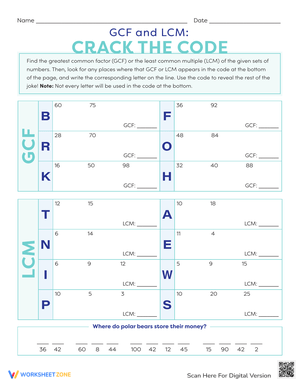
GCF is the largest number that divides evenly into each of the given numbers; LCM is the smallest number that all of the given numbers divide into evenly. The vocabulary itself contains the answer: factors are smaller than or equal to the original numbers, while multiples are larger. Students who mix up GCF and LCM are usually confusing the direction — smaller vs. larger — rather than the calculation. Venn diagram worksheets that show factors of each number in separate circles and shared factors in the overlap help students see why the GCF lives in the middle while LCM sits outside both circles entirely.
At what grade should students first encounter greatest common factor?
The concept of factors — what they are and how to list them — enters the curriculum in 3rd and 4th grade alongside multiplication. Finding the greatest common factor of two numbers becomes a formal expectation in 6th grade under CCSS 6.NS.B.4, though many 5th-grade classrooms introduce it as part of fraction simplification. It continues as a supporting skill through 7th grade and into pre-algebra, where students apply it to factoring algebraic expressions.
How do these worksheets connect to simplifying fractions?
Simplifying a fraction requires dividing both numerator and denominator by their GCF. A student who can find the GCF of 24 and 36 can simplify 24/36 to 2/3 in a single division step instead of reducing by small factors repeatedly. Several worksheets in this set pair GCF computation with immediate fraction application — students find the GCF, then use it to simplify — which makes the connection explicit rather than something teachers have to point out after the fact.
Which method should I teach first?
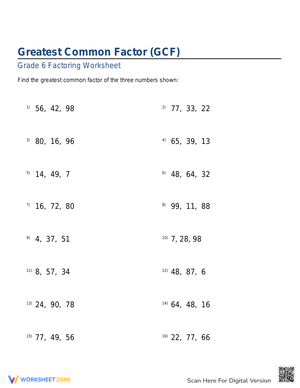
Start with listing. It's slow and doesn't scale, but it makes the definition of GCF visible — students can see the shared factors laid out before they identify the largest. Once that understanding is in place, factor trees give students a faster and more reliable procedure for medium-range numbers. The Euclidean algorithm comes last and only for students who need extension work; it's an efficient algorithm but offers little conceptual transparency for students still building their number sense.













 Interactive Worksheet Maker
 Quiz Maker
 Word Search Maker
 Crossword Puzzle Maker
 Word Scramble Generator
 Sentence Scramble Generator
 Handwriting Worksheet Generator
 Name Tracing Generator
 Fill In The Blank Generator