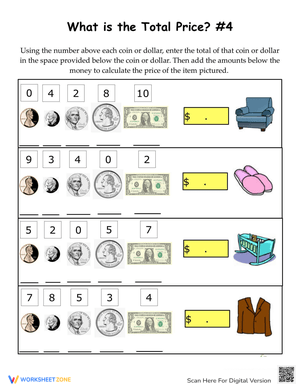
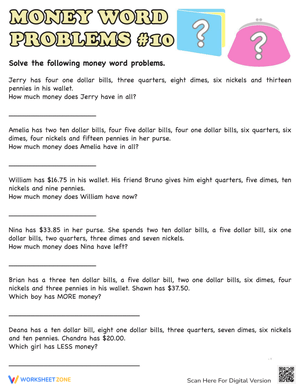
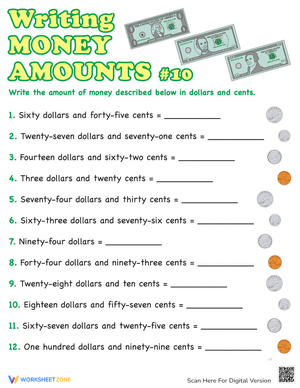
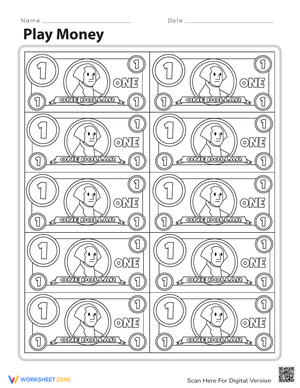
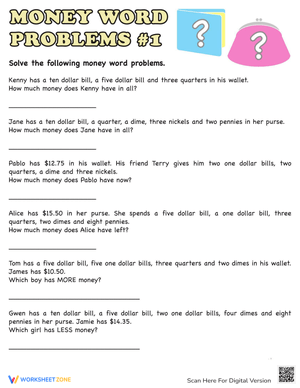
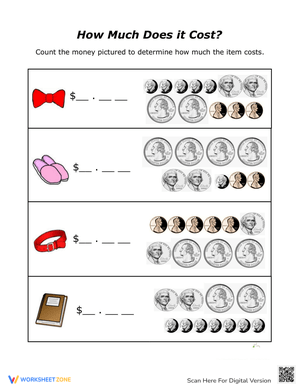
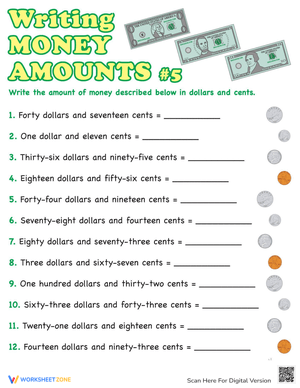
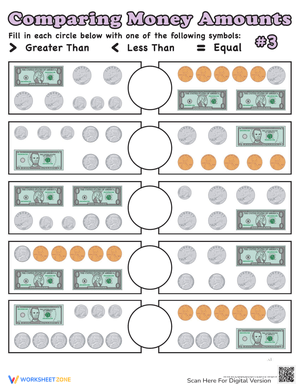
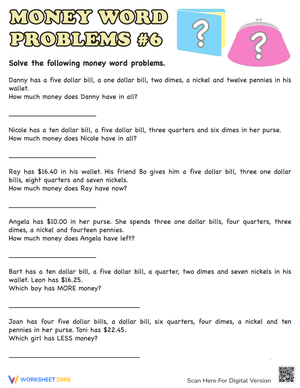
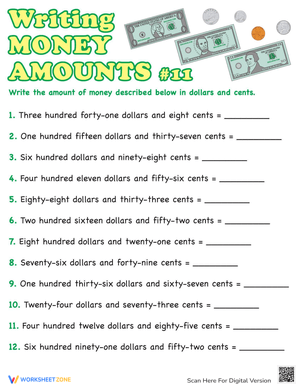
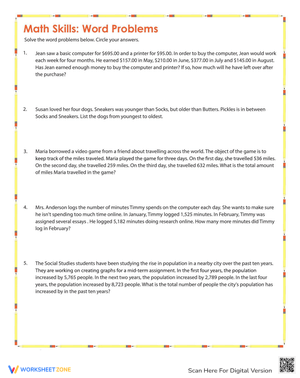
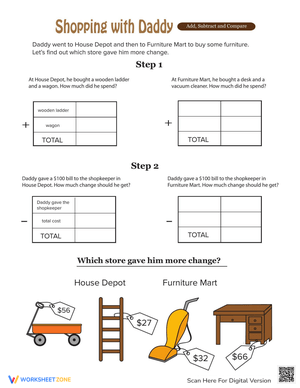
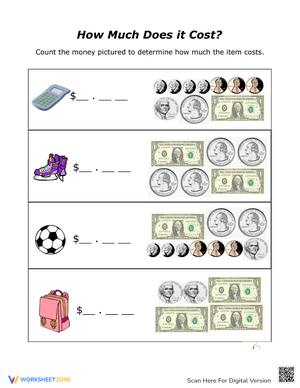
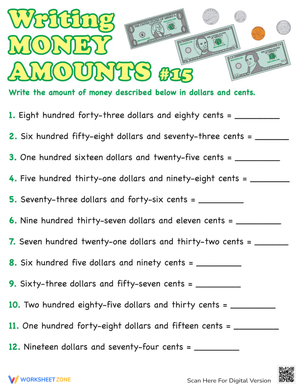
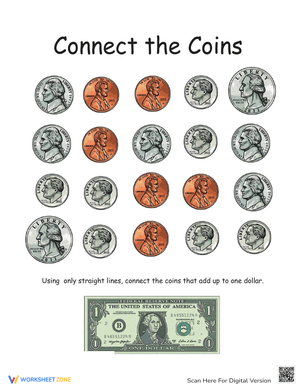
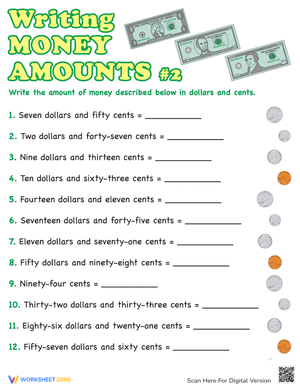
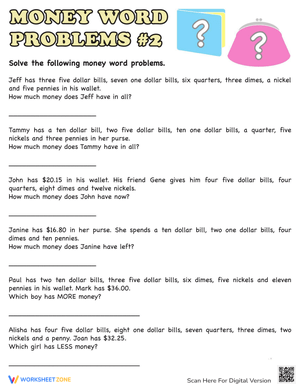
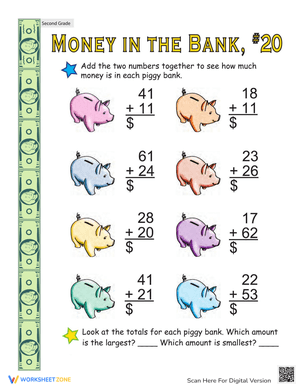
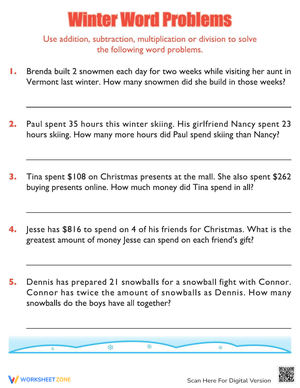
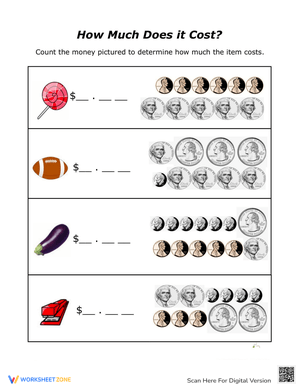
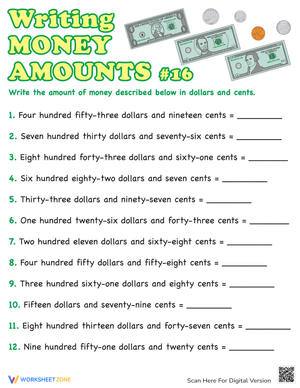
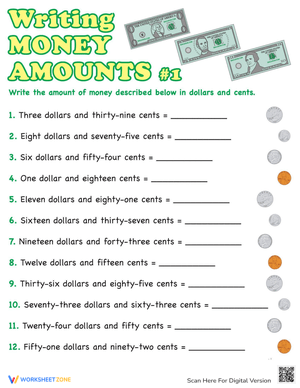
These dollars worksheets give 2nd and 3rd grade teachers a structured path through US paper currency — from naming the portrait on a $5 bill to calculating change in a classroom store scenario. The set covers visual identification, skip counting by denomination, and multi-step word problems, all built around realistic bill illustrations that support the visual memory students need before they ever handle real money.
What Skills Each Of These Dollars Worksheets Builds
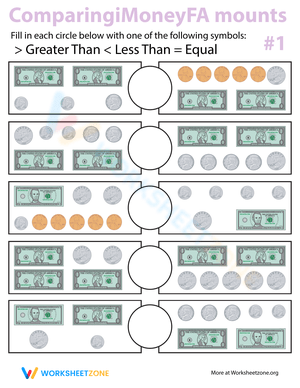
The skills progress in deliberate sequence. Early worksheets ask students to match denominations, label the historical figure on each bill, and sort bills by value — tasks that establish the visual distinctions between a $1 and a $10 before any arithmetic begins. From there, worksheets move into skip counting: rows of identical bills where students write the running total beneath each one, counting by 5s, 10s, and 20s. The final tier introduces mixed denominations, shopping scenarios with listed prices, and problems that require students to determine whether a given set of bills covers a purchase and how much change comes back.
Each worksheet addresses one focused objective. A worksheet on identifying the $20 bill isn't also asking students to make change — that separation reduces cognitive load and keeps error patterns legible. When a student struggles, the teacher can see exactly where the breakdown happened.
Standard Alignment
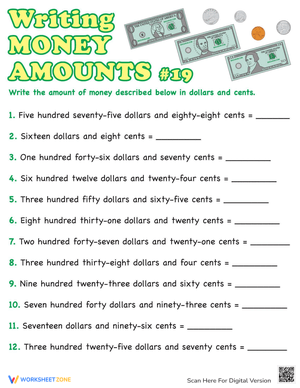
CCSS.MATH.CONTENT.2.MD.C.8 requires second-grade students to solve word problems involving dollar bills, quarters, dimes, nickels, and pennies using the $ and ¢ symbols correctly. These dollars worksheets embed the dollar sign in every problem from the first worksheet onward, which builds correct notation as a habit rather than an afterthought. The identification and sorting worksheets also support the foundational visual work that underlies the standard — students can't solve a word problem about a $20 bill if they're not certain what one looks like. Teachers in states using modified or alternate standards can map the same skill progression to their own grade-level expectations; the sequence from identification to computation holds regardless of the specific standard code.
Common Mistake Of Students That Teachers Should Aware and Address
The most consistent error at the skip-counting stage isn't miscounting — it's students treating the $10 bill as two $5s. They understand that $10 is larger, but the mental grouping feels slippery when bills are shown in a mixed row. These worksheets address that directly with problems that isolate the $10 before placing it next to smaller denominations.
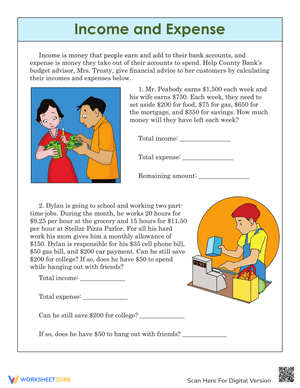
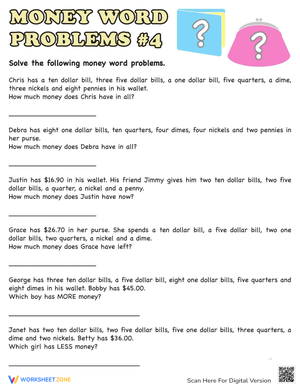
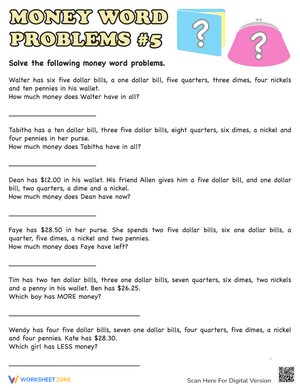
At the word-problem stage, students who handle single-denomination totals confidently will often stall when a shopping scenario lists three items at different prices. The difficulty isn't addition — it's the organizational step of deciding which bills to count first. Several worksheets in this set include a structured work space that prompts students to write each bill's value before summing, which scaffolds that organizational habit without removing the cognitive work of the problem itself.
Recommended Lesson Planning Strategies To Take Full Advantages Of These Worksheets
The identification and sorting worksheets work well as Monday warm-ups at the start of a money unit — five minutes after morning meeting to preview the week's denominations before any formal lesson. The skip-counting worksheets are a reliable independent practice choice during math rotations, particularly for groups that are solid on coin values but haven't yet transferred that fluency to bills.
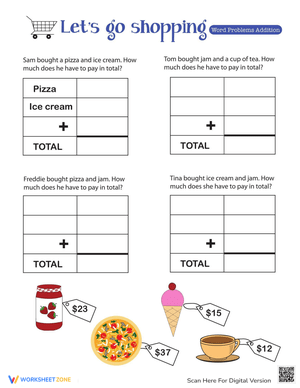
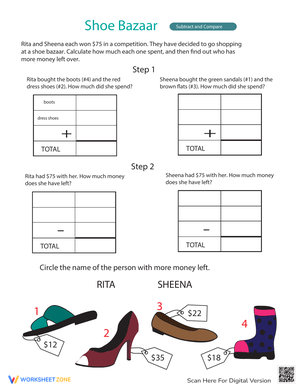
The shopping-scenario worksheets pair naturally with a classroom store station. A small table stocked with labeled items ($3, $8, $15) gives students a reason to care about the arithmetic. Students complete the worksheet transaction log at the station, which means the worksheet does its job — generating written evidence of thinking — without the activity feeling like a worksheet. Setup takes about ten minutes the first time; after that, the station runs independently.
Adapting These Worksheets For Different Levels of Students
Students who need more support can work through the identification worksheets with play money at hand, comparing the printed image on the worksheet against the physical bill before writing any answers. That side-by-side comparison slows down impulsive responses and builds the visual attention the problems require.
For students who move through the grade-level material quickly, the shopping-scenario worksheets can be extended with a "least number of bills" constraint — can you pay $23 using the fewest possible bills? That variation turns a straightforward addition problem into a reasoning task and pulls in early thinking about efficiency in computation. It also tends to reveal whether a student's fluency is genuine or whether they've been relying on counting-on strategies that break down at larger totals.
Frequently Asked Questions
At what point in a money unit should these worksheets be introduced?
Start with the identification worksheets on the first or second day of a money unit, after a brief whole-class look at actual or projected bill images. The skip-counting worksheets fit best in the middle of the unit, once students can reliably name each denomination. Save the shopping-scenario and mixed-bill worksheets for the final third of the unit, when students are ready to apply what they know in a problem-solving context.
Do these worksheets include coins, or only paper bills?
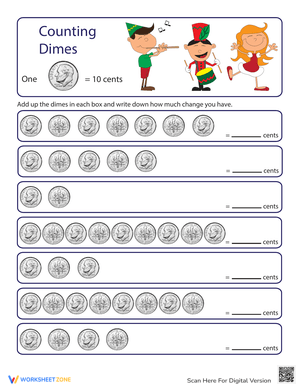
These dollars worksheets focus on paper currency. The shopping-scenario problems use whole-dollar prices, so students aren't required to work with coin values. If your unit covers bills and coins together, these worksheets work well as the bills-only component while separate coin worksheets handle cent values — keeping the two skill areas distinct during initial instruction before combining them in review problems.
How do I use these for quick formative checks rather than full practice sessions?
The skip-counting and identification worksheets each include enough problems to serve as a standalone five-minute check. Pull two or three problems from one worksheet, project them, and have students record answers on a half-sheet. That gives you a quick read on where the class stands before moving to the next stage of instruction without spending a full block on formal assessment.













 Interactive Worksheet Maker
 Quiz Maker
 Word Search Maker
 Crossword Puzzle Maker
 Word Scramble Generator
 Sentence Scramble Generator
 Handwriting Worksheet Generator
 Name Tracing Generator
 Fill In The Blank Generator