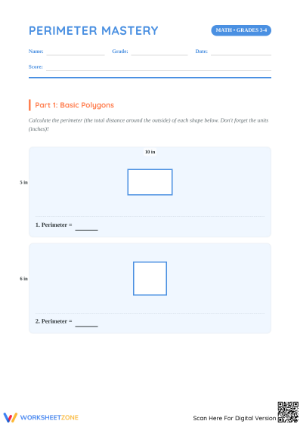
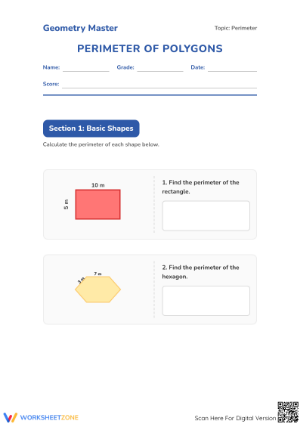
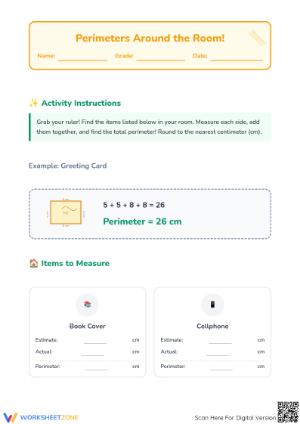
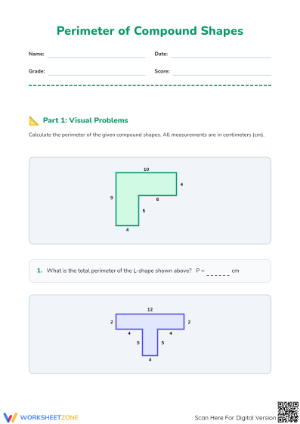
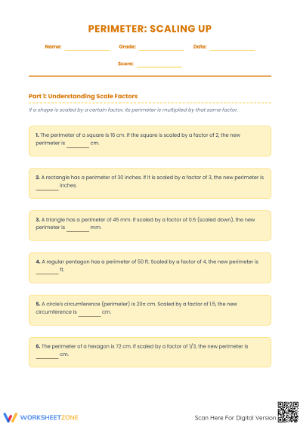
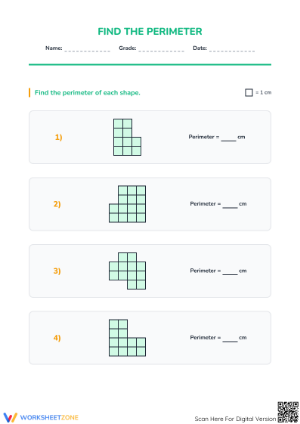
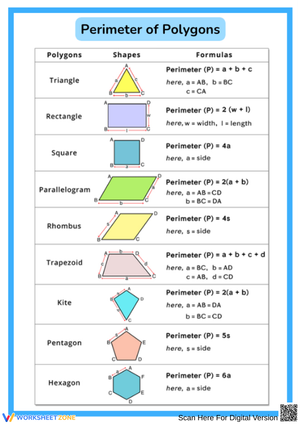
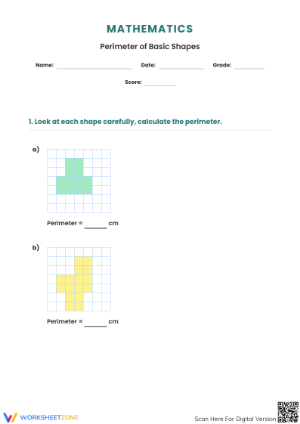
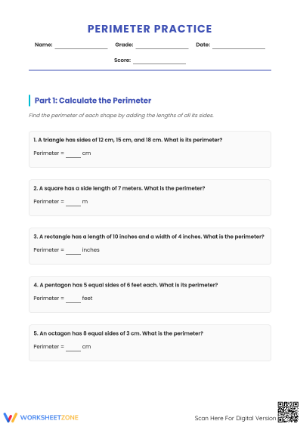
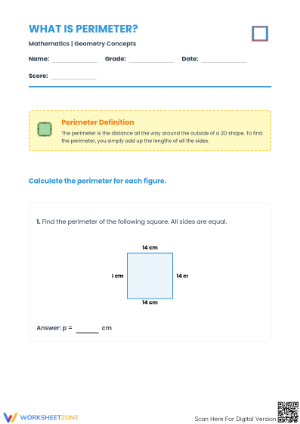
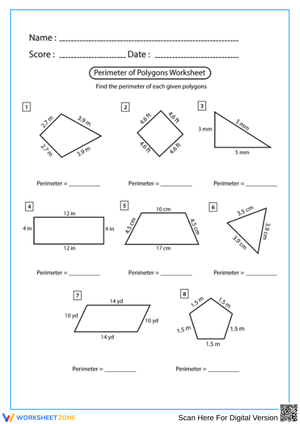
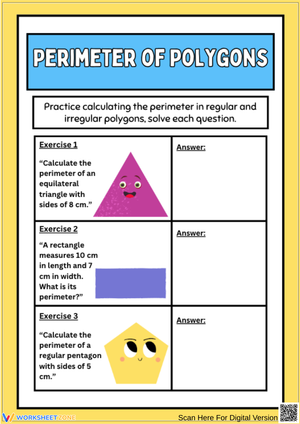
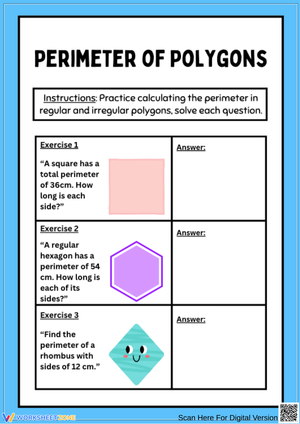
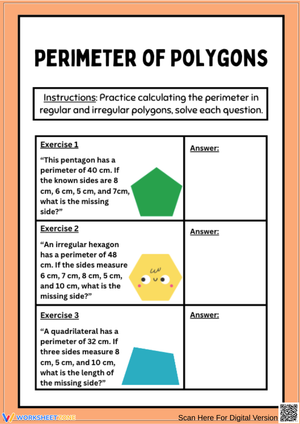
These perimeter of polygons worksheets cover every polygon type students encounter from third grade through sixth — triangles, rectangles, irregular hexagons, and composite figures — with problems that move from whole-number side lengths up through decimals and missing-side situations. Teachers get a set they can pull from across an entire unit rather than a single-purpose page.
Concepts on These Perimeter of Polygon Worksheets
Every worksheet in the set addresses the foundational procedure — identifying all outer sides and summing them — but the polygon types and number sets vary deliberately so students cannot rely on a single memorized routine. Regular polygons appear alongside irregular ones on the same page, which forces students to decide in the moment whether they can multiply or need to add each labeled edge separately. That decision point matters: a student who has only practiced regular polygons will, without warning, multiply all sides of an irregular quadrilateral when they see one with a right-angle marker.
Composite figures receive their own pages at the upper end of the set. These are shapes formed by joining two rectangles or a rectangle and a triangle, and the consistent error is that students sum every segment they can see — including interior shared edges — rather than tracing only the outer boundary. Worksheets in this section present the composite figure without pre-marking which edges count, so students practice that identification step themselves before any arithmetic begins.
Standards Alignment
CCSS 3.MD.D.8 is the entry point: students solve real-world perimeter problems and find unknown side lengths when the total is given. That second requirement — the missing-side problem — is the one that separates genuine conceptual understanding from procedural mimicry, and it is undersupported in a lot of third-grade materials. The lower pages in this set build toward it explicitly, starting with fully labeled polygons before introducing diagrams where one side length is replaced with a question mark and a total perimeter is provided.
CCSS 4.MD.A.3 extends the work to formulas for rectangles and to problems embedded in realistic contexts. By grades 5 and 6, the standards stop naming perimeter directly, but the skill reappears inside multi-step measurement problems and coordinate geometry. Worksheets at the upper end of the set use decimal and fractional side lengths to match that progression, so the same resource bank stays usable as students move through the grade bands.
Error Patterns For Teachers Worth Noticing
The most common error across grade levels is not arithmetic — it is miscounting sides on an irregular polygon. A student who works carefully with a regular hexagon will often lose track when a shape has eight or nine sides of different lengths, skipping one edge or returning to a side they already added. The fix is procedural: circling a starting vertex, then marking each side with a small checkmark as it is recorded. Worksheets that include irregular octagons and nonagons surface this problem quickly; a student who gets the regular hexagon right and the irregular octagon wrong tells you exactly where the gap is.
A second pattern appears on composite-figure pages. Students who correctly identify that a composite shape is "a rectangle plus a square" will sometimes find the perimeter of each piece separately and add those two totals together — which double-counts the shared interior edge. The phrasing that helps in class: "We're measuring a fence around the whole yard, not two fences for two small yards."
How These Worksheets Fit Into a Lesson Plan
The most efficient use is as a graduated release within a single lesson. Work the first two problems on a page together at the board — label every side, write out the addition sentence, check the units — then release students to finish the page independently or with a partner. The first two problems provide the model; the rest of the page provides the practice volume that builds fluency.
For the seven or eight minutes before a transition or pickup, a single-polygon problem projected on the board works as a low-prep formative check. Ask students to write their answer and show the addition on a sticky note or whiteboard. You read the room in under a minute. For Monday warm-ups after a weekend, a fully labeled regular polygon problem re-activates the procedure without adding cognitive load before the day's new content.
The missing-side pages work well as a mid-unit checkpoint. A short page with four problems — two direct-calculation, one missing-side rectangle, one missing-side irregular triangle — gives a clear picture of where the class is before moving into area. Students who can handle the missing-side problem are ready to move on; students who subtract the wrong sides or who set up the equation backwards need another day on 3.MD.D.8 before area instruction makes sense.
Frequently Asked Questions
Do students need to know area before working on perimeter?
No — and teaching them together too early creates one of the most persistent confusions in elementary math. Students who learn perimeter and area in the same week frequently conflate them for months afterward. Perimeter is more concrete and accessible first: it is a distance you can physically walk or trace. Area requires students to hold a two-dimensional quantity in mind. The standard sequence introduces perimeter in grade 3 and formally pairs it with area formulas in grade 4, which is the right amount of breathing room.
What do I do when a student can find the perimeter of a rectangle but falls apart on a pentagon?
This usually means the student has memorized P = 2l + 2w without understanding it as a sum of four side lengths. Return to the rectangle and rewrite the formula as P = l + w + l + w, then as four separate additions. Once the student sees the rectangle as a special case of "add all the sides," the pentagon problem becomes the same task with more terms. The irregular-polygon pages in this set are specifically designed to break the rectangle-formula dependence.
How many problems per page is appropriate for a single sitting?
Eight to twelve problems is the practical range for a focused independent practice session. Fewer than eight may not provide enough repetition to consolidate the procedure; more than twelve tends to produce fatigue errors on the later problems, especially when students are working with multi-sided irregular polygons that require five or six individual additions. The pages in this set stay within that range, with the composite-figure pages running shorter because each problem demands more setup time.













 Interactive Worksheet Maker
 Quiz Maker
 Word Search Maker
 Crossword Puzzle Maker
 Word Scramble Generator
 Sentence Scramble Generator
 Handwriting Worksheet Generator
 Name Tracing Generator
 Fill In The Blank Generator