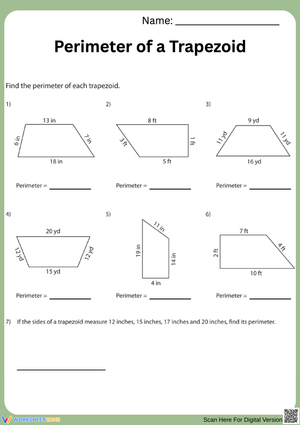
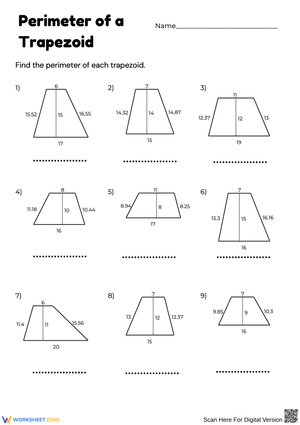
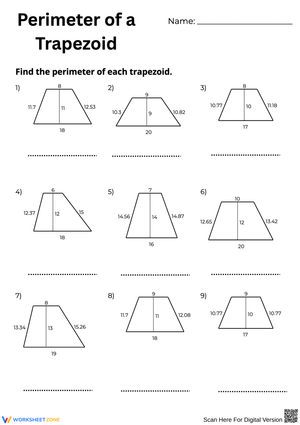
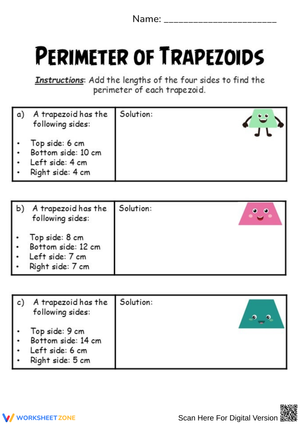
These perimeter of trapezoids worksheets give teachers a ready set of practice pages that move students from straightforward four-side addition through missing-side problems requiring basic algebraic reasoning — a range that covers grades 4 through 8 in a single resource collection.
The Specific Skills Targeted By These Perimeter of Trapezoids Worksheets
Every page focuses on one version of the same core operation: sum all four sides of a trapezoid. What changes across the set is the demand placed on number sense and reasoning. The earliest pages supply whole-number side lengths, and students add four values, attach a unit, and move on. Later pages shift to decimal and fractional measurements — side lengths like 4.75 cm or 3½ in — which fold geometry practice into the number work students are doing simultaneously in grades 5 and 6. The most demanding pages withhold one side length and supply the total perimeter instead, so students must subtract three known values from the whole. That last type is effectively a one-step equation wrapped in a geometry context, and it reads that way on the page: students who have seen x + 10 + 8 + 7 = 36 in pre-algebra recognize what they are doing even if they have not formalized the language yet.
Several pages include isosceles trapezoids alongside general ones. Because the two legs of an isosceles trapezoid are equal, students manage three distinct measurements rather than four — a real reduction in cognitive load during initial instruction, before the addition routine becomes automatic.
Where This Skill Sits Developmentally
Trapezoid perimeter appears at the intersection of two progressions that run through upper elementary: polygon study and multi-digit computation. In grade 4, students classify quadrilaterals and begin distinguishing trapezoids from parallelograms by identifying which shape has exactly one pair of parallel sides versus two. By grade 5, they are adding decimals fluently enough that a side length of 6.3 cm no longer derails the geometry thinking. The missing-side problems belong in grade 6 or 7, when students are building comfort with equations and can treat the unknown side as a variable without being told to. Keeping these pages in a teacher's collection means one resource spans a wide instructional window rather than serving a single unit.
Patterns You'll Recognize in Student Work
The most consistent error is using only two or three of the four sides. Students who understand perimeter as "add the sides" will still undercount when a trapezoid is drawn with a labeled height — the vertical measurement from base to base. That height line runs through the interior of the figure on many diagrams, and a significant number of students add it as if it were a fifth side, or substitute it for one of the legs. The problem is not carelessness; it is that the height looks like a side. Worksheets that annotate the height line clearly, or that omit it entirely on perimeter-only pages, cut this error rate substantially.
A second pattern: students who correctly handle whole-number sides will sometimes add only the two bases when decimals appear, treating the problem as if it were averaging. This shows up most on pages where b₁ and b₂ are labeled prominently and the legs are shorter and tucked to the sides of the diagram. Requiring students to underline all four sides before writing any numbers slows the impulsive reading of the figure and catches this miscount before it becomes a habit.
Where These Fit in Your Lesson Plans
A single-skill page with whole-number side lengths runs about eight minutes for most fourth and fifth graders, which makes it a natural warm-up during the first few days of a geometry unit or a closer on a day when the main lesson ends early. The mixed-type pages — some whole numbers, some decimals, one or two missing-side problems — work better as independent practice in the middle of a unit, after direct instruction but before an assessment. Teachers who run math stations pull the challenge pages for the group that has already shown mastery on basic perimeter and needs to be pushed toward algebraic notation.
The answer key on a separate page matters for a specific reason: when a worksheet travels home or goes to a substitute, there is no guarantee anyone in the room can quickly verify a student's answer for a trapezoid with legs of 4.6 in and 3.9 in. Having the key ready removes that friction entirely.
Pairing Perimeter and Area on the Same Page
One structural choice worth considering is placing a perimeter problem and an area problem side by side on the same trapezoid — same figure, two different questions. Students who have memorized A = ½(b₁ + b₂)h as a separate procedure from "add all sides" often treat them as unrelated operations until they see both applied to the same shape in the same sitting. The side-by-side format makes the contrast unavoidable: perimeter needs all four outer sides and produces a linear answer in centimeters; area needs the two bases and the height and produces a square-unit answer. Standardized assessments routinely present both measurements in a single problem set, so this format also functions as low-stakes test preparation without being labeled as such.
Frequently Asked Questions
Does a trapezoid perimeter problem require the height?
No. Perimeter is the total distance around the outside of the shape, so only the four side lengths matter — the two bases and the two legs. The height (the perpendicular distance between the bases) is necessary for area, not perimeter. When diagrams include a height measurement, students need explicit instruction that it is interior information and does not belong in the perimeter calculation. This is worth a full class discussion rather than a footnote on the worksheet.
What is the formula, and should students memorize it?
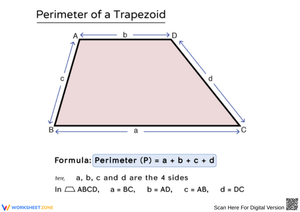
P = a + b₁ + b₂ + c, where b₁ and b₂ are the parallel bases and a and c are the legs. That said, framing it as a formula to memorize creates more confusion than it resolves. Students who understand that perimeter of any polygon is the sum of all side lengths will never need to recall a trapezoid-specific version — they just count sides and add. Reserving the labeled formula for reference helps students connect the variables to the diagram without encouraging rote use.
How do students find a missing side when only the perimeter is given?
Subtract the three known side lengths from the total perimeter. If P = 36 cm and the known sides are 10, 8, and 7, the missing side is 36 − 10 − 8 − 7 = 11 cm. Students who resist equation notation can set this up as a subtraction sequence without any formal algebra. The goal at this stage is the reasoning, not the notation — formal variable use follows naturally once the logic is established.













 Interactive Worksheet Maker
 Quiz Maker
 Word Search Maker
 Crossword Puzzle Maker
 Word Scramble Generator
 Sentence Scramble Generator
 Handwriting Worksheet Generator
 Name Tracing Generator
 Fill In The Blank Generator