


























Views
Downloads

Essential Perimeter Measurement Worksheet | Grade 3 Math
Paste this activity's link or code into your existing LMS (Google Classroom, Canvas, Teams, Schoology, Moodle, etc.).
Students can open and work on the activity right away, with no student login required.
You'll still be able to track student progress and results from your teacher account.
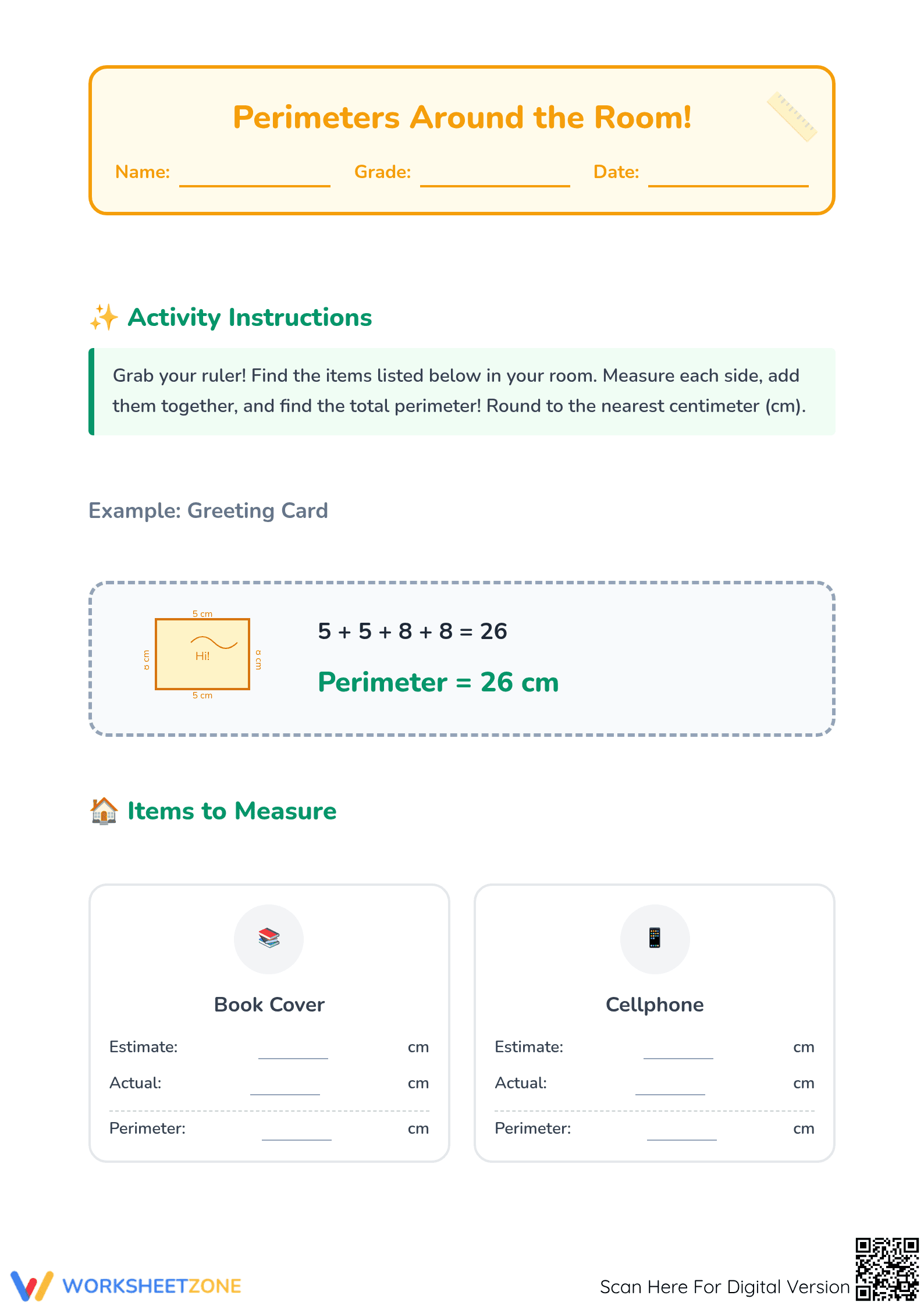
This Essential Perimeter Measurement Worksheet transforms abstract geometry into a tangible, hands-on classroom experience. By measuring actual objects like book covers and cellphones, students bridge the gap between numerical addition and physical space. This resource ensures learners master the foundational skill of calculating the total distance around various polygons.
At a Glance
- Grade: 3 · Subject: Math
- Standard:
CCSS.MATH.CONTENT.3.MD.D.8— Solve real world problems involving perimeters of polygons including finding unknown side lengths- Skill Focus: Real-world measurement and perimeter calculation
- Format: 4 pages · 12 problems · Answer key included · PDF
- Best For: Interactive math centers and homework practice
- Time: 30–45 minutes
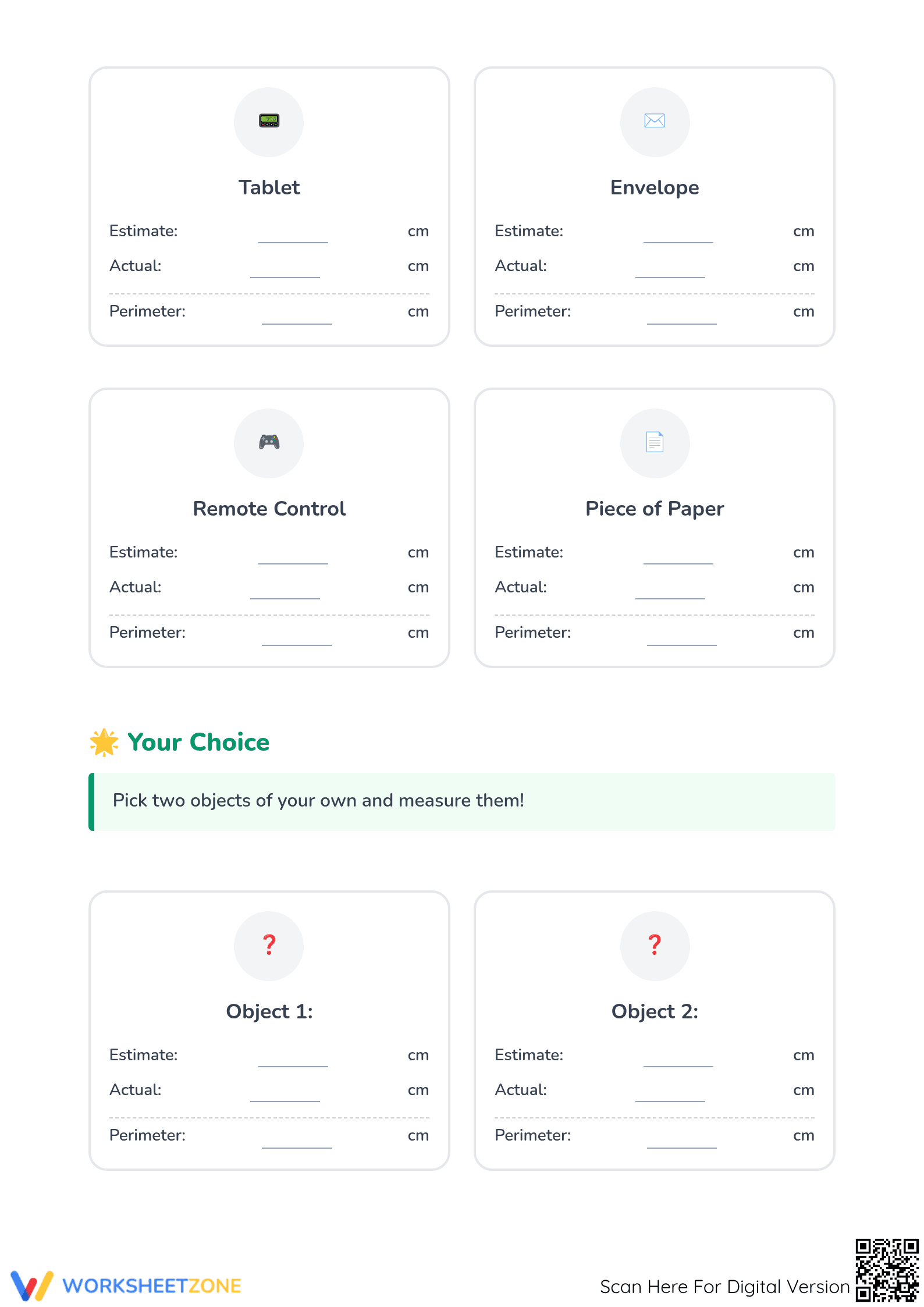
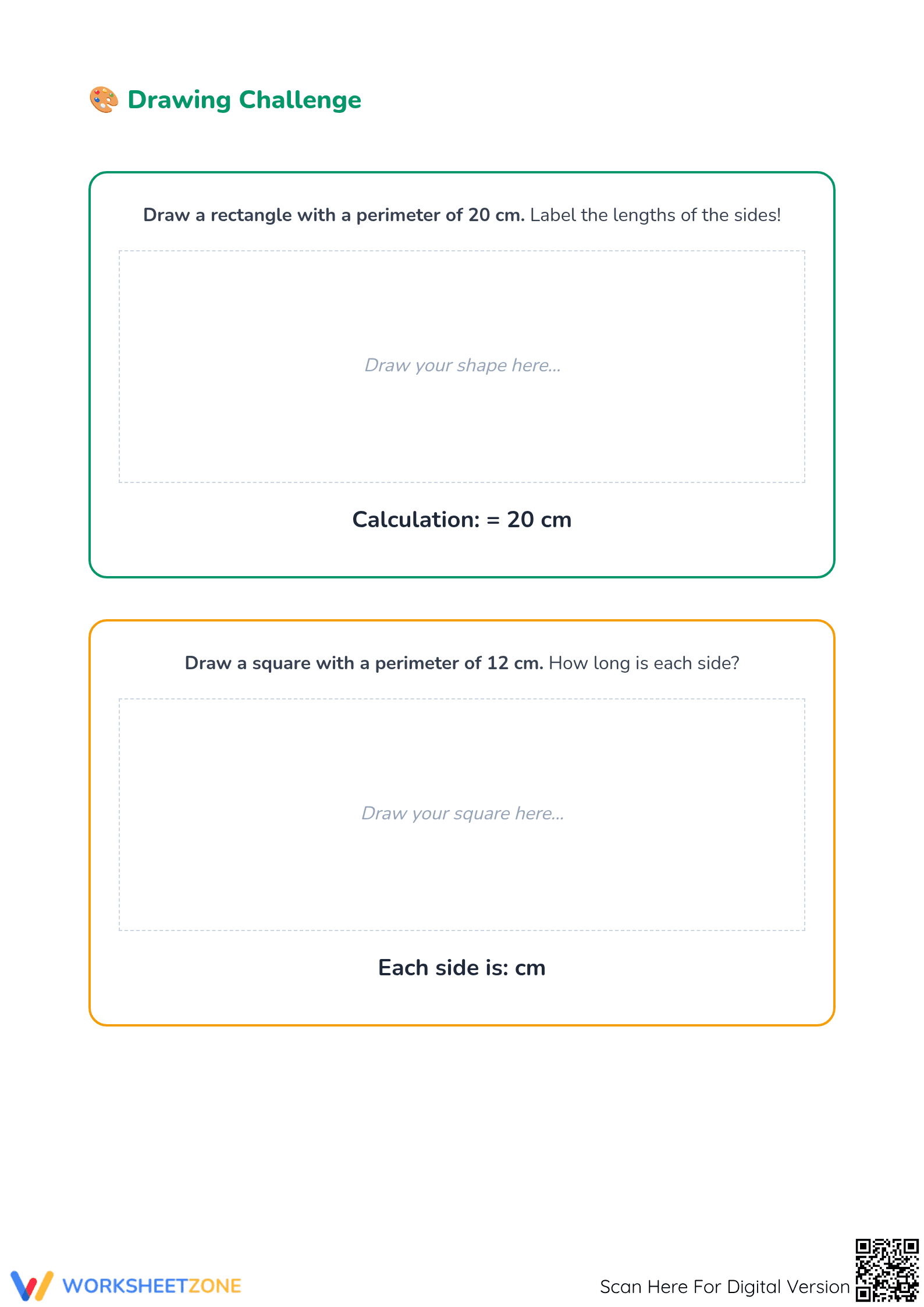
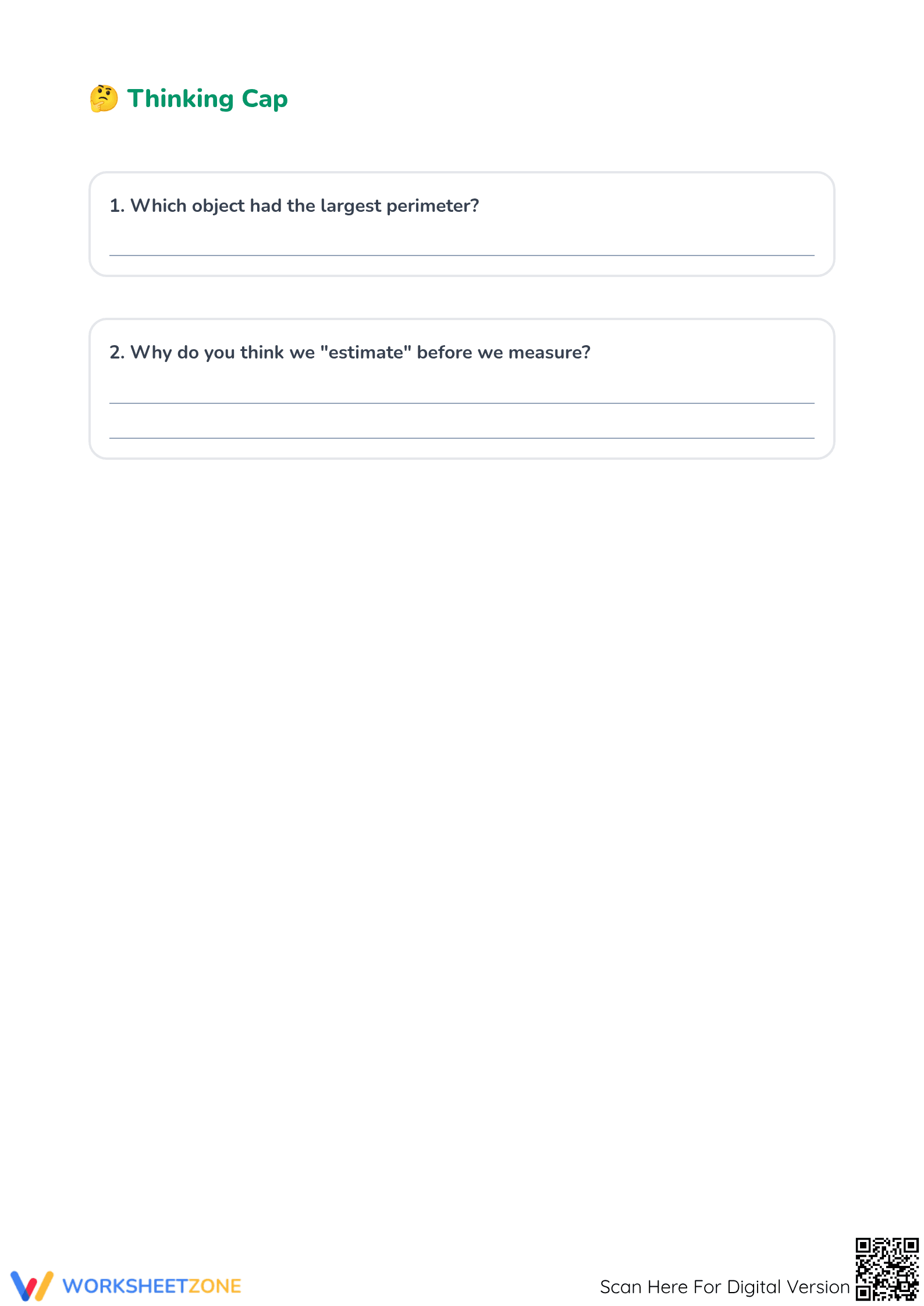
Inside this four-page PDF, teachers will find a structured progression of tasks starting with a worked example. The worksheet includes six pre-selected items for measurement, two "student choice" slots to encourage agency, and a drawing challenge that requires reversing the perimeter formula. A "Thinking Cap" section provides reflective questions on estimation, while the included answer key ensures quick and easy grading for busy educators.
Zero-Prep Workflow
The zero-prep design allows teachers to implement this activity in under two minutes. First, print the four-page packet for each student. Second, distribute the worksheets and ensure every student has a centimeter ruler. Finally, briefly model the rounding instruction before allowing students to explore the room independently. This streamlined workflow makes the resource an ideal candidate for emergency sub plans or last-minute math center rotations when teacher preparation time is extremely limited.
Standards Alignment
This resource is directly aligned to CCSS.MATH.CONTENT.3.MD.D.8, which requires students to solve real-world and mathematical problems involving perimeters of polygons. By measuring objects and drawing shapes with specific perimeters, students demonstrate a deep understanding of spatial boundaries. This standard code can be copied directly into lesson plans, IEP goals, or district curriculum mapping tools for easy tracking.
How to Use It
Deploy this worksheet during the "You Do" phase of a lesson to verify measurement skills. It works exceptionally well as a "scavenger hunt" where students move around the room, promoting engagement through physical movement. Teachers should observe students during the "Drawing Challenge" to identify those struggling with the concept of dividing a total perimeter into individual side lengths. It is best used after a direct instruction session on basic addition.
Who It's For
This activity is designed for third-grade students, though it provides excellent remediation for fourth graders or a challenge for advanced second graders. The inclusion of "Your Choice" objects allows for natural differentiation based on student interest. It pairs perfectly with a short instructional video on using a ruler or a classroom anchor chart displaying the perimeter formula as the sum of all sides.
According to the NAEP framework, connecting mathematical concepts to physical measurement is a critical milestone in early geometric reasoning. This "Perimeters Around the Room" worksheet leverages this principle by requiring students to interact with their environment to solve CCSS.MATH.CONTENT.3.MD.D.8 problems. By integrating estimation, actual measurement, and reverse calculation, the resource builds a comprehensive mental model of spatial boundaries. Fisher & Frey (2014) emphasize that such hands-on tasks provide the necessary scaffolding for students to transition from concrete operations to abstract geometric proofs. This resource serves as a validated tool for formative assessment, allowing educators to capture real-time data on student measurement accuracy and their conceptual grasp of additive properties. The multi-page format ensures sufficient repetitive practice to move students toward fluency and mastery of standard-aligned geometry objectives in any modern elementary classroom.


