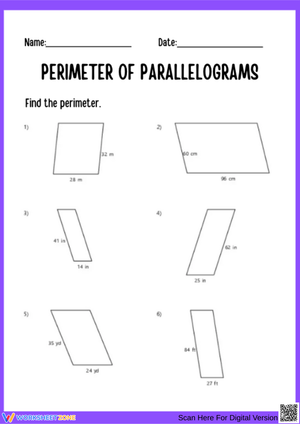
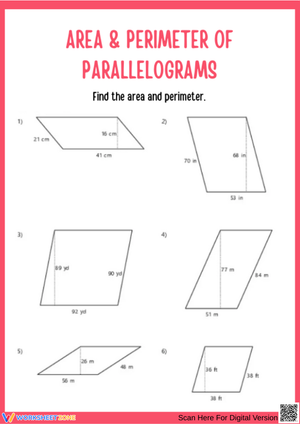
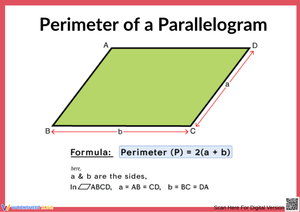
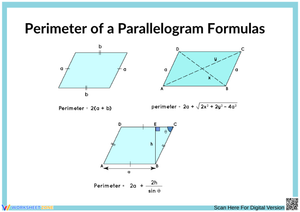
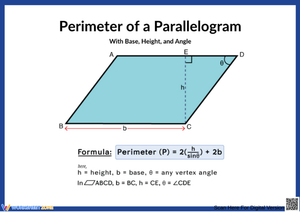
These perimeter of parallelograms worksheets give students repeated, structured practice with the one property that makes this shape computationally accessible: opposite sides are always equal, so two measurements are enough to find the full perimeter. The set spans basic labeled diagrams through algebraic missing-side problems, covering a grade range where this concept first appears and where it gets folded into more demanding work.
What Do The Perimeter of Parallelogram Worksheets Cover
Each worksheet targets a specific level of the same underlying skill. Early pages show a parallelogram with both side lengths labeled and ask students to apply P = 2(a + b) directly — straightforward enough that the focus stays on understanding why the formula works rather than juggling arithmetic. Later pages introduce one unlabeled side, a decimal measurement, or a fractional length, which forces students to slow down and read the diagram carefully rather than pulling numbers on autopilot. The most challenging pages integrate the formula into one-step algebra: a variable stands in for a side length, and students set up and solve an equation using the total perimeter given. That algebra layer connects geometry directly to the equation work students are doing in the same grade, which makes these pages useful across departments.
Standards Alignment
The perimeter formula appears in CCSS 4.MD.A.3, which asks fourth graders to apply area and perimeter formulas for rectangles — and the rectangle connection is exactly the right entry point for parallelograms. Because P = 2(a + b) is structurally identical for both shapes, teachers can frame the parallelogram as an extension of what students already know rather than a new formula to memorize. The honest difference is the slanted side: students who have only worked with rectangles expect every side of a quadrilateral to be either horizontal or vertical, so the diagonal boundary of a parallelogram looks longer than it "should" even when the numbers say otherwise. That perceptual tension is worth addressing explicitly before students ever pick up a pencil. In grades 6 and 7, under 6.G.A and related ratio and proportion standards, the same formula reappears with rational number side lengths and in word problems that require unit conversion — situations the later worksheets in this set are built for.
The Error That Shows Up Most Consistently
The most reliable mistake across grade levels: students use the perpendicular height in the perimeter calculation. This happens because many parallelogram diagrams include a dashed altitude drawn inside the figure — it's there for area problems in the same unit, and students see a labeled measurement and assume it belongs in their calculation. A student who correctly writes P = 2(a + b) will still substitute the height for one of the sides if the diagram looks cluttered enough. The error is so consistent that it's worth doing a brief physical demonstration before distributing these worksheets: take a rectangle cut from paper, verify its perimeter, then shear it into a parallelogram by sliding the top edge sideways. The area stays the same, but the slanted sides are now longer than the original vertical sides — the perimeter grows. That five-minute activity creates a reference image students can return to when they're deciding which measurements belong in the formula.
A second pattern: students add the two given side lengths and stop. They know they need a and b; they find a and b; they add them. The multiplication by 2 simply doesn't register as a required step. Writing the formula on the board isn't enough to prevent this — it helps more to ask students to label all four sides of the diagram before calculating, so they can see that a appears twice and b appears twice before they touch the formula.
How to Fit These Into Your Weekly Lesson Plans
The shorter single-level pages work well as Monday warm-ups after a weekend gap — four or five problems take about eight minutes and surface any retention loss before the lesson continues. The mixed-difficulty pages are better suited to Friday review, when students benefit from seeing all three problem types (whole numbers, decimals, algebra) in one sitting without scaffolding separating them. For station rotations, three pages at graduated difficulty let a class work simultaneously at different entry points: a basic page at one station, a decimal page at another, an algebraic page at the third. This arrangement works without requiring the teacher to produce three separate assignments, since the pages are already sequenced. Exit tickets drawn from these worksheets — one basic problem and one multi-step — give a fast formative read on whether students are confusing perimeter and area or struggling specifically with the algebraic extension.
Frequently Asked Questions
Do students need to know the height to find the perimeter?
No — and that distinction is one of the most important things to establish before students start these pages. The perpendicular height is used for area only. Perimeter requires only the two adjacent side lengths. Some diagrams in this set include the altitude as a labeled measurement specifically to give students practice ignoring it, which mirrors what they'll see on assessments.
What's the right grade to introduce these worksheets?
The whole-number pages are appropriate for late 4th grade, when students already know rectangle perimeter and are ready to extend that formula to a new shape. The decimal and fraction pages belong in 5th or 6th grade, depending on where rational number arithmetic sits in your vertical alignment. The algebraic pages are a 7th or 8th grade tool, or an enrichment option for advanced 6th graders moving quickly through the geometry unit.
How do these pages differ from rectangle perimeter practice?
The formula is the same, but the diagrams are not. A tilted figure with unlabeled sides requires students to use the opposite-sides property consciously — they can't just read all four sides off the diagram. The presence of the altitude in some problems also forces a decision about which measurements are relevant, something rectangle problems never require. That selection step is where the geometric reasoning actually happens.













 Interactive Worksheet Maker
 Quiz Maker
 Word Search Maker
 Crossword Puzzle Maker
 Word Scramble Generator
 Sentence Scramble Generator
 Handwriting Worksheet Generator
 Name Tracing Generator
 Fill In The Blank Generator